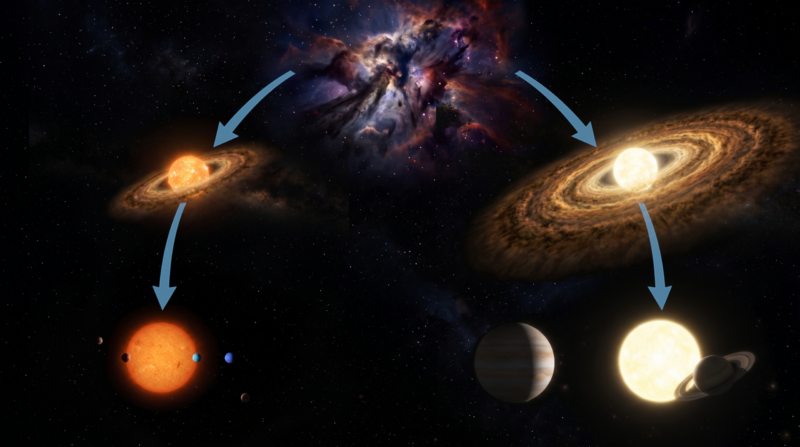
Planetary systems fall into 2 distinct families
Astronomers from the International Space Science Institute said on October 13, 2026, that planetary systems appear to fall into one of two families depending on their home star. After studying 300 of the best-characterized planetary systems in the Milky Way galaxy, they found that less massive stars tend to form planetary systems that are smaller in mass and width but with more planets. On the other hand, more massive stars tend to form planetary systems that are more chaotic and wider with more massive, though fewer, planets.
The researchers published their study in the peer-reviewed journal Nature Astronomy on October 13, 2026.
The 2 types of families
The researchers said that a planetary system’s host star appears to determine how its planets form and evolve. The amount of material in the cloud of gas and dust that forms the star influences what type of planetary family results. Let’s take a closer look at the two family types.
The compact planetary system
The compact, lower-mass planetary systems tend to orbit stars that are as massive as or less massive than our sun. These stars also tend to have similar or lower amounts of heavy elements. The width of the planetary system is smaller and it has less massive planets, but they’re packed more tightly. But not everything about this family type is diminutive. It tends to have more planets than the more massive planetary system.
Scientists said the lower-mass systems have neighboring planets that are similar to each other, or what they call “peas in a pod.” These systems have less gravitational upheaval and more orderly systems. To sum up:
- Host stars are as massive as or less massive than our sun, with similar or lower amounts of heavy elements
- Planets are less massive and more similar to each other
- Orbits are compact, close to the host star
- Dynamic history is less violent and closer to our solar system
The wider planetary system
The wider planetary systems have stars that are more massive than our sun. These stars have a higher proportion of heavy elements. This results in planets that are more massive, though fewer in number. However, these larger worlds orbiting their stars can gravitationally interact, causing instabilities. So the planets that survive these interactions are more likely to have varied orbits. To sum up this family:
- Host stars are more massive than our sun, with more heavy elements
- Planets are fewer but more massive
- Orbits are wider and more varied
- Dynamic history is violent with possible collisions and ejections
So why are wider systems unstable?
The wider planetary systems are more violent and chaotic, with planetary collisions and ejections. These processes can leave planets in a variety of orbits. Danae Polychroni, of the Italian National Institute for Astrophysics, explained why:
The scenarios that best reproduce the dynamical properties of the family of wide and massive systems are those in which the systems are unstable from birth. The greater abundance of material from which planets form around their host stars causes them to be born too large, preventing the system from remaining stable.
Sorting planetary systems
Co-author Diego Turrini of the International Space Science Institute said:
The fundamental question we started from was: What determines the characteristics of planetary systems as we see them today? Are they established at birth or sculpted by evolution over time? The truth, in the end, turned out to lie somewhere in the middle. Our results show that there is a genetic link between planetary systems and their stars, and that, depending on the star around which they are born, this link also determines their fate.
Co-author Camilla Danielski of the University of Valencia said:
The main difficulty during the data analysis was determining whether the two families of planetary systems were real or just an illusion created by the technological limits of current observational techniques. At the end of the path, it became clear that selection effects acted as the tip of the iceberg, revealing the existence of much deeper structural diversities between these systems.
The astronomers hope that understanding which stars create which planetary systems will help in the search for planets that could be home to life.
Bottom line: Astronomers studying planetary systems in the Milky Way have found they can be sorted into two families. These families are largely determined by the host star.
Source: Two families of multi-planet systems with distinct architectures and stellar hosts
Via International Space Science Institute
Read more: Black holes could have planets, new simulations suggest
Read more: Could there be life in helium atmospheres on exoplanets?
Like what you read?
Subscribe and receive daily news delivered to your inbox.
More from
Kelly Kizer Whitt


Strange cloud! What was it? Observers in U.S. East report

Visible planets and night sky guide for October
Proxima Centauri is the closest star to our sun
Arizona’s Chiricahua poised to become 64th US National Park