- Uranus and Neptune seem to be quite similar. But are the origins of Uranus and Neptune the same?
- The origins of the two planets are quite different, according to a new study from an international team of researchers.
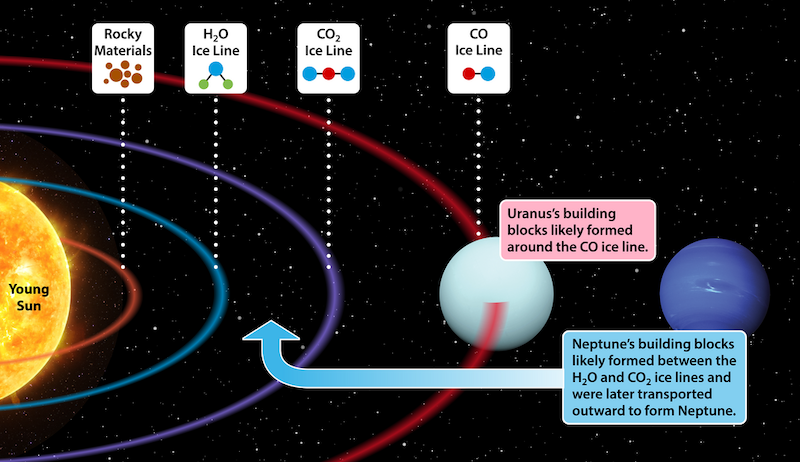
- They say Uranus formed where it is located today, but Neptune’s building blocks first formed much closer to the sun.
Science news, night sky events and beautiful photos, all in one place. Click here to subscribe to our free daily newsletter.
The origins of Uranus and Neptune
Uranus and Neptune appear to be much alike, and in some ways they are. But a new study from an international team of scientists says that the origins of Uranus and Neptune are quite different.
The researchers said on October 19, 2026, that Neptune’s material building blocks originated much closer to the sun than those of Uranus. So although the two planets are superficially similar, their evolutionary paths are quite different.
The researchers published their peer-reviewed results in Astronomy & Astrophysics on October 19, 2026.
Planetary twins … or not?
Uranus and Neptune have long been regarded as “twins.” They’re similar in size, both blue or greenish-blue, with deep atmospheres of methane, ammonia and water. There are no solid surfaces beneath their atmospheres. Co-author Olivier Mousis, a program director in the Southwest Research Institute’s (SwRI’s) Solar System Science and Exploration Division in Boulder, Colorado, said:
Uranus and Neptune may resemble twins today, but their chemistry is telling us that they are more like cousins with very different histories. Their atmospheric compositions may be connected to different regions of the protoplanetary disk where the planets formed, which would make their similarities a noteworthy coincidence.
Similar worlds, different origins
Despite their seeming similarities, the new study suggests that the origins of Uranus and Neptune are rather different. The researchers made this determination by studying their atmospheres. This included new measurements from the Atacama Large Millimeter/Submillimeter Array (ALMA) in the Atacama Desert in Chile.
Interestingly, Neptune’s atmosphere has more oxygen than Uranus’. This creates a different carbon-oxygen ratio. The researchers used models to compare this to the dust and gases in the protoplanetary disk billions of years ago. That is, the disk of dust and gas around the young sun where the planets were born. As Mousis explained:
We can’t directly access the deep atmospheres of Uranus and Neptune, but chemical tracers allow us to probe the conditions hidden beneath their visible clouds. Studying carbon monoxide, or CO, is particularly useful because of its abundance in many planets’ upper troposphere. Using this data, we can model the chemical evolution of the protoplanetary disk and the origins of its materials.
Migrating outward from the sun
The most surprising finding is that the building blocks of Neptune first formed much closer to the sun. This is because volatile compounds — ones that can evaporate easily — condensed into solids at different distances from the young sun.
This created distinct chemical reservoirs of material at various distances. The new research models showed that the material that formed Neptune was originally a lot closer to the sun than it is now. As a result, the origins of Uranus and Neptune diverged.
Later, over time, that material migrated outward. It eventually reached the region where Neptune is today. Mousis said:
Neptune’s chemistry is difficult to reconcile with the idea that it formed where we see it today, pulling from the same reservoir of cosmic materials as Uranus. Instead, our models lead us to believe that its building blocks traveled a long way to where Neptune could accrete them. In short, two superficially similar worlds may have reached their present locations and formations through two very distinct evolutionary paths.
Limited understanding of the atmospheres
The new findings are compelling, but the researchers acknowledge that they are limited. This is because we currently can’t study the planets’ atmospheres in situ, with a spacecraft.
The findings also have implications for similar kinds of planets much farther away. Mousis said:
Our findings have implications beyond Neptune and Uranus and even far beyond our solar system. Similarly sized planets are common around other stars, which is why Uranus and Neptune are essential benchmarks for understanding how planets form and evolve throughout the galaxy. This is precisely why missions like NASA’s planned Uranus Orbiter and Probe, expected to launch sometime in the next decade, are so important.
The true colors of Uranus and Neptune
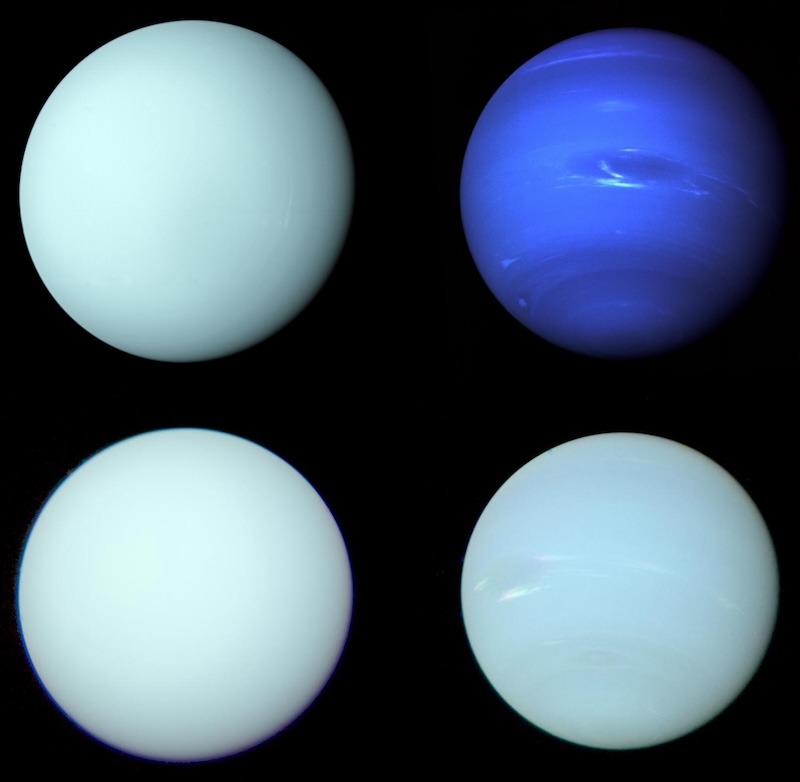
In 2024, researchers at the University of Oxford in the U.K. said that they had determined the real colors of Uranus and Neptune. Uranus had always looked light greenish-blue, while Neptune was a much darker azure blue.
But their study showed that Neptune wasn’t actually as dark as previously thought. It was a lighter greenish-blue, more similar to Uranus.
And at the beginning of this year, researchers from the University of Zurich and NCCR PlanetS in Switzerland said that Uranus and Neptune might be rocky worlds deep inside … Not ice giants as long thought. Interesting!
Bottom line: A new study suggests that the origins of Uranus and Neptune are quite different, even though the two planets are similar in many ways.
Read more: Are Uranus and Neptune rock giants and not ice giants?
Read more: True colors of Uranus and Neptune in newly processed images
Like what you read?
Subscribe and receive daily news delivered to your inbox.
More from
Paul Scott Anderson


Habitable worlds: Better than Earth? Scientists wonder

Pentagon UAP files part 7: Silent black triangles
Lucy mission to Trojan asteroids: 5 years of discoveries
Surprising colors of white dwarf stars revealed for 1st time