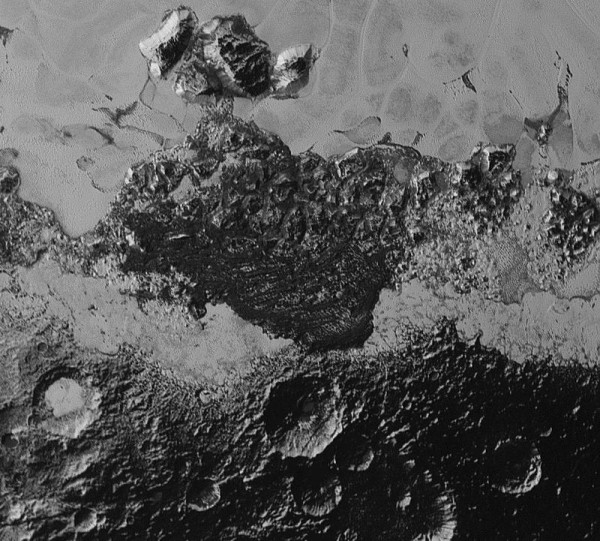
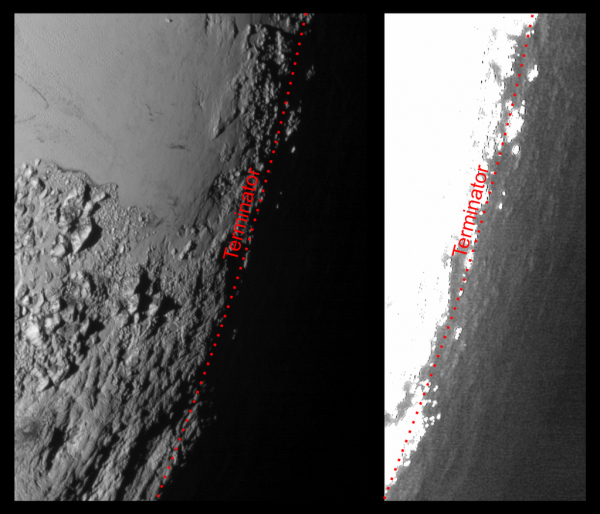
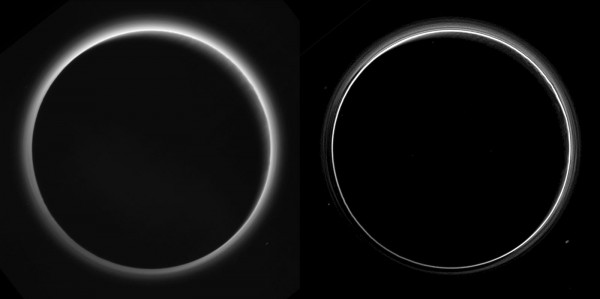
View larger. | Remember the beautiful image of the heart-shaped feature on Pluto? Here it is in closer detail. This image covers an area 1,100 miles (1,800 kilometers) across. Scientists call the heart-shaped feature Tombaugh Regio; it’s a smooth, icy plain. Image via NASA/Johns Hopkins University Applied Physics Laboratory/Southwest Research Institute.View larger. | The left side of Pluto’s “heart,” in even more detail. Image via NASA/Johns Hopkins University Applied Physics Laboratory/Southwest Research Institute.View larger. | A closer view of the border region of the Pluto’s “heart.” There are mountain ridges and other kinds of elevated terrain here, a landscape that scientists call a “chaos region.” Image via NASA/Johns Hopkins University Applied Physics Laboratory/Southwest Research Institute.View larger. | Some regions on Pluto are much darker than others. Scientists aren’t sure why. Image via NASA/Johns Hopkins University Applied Physics Laboratory/Southwest Research Institute.View larger. | The twilight region on Pluto, where day meets night. Image via NASA/Johns Hopkins University Applied Physics Laboratory/Southwest Research Institute.View larger. | Two versions of Pluto’s night side, with its strange haze layer. New Horizons captured the image while looking back at Pluto, as it was leaving this world behind. The lefthand image underwent only minor processing. On the right – if you click into the larger view – you’ll see not just one haze layer but several, made visible by special processing. You can see subtle parallel streaks in the haze, which scientists say, may be crepuscular rays: shadows cast on the haze by Pluto’s mountains. Image via NASA/Johns Hopkins University Applied Physics Laboratory/Southwest Research Institute.
Deborah Byrd (asteroid 3505 Byrd) helps edit EarthSky.org and is a frequent host of EarthSky videos. Deborah created the EarthSky radio series in 1991 and founded EarthSky.org in 1994. Prior to that, she had worked for the University of Texas McDonald Observatory since 1976, and created and produced their Star Date radio series. She has won a galaxy of awards from the broadcasting and science communities, including having an asteroid named in her honor in 1990, a Public Service Award from the National Science Board in 2003, and the Education Prize from the American Astronomical Society in 2020. A science communicator and educator since 1976, Byrd believes in science as a force for good in the world and a vital tool for the 21st century. "Being an EarthSky editor is like hosting a big global party for cool nature-lovers," she says.
Like what you read? Subscribe and receive daily news delivered to your inbox.
Thank you! Your submission has been received!
Oops! Something went wrong while submitting the form.