



Science matters. Wonder matters. You matter. Join our 2026 Donation Campaign today.
Alien intelligence: Have we been searching wrong?
In the movie Contact, Jodie Foster’s character – the astronomer Ellie Arroway – sits by a row of radio telescopes, listening through headphones for signals from alien intelligence. This scene has become symbolic of SETI (the Search for Extraterrestrial Intelligence). But now it turns out Ellie’s character, and SETI astronomers generally, might have been listening to the wrong radio channels.
SETI astronomers search for radio signals, mostly from a specific band of the radio spectrum: the frequencies between 1.42 and 1.66 GHz. And, on July 24, 2026, Louisa Mason of the University of Manchester in the U.K. said we might be searching in the wrong way. She told astronomers attending the National Astronomy Meeting in Birmingham in the U.K. that different radio frequencies might yield a result.
Astronomers originally chose the frequencies between 1.42 and 1.66 GHz, which they call the water hole, because of its location between hydrogen (H) and hydroxyl (OH). These elements combine to form water. And astronomers think water is likely essential to life. Besides the relation to water, this frequency is exceptionally quiet and free of background noise. So it would be a good frequency for aliens to communicate across vast distances, like a cosmic watering hole.
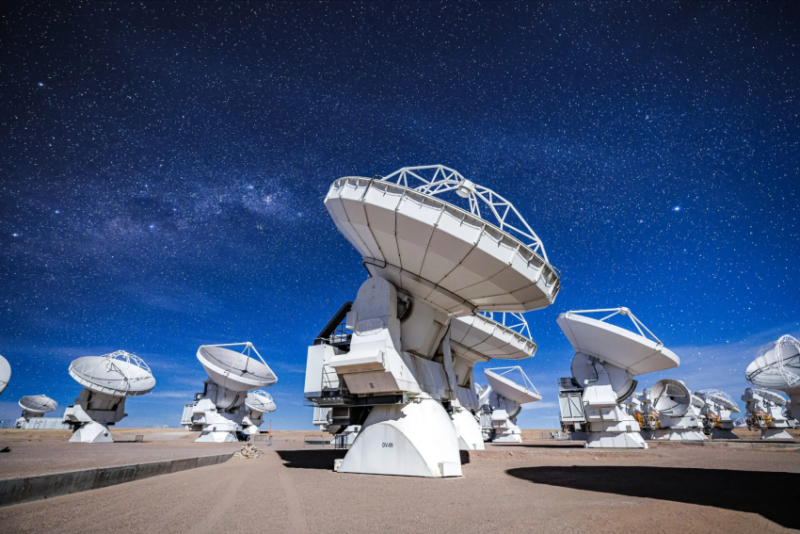
But Mason suggests we should be looking at higher radio frequencies. And she’s already gotten started. Mason and her colleagues looked at data from past observations with the Atacama Large Millimeter/submillimeter Array (ALMA) radio telescope in Chile.
It was the first-ever search for extraterrestrial intelligence using the powerful ALMA telescope.
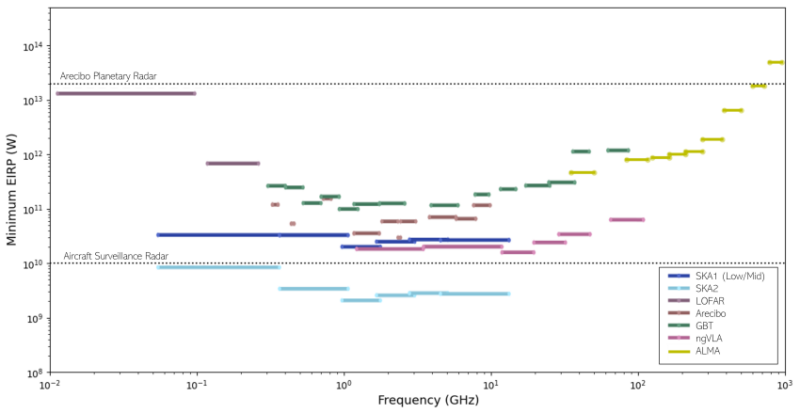
The search for aliens using ALMA
Mason said:
For decades, SETI searches have concentrated on a relatively small part of the radio spectrum. We wanted to ask what might happen if we looked somewhere very different. The millimeter and submillimeter radio bands remain almost completely unexplored for SETI, so this is really about opening up a new area of parameter space to search.
To start, the team looked at four archived ALMA observations. They were looking for narrowband radio signals that did not look natural. Astronomers call these technosignatures.
So far, they haven’t found any technosignatures. But their first attempt did reveal a hidden opportunity within every radio observation. Every time a radio telescope points at its target, it captures a myriad of other stars in its field of view.
Stars beyond the main target
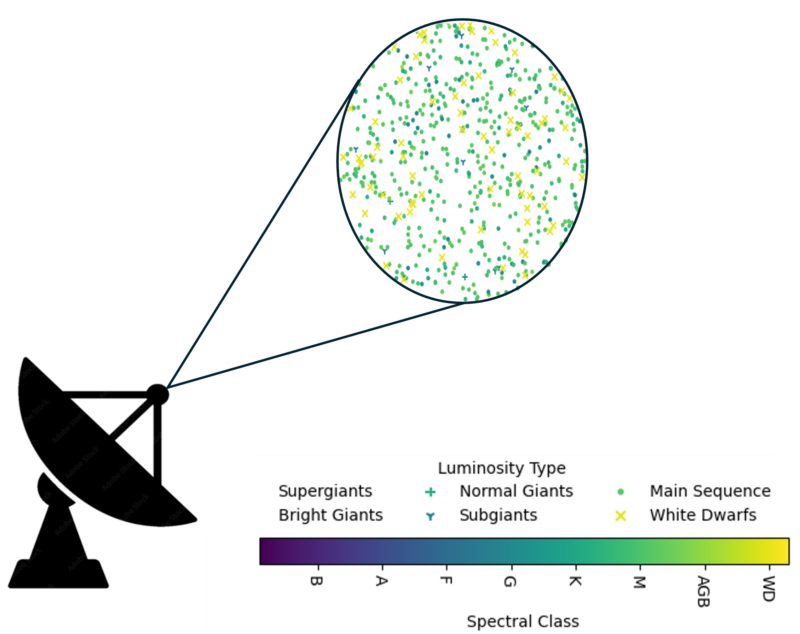
Every time a radio telescope points at its target, it’s capturing data from its goal plus a slew of stars in the same field of view. Astronomers call this the stellar bycatch. Astronomers use data from ESA’s Gaia mission to get an idea of what population is within this stellar bycatch.
But Mason and team used the Besançon Galactic Model to get a better estimate of the full stellar population in each observation. Gaia has restrictions in magnitude (the brightness of stars) and distance, among other issues. So the Besançon Galactic Model allowed the team to get a fuller look at what might be in their data.
For example, the Besançon Galactic Model revealed that a previous SETI survey of 1,327 telescope pointings really included more than 6.1 million stars in total. The Gaia estimate had identified only 288,000 stars. Mason said:
One of the most exciting things about this work is realizing that we’ve surveyed many more stars than initially thought. Even a very small observation can contain a huge number and diversity of stars that we might never have intended to study. By combining high-frequency observations with galactic simulations, we can better understand exactly what we’ve searched and where we should look next.
Bottom line: Some astronomers believe we should search for alien signals at higher radio frequencies than those traditionally used in SETI. They’ve already begun doing just that.
Like what you read?
Subscribe and receive daily news delivered to your inbox.
More from
Kelly Kizer Whitt


No more leap seconds! Timekeeping is officially changing

Space is getting crowded. Here’s the latest satellite report
Visible planets and night sky guide for October
Planetary systems fall into 2 distinct families, astronomers say



