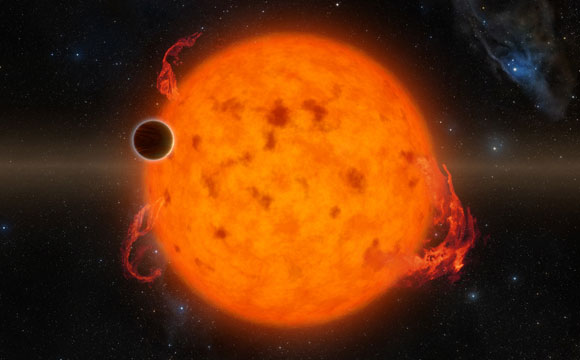
- Exoplanets are planets that orbit other stars. Astronomers have discovered more than 6,000 exoplanets so far. How do they do it?
- Scientists use multiple methods to find exoplanets.
- Each method reveals different information. Combining them can tell astronomers a planet’s size, mass, orbit, and what it may be made of.
Exoplanets are a hot topic
As of late August 31, 2026, astronomers had confirmed 6,354 exoplanets, planets orbiting other stars, with approximately 8,000 more awaiting confirmation. About 3/4 of known exoplanets were discovered through the transit method. That is, astronomers look for exoplanets by watching a star dim its planet as it passes in front of it.
Or they are able to measure a tiny orbital “wobble” as the star and its planet orbit a common center of gravity. Or, in a small number of cases, they can directly image the planet.
But stars are very, very bright in comparison to their planets. It’s this brightness of stars that makes exoplanets so hard to find. Keep reading to learn how astronomers find exoplanets.
Most exoplanets are found via the transit method
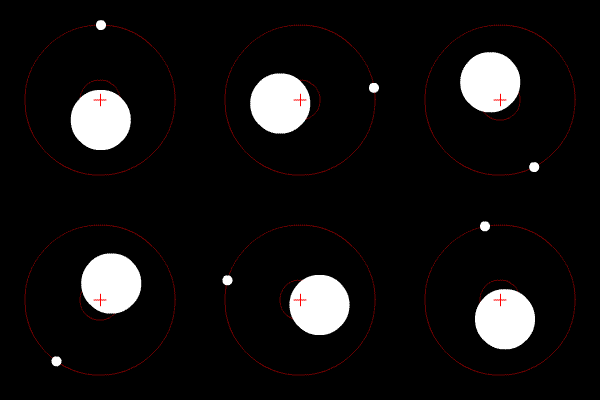
Some exoplanets are found via the radial velocity (wobble) method
A few exoplanets are found via direct imaging
A few exoplanets are found via gravitational microlensing
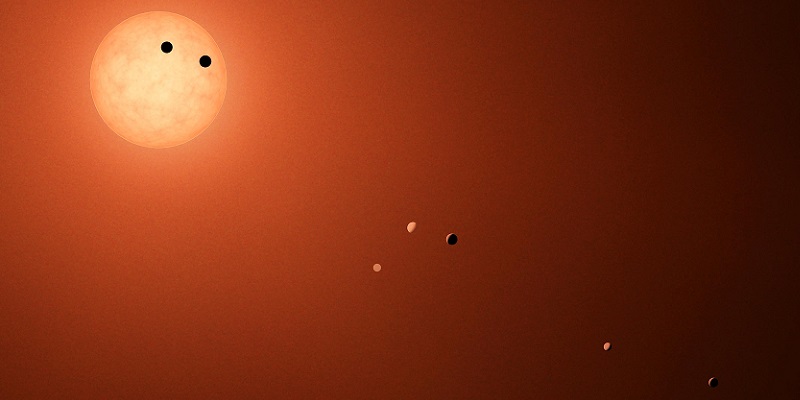
Transits: When planets pass in front of their stars
One of the most intriguing nearby systems of exoplanets is the TRAPPIST 1 system, less than 40 light-years away. It has at least seven Earth-sized exoplanets. The word TRAPPIST stands for the ground-based TRAnsiting Planets and PlanetesImals Small Telescope. That telescope – along with NASA’s Spitzer Space Telescope and other telescopes – helped reveal the planets in this star system.
And in fact we know most exoplanets via the transit method in part because our world’s previous chief planet-hunter telescope – the space-based Kepler mission – used this method. The original mission, launched in 2009, found 4,696 exoplanet candidates, of which 2,331 are confirmed exoplanets, according to NASA. Since then the extended Kepler mission (K2) discovered many more.
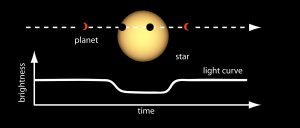
How does the transit method work? It’s like watching a tiny eclipse. A solar eclipse happens when the moon passes between Earth and the sun, blocking some or all of the sun’s disk. Similarly, an exoplanet can pass in front of its star as seen from Earth. The planet blocks only a small amount of starlight, often less than 1%. But modern technologies have enabled astronomers to observe these tiny dips in light. And, if they can detect the same slight dip at regular intervals, they can infer that a planet is orbiting the star, even though they can’t see the planet directly.
NASA’s recently launched Nancy Grace Roman Space Telescope will use the transit method to find thousands more exoplanets, some 100,000 of them!
So the dip in a star’s light is a handy tool for revealing exoplanets. To use it, though, astronomers have had to develop very sensitive instruments that can quantify the light emitted by a star. That’s why, although astronomers looked for exoplanets for many years, they didn’t begin to find them until the 1990s.
The light curve obtained by graphing the light of a star over time also enables scientists to deduce the tilt of an exoplanet’s orbit and its size.
But note that we don’t actually see the exoplanets discovered with the transit method. Instead, their presence is inferred.
This video from NASA shows you the transit method for detecting exoplanets.
The radial velocity method: Good for finding giant exoplanets
The 2nd-most-used path to discovering exoplanets is via Doppler spectroscopy. This is the radial velocity method, sometimes called the wobble method by the popular press. The radial velocity method was one of the first successful ways to discover exoplanets. It has since yielded hundreds of confirmed worlds.
A great example was the planet 51 Pegasi b, the first exoplanet discovered orbiting a sunlike star. This exoplanet is half the size of Jupiter. After decades of searching for exoplanets orbiting sunlike stars, astronomers announced its discovery to a room crowded with astronomers and onlookers, at a meeting of the American Astronomical Society in San Antonio in 1995.
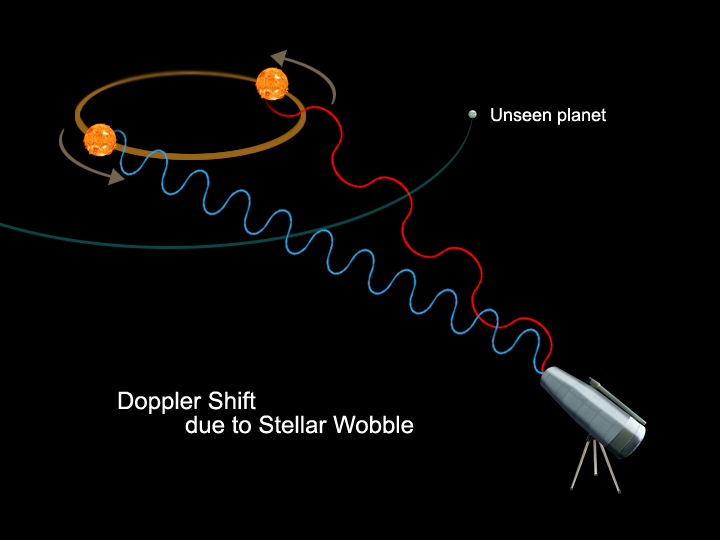
Here’s how it works. In all gravitationally bound systems involving stars, the objects in orbit – in this case, a star and its exoplanet – move around a common center of mass, called a barycenter. When an exoplanet’s mass is significant in comparison to its star’s mass, there’s the potential for us to notice a “wobble” in the system, detectable via a shift in the star’s light frequencies. This shift is essentially a Doppler shift. It’s caused by the star’s orbit around the barycenter. It’s the same sort of effect that makes the vroom of a race car’s engine sound high-pitched as the car zooms toward you and low-pitched as the car races away.
Likewise, when viewed from Earth, the slight movements of a star and its planet (or planets) around a common center of gravity affects the star’s normal light spectrum. If the star is moving towards the observer, then its spectrum would appear slightly shifted towards the blue; if it is moving away, it will be shifted towards the red.
The difference isn’t very big, but modern instruments are sensitive enough to measure it.
So when astronomers measure cyclic changes in the light spectrum of a star, they may suspect a significant body – a large exoplanet – is orbiting it. Other astronomers may then confirm its presence. The wobble method is useful only for finding very large exoplanets. Earth-like planets couldn’t be detected in this manner because the wobble caused by Earth-like objects is too small to be measured by current instruments.
Also note that, again, using this method, we don’t actually see the exoplanet. Its presence is inferred.
Direct imaging: Separating planets from bright starlight

When astronomers are able to acquire an image of a distant star system with its planet, they say they are acquiring a direct image. As mentioned above, stars are blazingly bright. And planets emit no light of their own; like the planets in our solar system, they shine only with reflected light from their star. Even with advanced imaging methods in astronomy, it’s difficult to image an exoplanet. So this method of discovering exoplanets has been used successfully, but much more rarely than the transit method, or the radial velocity method.
Direct imaging is a very difficult and limiting method for discovering exoplanets. First of all, the star system has to be relatively close to Earth. Next, the exoplanets in that system must be far enough from the star so that astronomers can distinguish them from the star’s glare. Also, scientists must use a special instrument called a coronagraph to block the light from the star, revealing the dimmer light of any planet or planets that might be orbiting it.
Wikipedia has a list of (currently) 89 directly photographed exoplanets. But some weren’t discovered via direct imaging. They were discovered in some other way and later – via excruciatingly hard work and painstaking cleverness, plus advances in instrumentation – astronomers were able to obtain an image later on.
Microlensing: using gravity as a magnifying glass
What if an exoplanet isn’t very large and absorbs most of the light received by its host star? Does that mean we’re just not able to see those?
For smaller dark objects, scientists use a technique based on an awesome consequence of Einstein’s General Relativity. That is, objects in space curve spacetime; light traveling near them bends as a result. This is analogous to optical refraction in some ways. If you put a pencil in a cup of water, the pencil appears broken because the light is refracted by the water.
Although it wasn’t proven until decades later, the famous astronomer Fritz Zwicky said as early as 1937 that the gravity of galaxy clusters should enable them to act as gravitational lenses. In contrast to galaxy clusters, or even single galaxies, though, stars and their planets aren’t very massive. They don’t bend light very much.
That’s why this method is called microlensing.
To use microlensing for exoplanet discovery, one star must pass in front of another more distant star as seen from Earth. Scientists might then be able to measure the light from the distant source being bent by the passing system. They might be able to differentiate between the intervening star and its exoplanet. This method works even if the exoplanet is very far away from its star, an advantage over the transit and wobble methods.
But, as you can imagine, it’s a difficult method to use. Wikipedia has a list of many exoplanets currently discovered by microlensing.

Coronographs and starshades
NASA also has a good overview on how exoplanets are discovered and characterized. In addition to the above methods used, it also explains the role of coronographs and starshades.
Coronographs are inside the telescope, and dim the overwhelming glare of the stars to be able to see the much smaller, dimmer planets. Starshades do this too, but from outside the space telescopes.
WFIRST’s coronagraph instrument. Video via NASA Goddard.
Studying other worlds with the help of a starshade. Video via NASA/ JPL.
Other novel methods
There are many other more novel and experimental methods devised to find exoplanets. These includes astrometry, relativistic beaming, ellipsoidal variations, pulsar timing, variable star timing, transit timing, transit duration variation, eclipsing binary minima timing polarimetry, X-ray eclipse, disc kinematics, flare and variability echo detection, transit imaging, magnetospheric (auroral) radio emissions, optical interferometry, modified interferometry, detection of dust trapping around Lagrangian points and gravitational waves.
Taken altogether, there are many possible ways to find exoplanets!
Bottom line: Astronomers find exoplanets mainly by watching stars dim during transits or wobble under the gravitational pull of orbiting planets. They also use gravitational microlensing, direct imaging and astrometry to uncover worlds beyond our solar system.
Read more:
How WFIRST will use warped spacetime to find exoplanets
Like what you read?
Subscribe and receive daily news delivered to your inbox.
More from
Editors of EarthSky


We fly between the sun and Saturn. At opposition today

October birthstone: Colorful opal and tourmaline
Watch for the daytime moon after sunrise this week
Neptune at opposition on September 26, 2026