The Hera mission hits the brakes
The European Space Agency’s Hera mission is ready to hit the brakes! The spacecraft is headed for the site of a human-made impact on the asteroid Dimorphos, created in 2022 by NASA’s DART spacecraft as a test of our ability to move an asteroid in its orbit. But — before Hera can properly reach Dimorphos — first it has to slow down.
That’s why the spacecraft will fire its thrusters this week — early Thursday, October 15, 2026. And, ESA said, the maneuver will be a tricky one:
Hera will rotate around so that its ring of Orbit Control Thrusters face toward the Didymos system. Three of these hydrazine-based thrusters will be ignited at once, burning continuously for a total of 93 minutes, to reduce Hera’s velocity relative to the asteroids by a few hundred meters per second.
If all goes well, Hera should arrive at Dimorphos next month to begin its investigations!
Hera is ready for its asteroid rendezvous
In 2022, the groundbreaking DART mission struck and moved an asteroid. It was a test of Earth’s ability to defend itself from an incoming asteroid threat. Two years ago, on October 7, 2024, a follow-up mission — ESA’s Hera — launched toward the asteroid impact site on Dimorphos, a little moon of the asteroid Didymos. Now, Hera is almost ready for its November 2026 meeting with the asteroid pair. After it arrives, it will spend six months investigating the aftereffects from the impact.
So far in 2026, the Hera mission has undergone a deep-space maneuver to correct its course toward its target. And in July 2026, it finished receiving an upgrade to its software. This newest braking maneuver on October 15 should get the spacecraft to its target.
When Hera reaches the asteroids, it will release two cubesats, Milani and Junventas. Milani is in charge of spectral surface observations (splitting light bounced off the asteroid into a rainbow array of colors, then analyzing that light). And Juventas will take the first radar soundings in the heart of an asteroid.

When DART hit Didymos
Back in 2022, when DART hit Didymos’ little moon Dimorphos, it made a big splash. We know for sure it pushed the asteroid slightly out of its previous orbit. And the debris kicked up in the collision might even have created a new meteor shower for Earth!
Hera is going to learn more about just what happened when DART struck the little asteroid, creating a crater on its surface and moving it slightly in orbit. It’s going to learn more about Dimorphos itself, to help refine our knowledge of what DART did … to keep us safe from future asteroid collisions.
This will be the first investigation of a binary asteroid. Hera’s focus will be on Dimorphos, the moonlet that DART impacted. According to ESA — the mission planner — Hera will conduct a “crime scene investigation” at the little asteroid moon. But Hera will also check out both Didymos and the dusty environs unleashed by the impact.
Here are 3 mysteries that Hera will help solve
ESA shared three mysteries that Hera will help solve:
- Hera will measure the density and composition of Dimorphos in detail and help scientists determine whether it is a “rubble pile” loosely held together by gravity, or a solid core covered in boulders and gravel.
- Hera will map the crater created by DART’s impact down to 4-inch (10-cm) resolution to help scientists better understand how the surface material responded to the collision. It’s possible that there is no crater at all, but rather the impact reshaped the entire asteroid!
- About 15% of known asteroids are actually binary systems, but their origins remain mysterious. Hera will determine whether Dimorphos and Didymos are made from the same material, which would hint that the rapidly spinning Didymos once threw off debris into space that later formed Dimorphos.
Hera project scientist Michael Küppers
Watch EarthSky’s Deborah Byrd speak with Hera project scientist Michael Küppers below. Get the latest here about keeping Earth safe from asteroids.
The Hera mission and a missing planet
Watch a video about the Hera mission to the asteroids Didymos and Dimorphos.
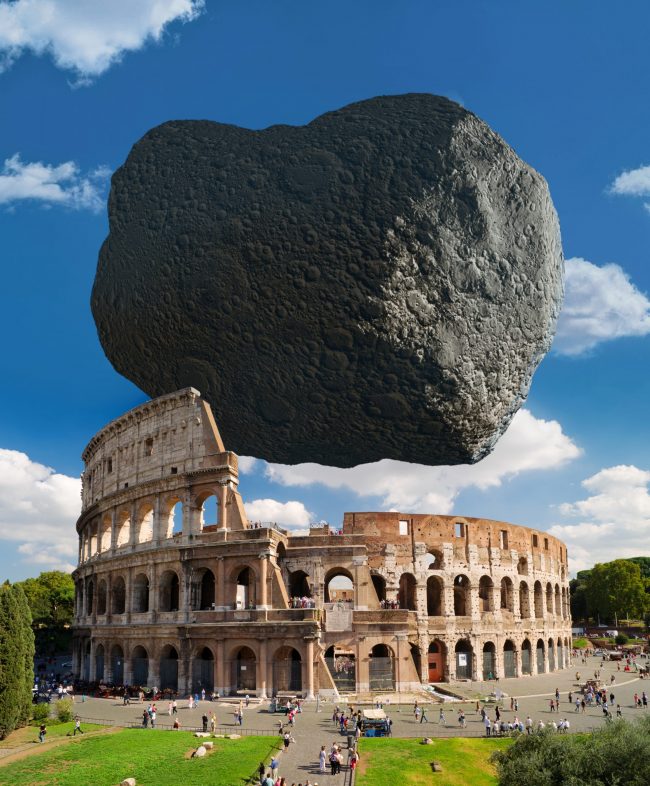
The Hera mission vs the Colosseum
The asteroid Didymos is about a half mile (800 meters) wide. So, that’s about the size of the Golden Gate Bridge. Its little companion, Dimorphos, is about 560 feet (170 meters) in diameter. And that’s about the size of the Great Pyramid. Or compare it to Italy’s Colosseum below.
Bottom line: The Hera mission will hit the brakes this week as it slows down to reach Didymos and Dimorphos. These asteroids were the site of a human-made impact in 2022. Hera is going to investigate the aftermath.
Read more: Boulders from asteroid Dimorphos, after spacecraft impact
Read more: Remember when DART struck an asteroid? New surprises!
Like what you read?
Subscribe and receive daily news delivered to your inbox.
More from
Kelly Kizer Whitt


Visible planets and night sky guide for October

Why does anything exist? New theory emerges
Euclid was mapping the universe. Then it found a comet
Auriga the Charioteer and bright Capella on October evenings