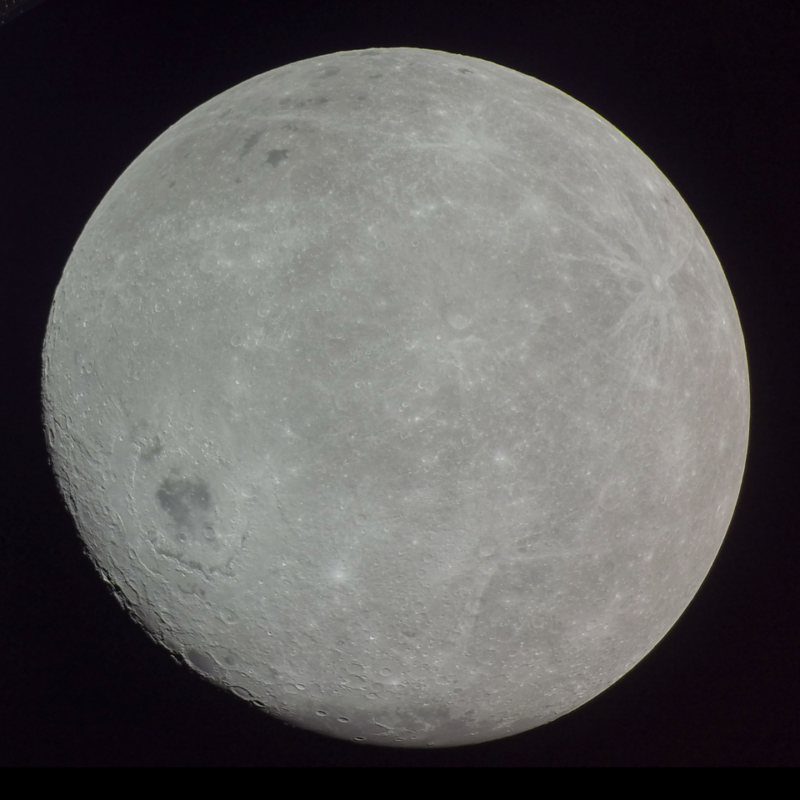
- Experts have been debating how we should use the moon’s far side. Should we protect it exclusively for science? Or should we open it to commercial activity?
- One side argued the far side of the moon has a unique radio-quiet, dark and stable environment. This makes it an ideal location for future radio astronomy, gravitational-wave research and other studies.
- The other side argued that commercial and scientific activities can coexist under effective international governance. Which side won over the audience? Read on to find out.
The Royal Astronomical Society shared this press release on July 22, 2026. Edits by EarthSky.
Should we reserve the far side of the moon for science?
What we do on the moon now will set a precedent for preserving parts of the entire solar system as we move out into it, according to astrophysicist and leading space debris expert Jonathan McDowell.
He was speaking during a debate in which experts considered whether we should preserve the far side of the moon solely for scientific endeavors. Or, alternatively, if we should open it to commercial and industrial activity.
McDowell said:
Is the whole solar system up for grabs, or are we going to have nature reserves and science reserves, where we don’t mine all the asteroids and don’t turn all of Mars into a theme park?
A debate among experts
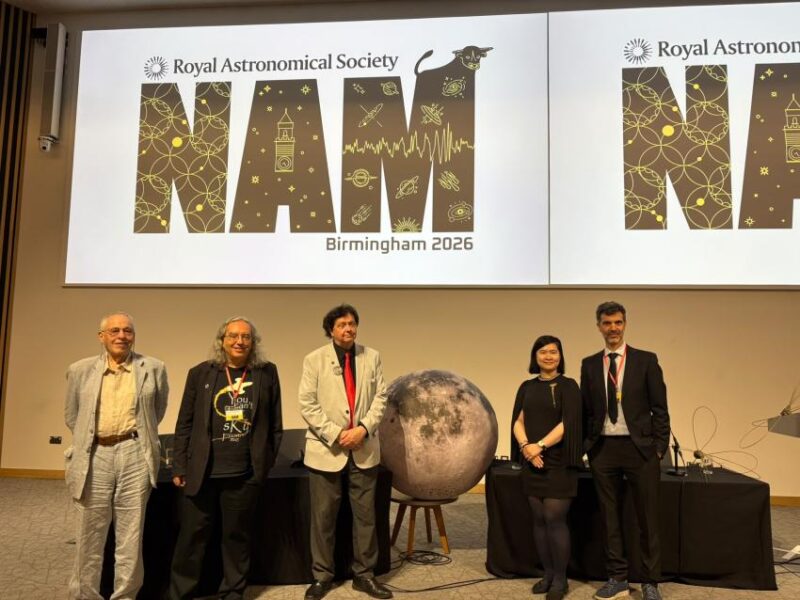
The debate on Tuesday, July 21, 2026, formed part of several sessions on lunar governance during the Royal Astronomical Society’s National Astronomy Meeting (NAM 2026) being held this week at the University of Birmingham.
A panel of eminent astronomers and commercial space professionals were asked to explore a question that is becoming increasingly important as governments and commercial companies prepare more missions to the moon: Should the lunar far side remain a protected scientific environment, or should commercial activity be allowed alongside research?
The argument for science
The far side of the moon presents a unique environment that is radio-quiet and free of artificial light. This is because the moon is tidally locked to Earth. So its rotation on its axis takes exactly as long as its orbit around Earth. These two motions sync up perfectly. Thus, the same lunar hemisphere faces Earth at all times, and the far side of the moon is never exposed to Earth noise.
Astronomers Professor Joe Silk and McDowell argued in favor of preserving the lunar far side. They called it one of the most scientifically valuable locations in our solar system.
As it is permanently shielded from Earth’s radio transmissions, they said it is the only nearby location where radio telescopes could observe the universe without interference from human-made signals. Such observatories could detect faint radio emissions from the cosmic Dark Ages. This is the period after the Big Bang before the first stars and galaxies formed.
They also argued that the far side offers an exceptionally stable environment for future gravitational wave detectors. The moon has no atmosphere, no weather and very little seismic activity compared with Earth. So it could provide an ideal platform for experiments that need to measure extraordinarily small distortions in space-time. These would include studying gravitational waves that give us insights into the origins of the universe.
More arguments in favor of science
The permanently dark lunar night also offers conditions free from the artificial light pollution that increasingly affects optical astronomical observations on Earth.
Silk argued that protecting these conditions now is essential if future generations are to tackle some of astronomy’s biggest unanswered questions. He said:
I think it’s important to preserve the far side for the ultimate science, which will be decades in the future. We have to plan ahead, and the reason is very simply that these are some of the most important questions that humanity has ever posed: Are we alone in the universe, and how did the universe begin?
Silk and McDowell said many of these scientific opportunities could be compromised if the far side becomes developed. Future communications satellites around the moon, landing spacecraft, mining activities and other infrastructure could introduce radio interference, dust, vibration and artificial light. They said these would permanently degrade the unique environment that currently makes the far side so valuable for science.
McDowell said the decisions made over the next few years would set a precedent that shapes humanity’s wider relationship with the solar system. He added:
What we do now and in the next few years to preserve science on the moon is going to be critical not just to the future of science on the moon, but to the future of science and the environment throughout the solar system.
The argument for science and commerce
Those speaking against the motion argued that scientific discovery and commercial activity should not be viewed as mutually exclusive. Nikita Chiu said the debate was about whether ensuring future exploration could be sustained. She argued that commercial investment would be essential if lunar exploration is to become more resilient and less dependent on government funding. Chiu added:
Today’s debate is not to challenge the value of scientific endeavors, but is about understanding how we may sustain exploratory efforts.
Chiu argued that commercial and scientific activities can coexist under appropriate governance. She explained:
An inclusive cislunar economy for the far side of the moon does not need to lead to a ‘Wild West’ situation. I argue that the far side of the moon should not be confined solely for scientific endeavors.
The debate was held ahead of the conference session Protecting the Moon: Governance, regulation and the lunar economy. That session explored how international governance could protect the moon’s radio-quiet regions, dark sky environments and scientifically significant sites while enabling responsible commercial activity and clear rules for future lunar exploration.
How the audience voted
Audience members voted before and after the debate via a QR code about the statement: The far side of the moon shall be preserved solely for scientific endeavors.
Support for the motion increased from 68% before the debate to 76% after hearing arguments from both sides of the panel.
The discussion formed part of a wider program at NAM 2026 examining future governance of the moon. While renewed interest in lunar exploration promises discoveries and commercial opportunities, it also raises questions about whether to protect parts of the moon that offer unique scientific value.
Martin Ward, of the University of Durham, who hosted the evening, convened the debate.
Bottom line: Should the far side of the moon be reserved for science? What we decide now could shape the future of the entire solar system.
Read more: Starlink satellite breaks up, scatters debris
Read more: Probing the Cosmic Dark Ages from the far side of the moon
Like what you read?
Subscribe and receive daily news delivered to your inbox.
More from
EarthSky Voices


Why leaves change color in the autumn

How a helium leak in an exoplanet atmosphere hints at life
Would a Yellowstone supervolcano eruption end humanity now?
Neptune discovered on this date 180 years ago