NASA’s Mars Reconnaissance Orbiter has once again revealed Mars as a real and dynamic world, in this case a world with wind. It captured a sequence of photos – shown in sequence below – of the parachute jettison by Curiosity, the newest rover on Mars. Curiosity used the chute during its dramatic landing on August 5-6, 2012. Now NASA has released seven images from the Mars Reconnaissance Orbiter – taken between August 12, 2012 and January 13, 2013 – showing Curiosity’s parachute shifting its shape at least twice in response to wind, as the chute lay on the Martian soil.
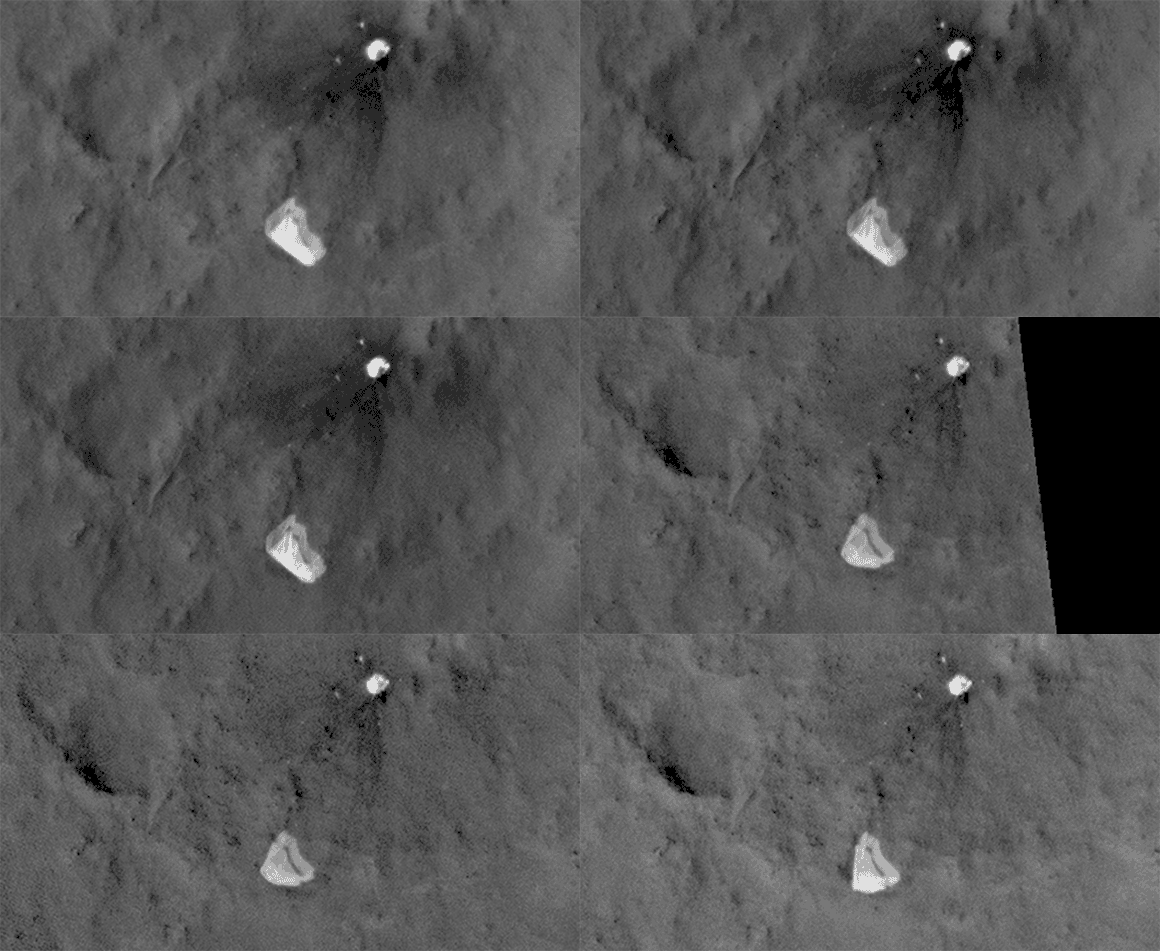
Space scientists used the High Resolution Imaging Science Experiment (HiRISE) camera on the Mars Reconnaissance Orbiter to acquire these images. They’ve used HiRISE to let us see many types of changes on Mars, which has been fascinating. Read more about this sequences of images from NASA.
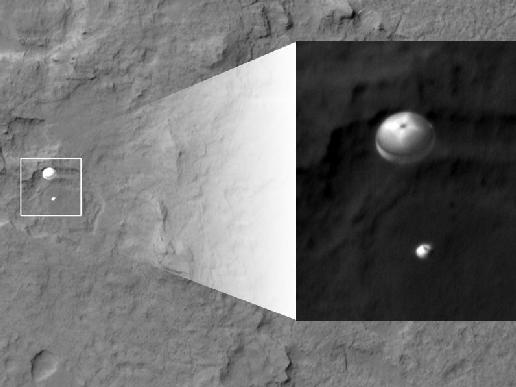
HiRISE’s first image of Curiosity’s parachute, above, caught the spacecraft suspended from the chute during descent through the Martian atmosphere on August 5-6, 2012. Watch a good video about Curiosity’s dramatic landing here.

Bottom line: The Mars Reconnaissance Orbiter has captured a series of images from its perch in orbit around Mars, showing the jettisoned parachute of the new Curiosity rover on Mars, flapping in the wind.
Like what you read?
Subscribe and receive daily news delivered to your inbox.
More from
Deborah Byrd


Visible planets and night sky guide for October

Stargazing tips! 10 great tips for beginning astronomers
Mars calendar year begins September 30: Happy New Year, Mars!
Alpha Cephei, or Alderamin, is a fast-spinning star