



Asteroid 2024 YR4 won’t hit the moon
When asteroid 2024 YR4 was first discovered – in December 2024 – there were only a few observations of its movement in front of the stars. Because scientists didn’t have a long history of its orbital path, they didn’t know precisely where it would go in the future. This window of uncertainty included the possibility that the asteroid could strike Earth. And so 2024 YR4 caused a short-lived stir. That possibility was soon ruled out, but some uncertainty remained. And then it seemed that 2024 YR4 could hit the moon, possibly with a crash that we on Earth might witness. Many astronomers got excited about this possible observation! But on March 5, 2026, NASA said it has ruled out the possibility of a lunar impact. NASA said:
Using data from NASA’s James Webb Space Telescope observations collected on February 18 and 26, 2026, experts from NASA’s Center for Near-Earth Object Studies at the agency’s Jet Propulsion Laboratory in Southern California have refined near-Earth asteroid 2024 YR4’s orbit and are ruling out a chance of lunar impact on December 22, 2032.
With the new data, 2024 YR4 is expected to pass by the lunar surface at a distance of 13,200 miles (21,200 km).

This update reflects improved precision in our understanding of where the asteroid is expected to be in 2032 rather than a shift in its orbital path. Previous analyses, made before the incorporation of these new observations, suggested 2024 YR4 had a 4.3% chance of a lunar impact on this date.
Why did it take so long? The asteroid became too faint to see, even with our biggest telescopes, in the spring of 2025, as it moved to a far part of its orbit around the sun. But now, using the space-based Webb telescope, astronomers have managed to get new observations. And those observations have enabled them to rule out a lunar impact in 2032.
At first we thought it might hit Earth
Asteroid 2024 YR4 first swept into the view of the ATLAS asteroid impact early warning system – with telescopes in Hawaii, Chile and South Africa – on December 25, 2024. And astronomers thought it might have a chance of hitting Earth.
It reached a 3 on the Torino Asteroid Hazard Scale, something no other asteroid has done, other than the infamous asteroid 99942 Apophis. As you might recall, Apophis caused a stir when it achieved a Torino Scale rating of 4 in 2004.
As with Apophis, there was initially a lot of buzz about 2024 YR4.
But in February 2025, we learned that 2024 YR4 will not strike Earth in 2032. As a result, its rating on the Torino Scale dropped to near zero. Then, a new story emerged: Will 2024 YR4 strike the moon on December 22, 2032?
Hear an astronomer speak on the possible Earth impact
Astronomer Richard Binzel, inventor of the Torino Asteroid Hazard Scale, spoke with EarthSky’s Deborah Byrd about the unusual circumstance of asteroid 2024 YR4 at Level 3 (initially) on this scale. Level 3 means it was categorized as “Meriting Attention by Astronomers.” Dr. Binzel explained the details in this interview from early 2025. A few months later, an Earth impact was ruled out entirely.
Richard Binzel later told EarthSky:
Asteroid 2024 YR4 has now been reassigned to Torino Scale Level 0: the level for No Hazard. Additional tracking of its orbital path reduces its possibility of intersecting the Earth to below the 1-in-1,000 threshold. That is the established level for downgrading to Level 0. [Editor’s note: Odds of 1-in-1,000 are the threshold for Level 0 for any space object smaller than 100 meters. The initial estimates of 2024 YR4 were for a size of 50 meters].
2024 YR4 fell to Torino Scale Level 1 (Green ‘Normal’) on February 20, down from Level 3 (Yellow ‘Meriting Attention by Astronomers’).
Level 0 is labeled as the (White) No Hazard zone on the Torino Scale, which considers the two dimensions of impact probability and impact consequence in assigning its Levels. Find the Torino Scale categories’ full descriptions here.
In detail for the current probability, the NASA JPL Center for Near-Earth Object Studies now lists the 2024 YR4 probability as 0.00005 (0.005%) or 1-in-20,000 for its passage by Earth in 2032.
That’s zero, folks!
Then we thought it might strike the moon
In February 2025 – when the Earth strike had been ruled out – the odds of the asteroid’s striking the moon were 1.8%, or a 1-in-56 chance.
Then, on April 2, 2025, NASA said that new data from the Webb space telescope and ground-based telescopes suggested a 3.8% chance of a moon strike.
Afterwards, on June 3, 2025, the Webb achieved one more observation of the asteroid as it moved in its orbit around the sun. This observation helped to refine our knowledge of the space rock’s orbit. Astronomers updated their estimate of its chances of hitting the moon on December 22, 2032, from 3.8% to 4.3%. NASA went so far as to reassure the public that:
In the small chance that the asteroid were to impact, it would not alter the moon’s orbit.
But now, on March 5, 2026, NASA says the asteroid will not strike the moon in 2032.
Hear an astronomer speak on the possible moon impact
Astronomer Andrew Rivkin, who works in planetary defense, spoke with EarthSky’s Deborah Byrd when the story broke that asteroid 2024 YR4 might strike the moon. This interview is from mid-2025 … Now a lunar impact has been ruled out, too.
How big is asteroid 2024 YR4?
Webb observations helped astronomers refine their knowledge of this asteroid’s size. NASA said 2024 YR4 is somewhere between 174 to 220 feet (53 to 67 meters) in diameter, or about the size of a 15-story building. Previous estimates of the asteroid placed it at around 150 feet (46 meters). So it’s slightly bigger than we thought. An object that size striking Earth could take out a city.
The asteroid’s shape and origin
On April 8, 2025, NOIRlab said that observations with the Gemini South telescope reveal the asteroid’s shape and origin. Scientists said it has a bit of a hockey-puck-like shape. And they said it mostly likely came from the main asteroid belt. Both of these were unusual findings. Regarding the shape, team member Bryce Bolin of Eureka Scientific said:
This find was rather unexpected since most asteroids are thought to be shaped like potatoes or toy tops rather than flat disks.
And about the asteroid’s origin, Bolin said:
We are a bit surprised about its origin in the central main asteroid belt, which is a location in the asteroid belt that we did not think many Earth-crossing asteroids could originate from.

What is the Torino scale?
The IAU has been using the Torino Impact Hazard Scale since 1999 to categorize asteroids that could potentially hit Earth. An object with a score of 3, as 2024 YR4’s rating was for a while, is in the yellow zone. This means the object merits attention by astronomers and the public. The description of a score of 3 reads:
A close encounter, meriting attention by astronomers. Current calculations give a 1% or greater chance of collision capable of localized destruction. Most likely, new telescopic observations will lead to reassignment to Level 0. Attention by public and by public officials is merited if the encounter is less than a decade away.
In fact, most new asteroids that get listed on the Torino scale have their likelihood of hitting Earth go up with more observations … until it drops to zero. That’s because the uncertain path of the asteroid is wide and more observations shrink the path, making it look more likely, until the path shrinks enough to show that it will not cross Earth’s. And that’s what happened with asteroid 2024 YR4 also.
DART
If someday we find an asteroid that is on a collision course with Earth, we’ll be somewhat prepared. We’ve already sent a mission to hit and move an asteroid as a test of our planetary defense system. That mission was the Double Asteroid Redirection Test (DART), which impacted an asteroid’s moon named Dimorphos in 2022.
And Dimorphos was much larger than asteroid 2024 YR4, at 525 feet (160 meters) across.
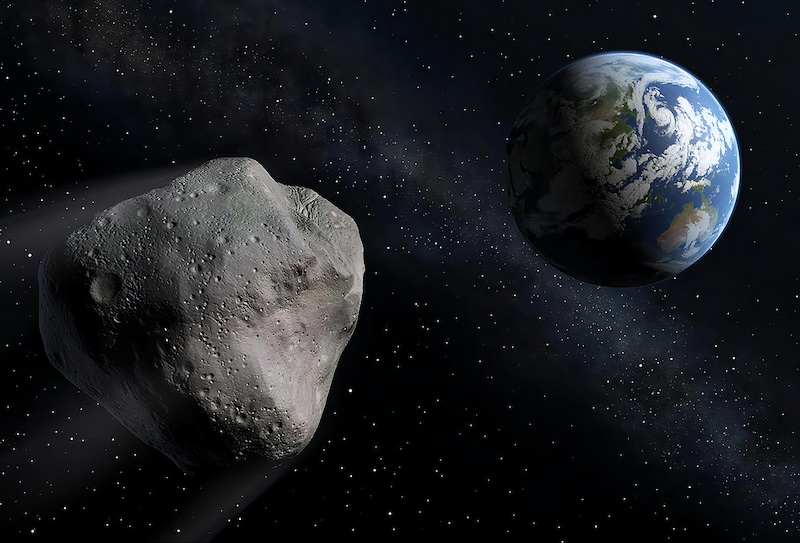
Bottom line: NASA said on March 5, 2026, that asteroid 2024 YR4 will not strike the moon in 2032. The asteroid had a low probability of a future strike, but new observations have now ruled that out.
Like what you read?
Subscribe and receive daily news delivered to your inbox.
More from
Kelly Kizer Whitt


Euclid was mapping the universe. Then it found a comet

Visible planets and night sky guide for October
Auriga the Charioteer and bright Capella on October evenings
It’s official! Chiricahua is now the 64th US national park



