



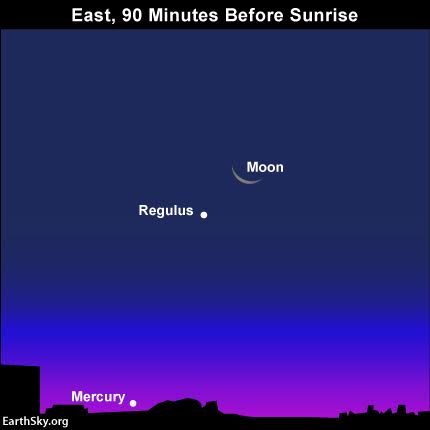
Before dawn on September 27, 2016, the waning crescent moon and star Regulus are visible near each other. Regulus is the brightest star in the constellation Leo the Lion. You’ll want to be outside before sunrise, to see the moon and Regulus in the eastern predawn sky.
Around the world, nearly everyone has a reasonably good chance of catching this star near Earth’s companion moon … and not just on September 27. You can see them together on September 28, too. However, there’s also a planet in the vicinity of the moon and Regulus, and the Northern Hemisphere has a better view of the planet Mercury, which we talk about here.
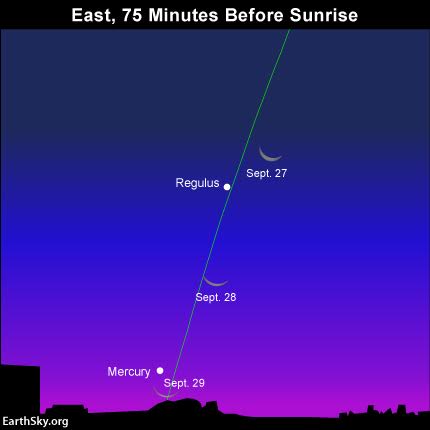
Bottom line: Given clear skies and an unobstructed eastern horizon, almost everyone worldwide should be able to see the moon and Regulus in the morning sky on both September 27 and September 28, 2016.
Like what you read?
Subscribe and receive daily news delivered to your inbox.
More from
Bruce McClure


Alpha Cephei, or Alderamin, is a fast-spinning star

The Andromeda Galaxy: All you need to know
Are day and night equal on the equinox? Not exactly
See the year’s fastest sunsets and sunrises around equinoxes



