



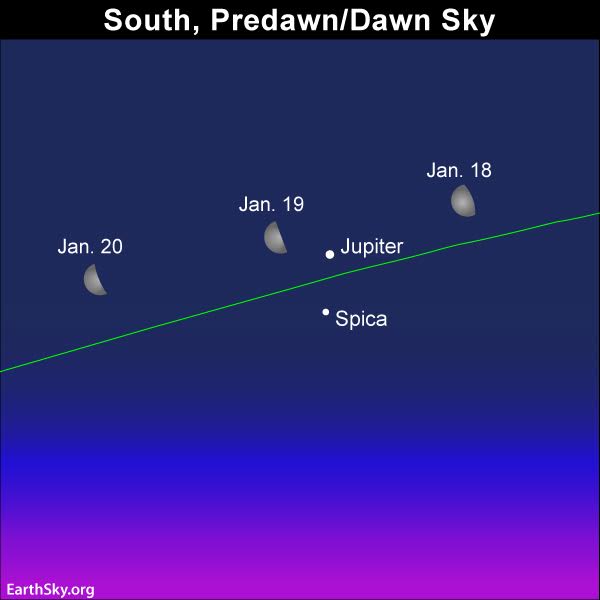
On the mornings of January 18, 19 and 20, you can see the planet Jupiter near the moon. You can also see them very late at night, after midnight. Click here for data on when the moon, the planet Jupiter and the star Spica rise in your sky tonight.
But no matter where you live around the world, look first for the moon. The dazzling “star” nearby the moon is actually the king planet Jupiter, and the star in Jupiter’s vicinity is Spica, the brightest star in the constellation Virgo.
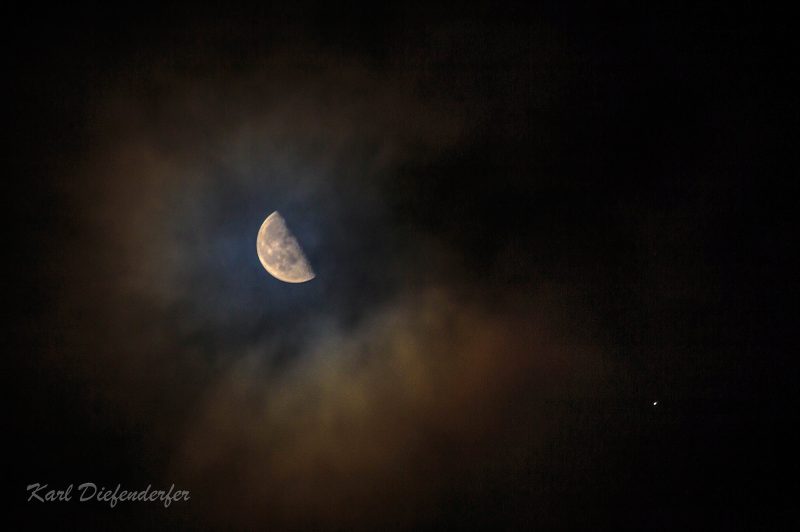
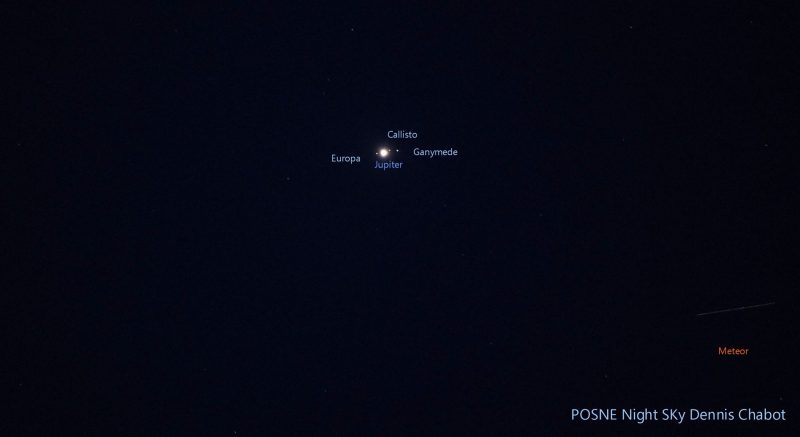
In fact, three bright planets beautify the predawn sky: Jupiter, Saturn and Mercury.
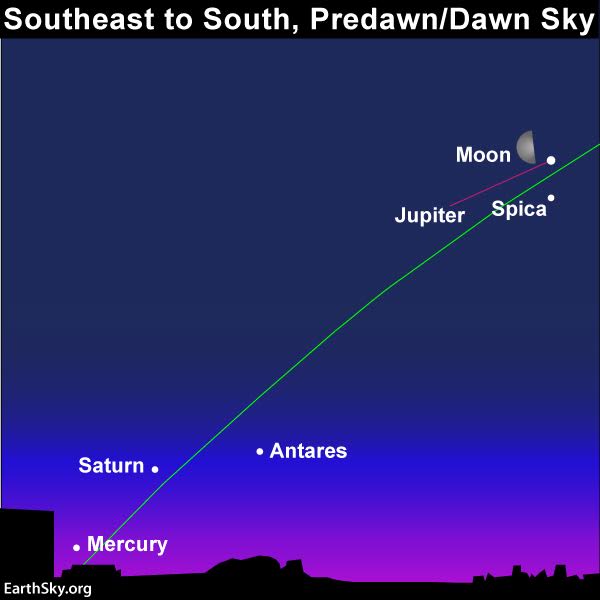
You can use the moon and Jupiter as your guide to Saturn and Mercury in the coming days. All of these objects reside along the ecliptic, or path of the sun, moon and planets. So – as shown on the chart below – a line from the moon and Jupiter, through Saturn, points to Mercury.
But there’s a lot more in store. All five bright planets – the five planets visible to the unaided eye from Earth – grace these January 2017 nights. The other two are Venus and Mars. They shine in the west from nightfall until mid-evening.
Venus and Mars are shown on the chart below. You’ll find them in the west, as soon as the sky darkens after sunset. Venus is extremely bright, and Mars much fainter.
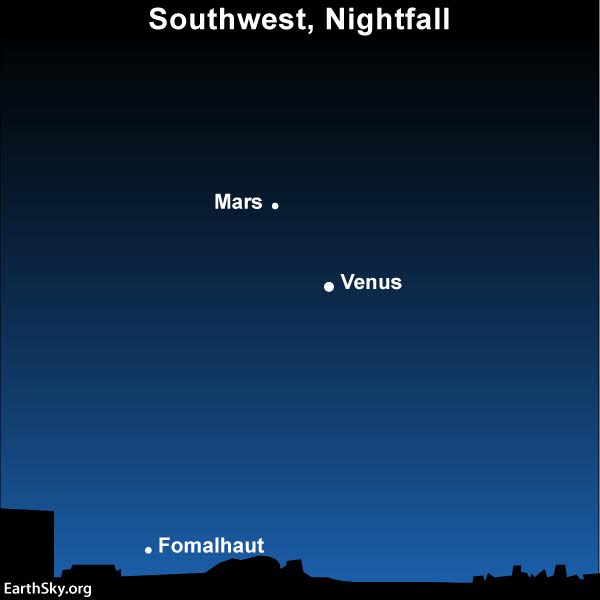
Bottom line: The moon is sweeping past Jupiter now, but – if you know where to look – you can find all 5 bright planets on these January 2017 nights. Charts and info here.
Click here for recommended almanacs; they can help you find out rising times of planets.
Like what you read?
Subscribe and receive daily news delivered to your inbox.
More from
Bruce McClure


Alpha Cephei, or Alderamin, is a fast-spinning star

The Andromeda Galaxy: All you need to know
Are day and night equal on the equinox? Not exactly
See the year’s fastest sunsets and sunrises around equinoxes



