A daily update by email. Science news, great photos, sky alerts.
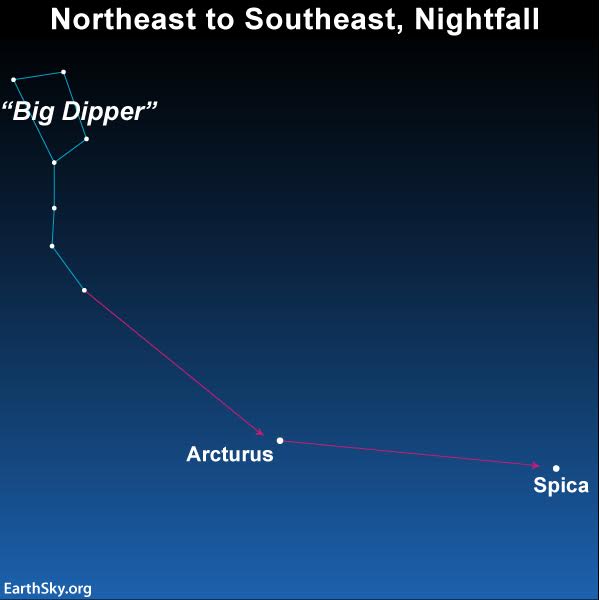
If you only ever learn 1 star mnemonic, make it this one! Arc to Arcturus and speed on to Spica to identify 2 of the sky's brightest stars.
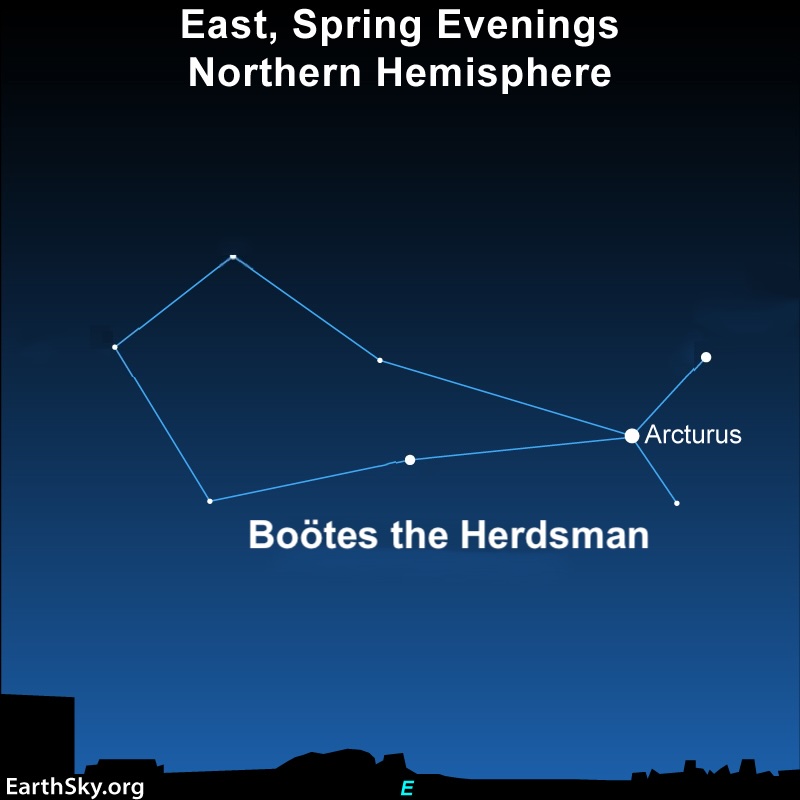
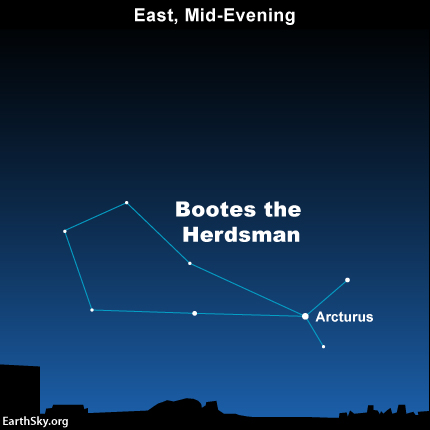
Boötes the Herdsman is a large constellation that holds one of the brightest stars in the sky, Arcturus. Only 3 other stars in the night sky are brighter.
Learn a phrase useful to sky watchers: Follow the arc to Arcturus and drive a spike (or speed on) to Spica.
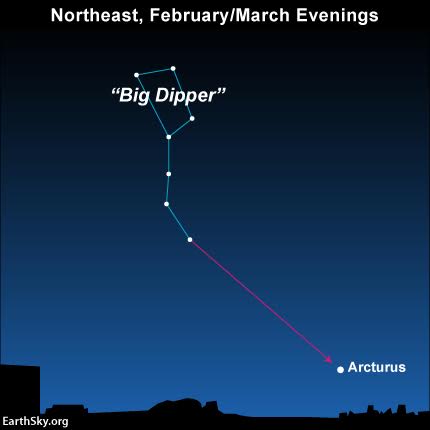
Arcturus is one of the easiest stars to find. Late at night in February - earlier as the months pass - just locate the Big Dipper in your northern sky. Then follow the arc in the Dipper's handle to find yellow-orange star Arcturus.
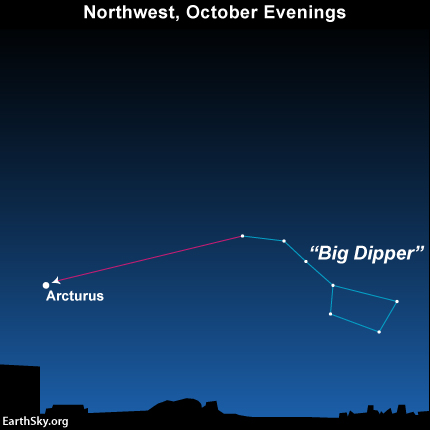
On October evenings, look for brilliant Arcturus in the west, flashing in colors. Follow the curve in the Big Dipper’s handle to this yellow-orange star.
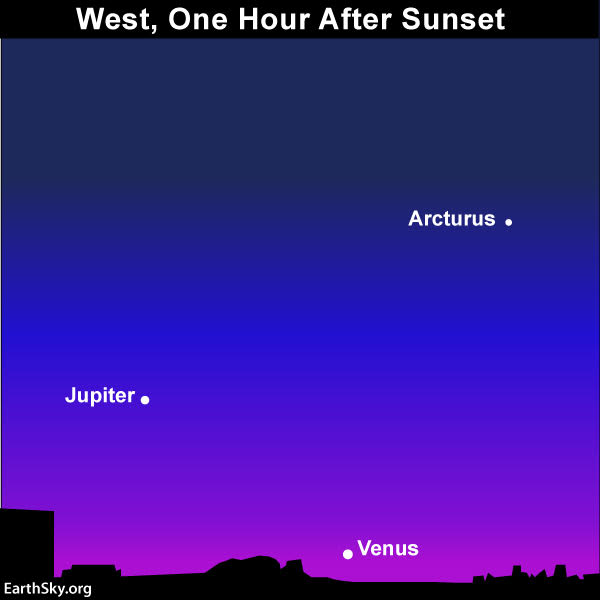
Look west at dusk throughout September, 2018, for a bright celestial threesome. In order of brightness, they are Venus, Jupiter and the star Arcturus.
Right now, the planets Venus and Jupiter - and the Big Dipper - can help you learn the sky mnemonic follow the arc to Arcturus and drive a spike to Spica.
Orange Arcturus is the constellation Bootes the Herdsman's brightest star. Look for it in the east around nightfall.
Visible planets and night sky guide. This evening, look for the moon near bright Jupiter and the twin stars of Gemini. And don't miss the Lyrid meteor shower!
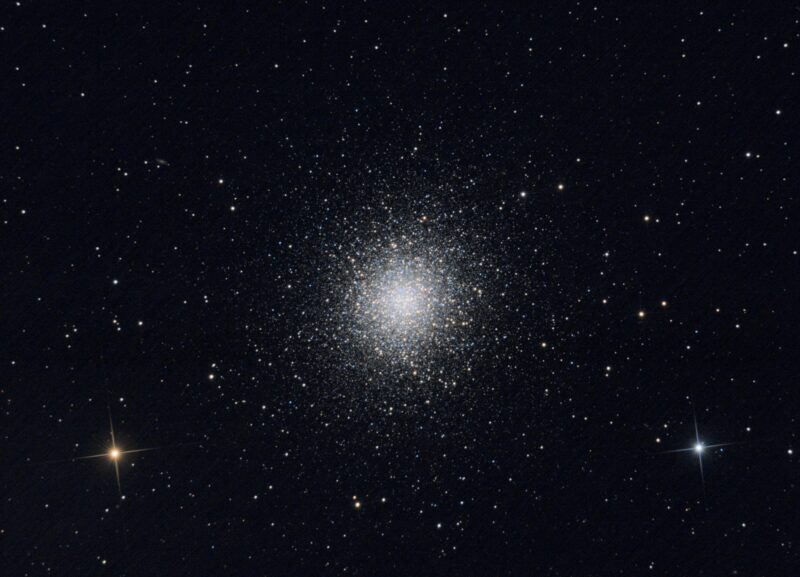
Many stargazers call it the finest globular cluster in the northern half of the heavens. It's M13, also known as the Great Globular Cluster in Hercules.
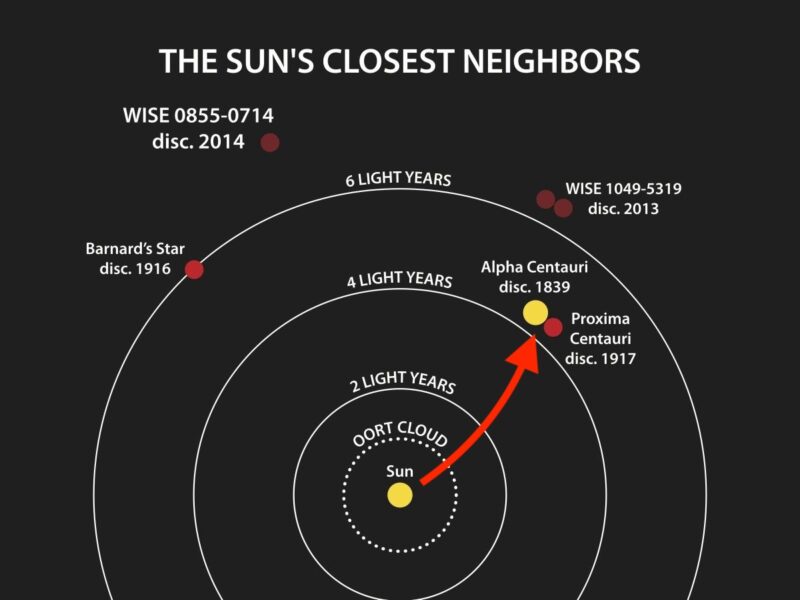
Our closest stellar neighbors are the 3 stars that make up the Alpha Centauri system. They lie just over 4 light-years away from us.
Myriads of galaxies - in all shapes and sizes and visible only in telescopes - shine in the Coma Berenices galaxy cluster.
Coma Berenices is the constellation of Queen Berenice's Hair. It used to be the tail of Leo the Lion before it became its own constellation.
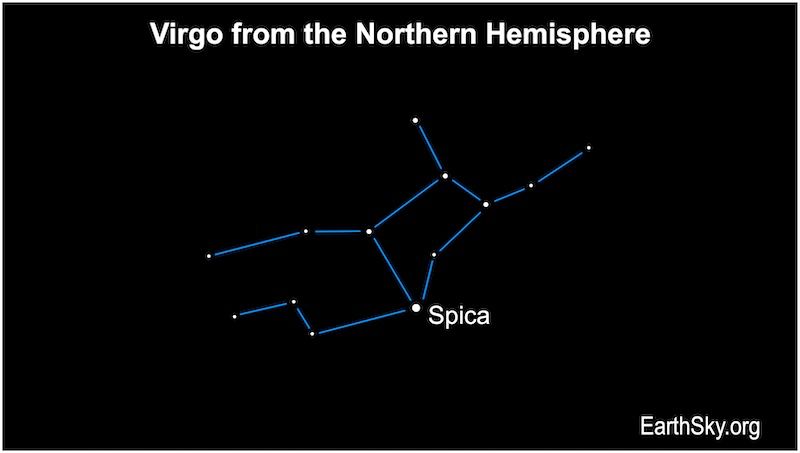
The April 2026 full moon – overnight on April 1-2 – is the Pink Moon and will lie near the star Spica in the constellation Virgo.
Alphard is the "heart" and brightest star in the constellation Hydra the Water Snake, and it represents a welcome sign of spring for the Northern Hemisphere.
As the Northern Hemisphere enters spring, look for the Spring Triangle rising in the east, made up of bright stars from 3 prominent constellations.
Do you know how to find the North Star? The 2 outer stars in the bowl of the Big Dipper point to Polaris, the North Star. It's quick and easy!
Sirius is the brightest star in Earth's sky because of how close it is to us. It's so bright you might see glints of different colors flashing from it.
Sirius is the brightest star as seen from Earth and is visible from both hemispheres. It lies just 8.6 light-years away, in the constellation Canis Major.
The 6th-brightest star in the night sky, Capella, in the Northern Hemisphere constellation Auriga the Charioteer, is also a point of the Winter Hexagon.
EarthSky Newsletter
Nearly half a million daily subscribers love our newsletter. What are you waiting for? Sign up today!
Join now to receive free daily science news delivered straight to your email.