A bonanza of meteorites from the Ohio meteor
The meteor whose big boom rocked parts of Ohio and Pennsylvania on St. Patrick’s Day also dropped meteorites onto the landscape. According to the latest reports, at least one official fragment has been confirmed so far. Meteorite hunter Roberto Vargas found it in Medina County, Ohio. It weighs 10 grams (.35 ounces). Meanwhile, there are “many” other potential fragments currently awaiting official confirmation from experts. And NASA’s radar signatures suggest a significant amount of debris fell over a 12-minute period, so the number of confirmed meteorites is expected to rise as hunters scour the strewn field.
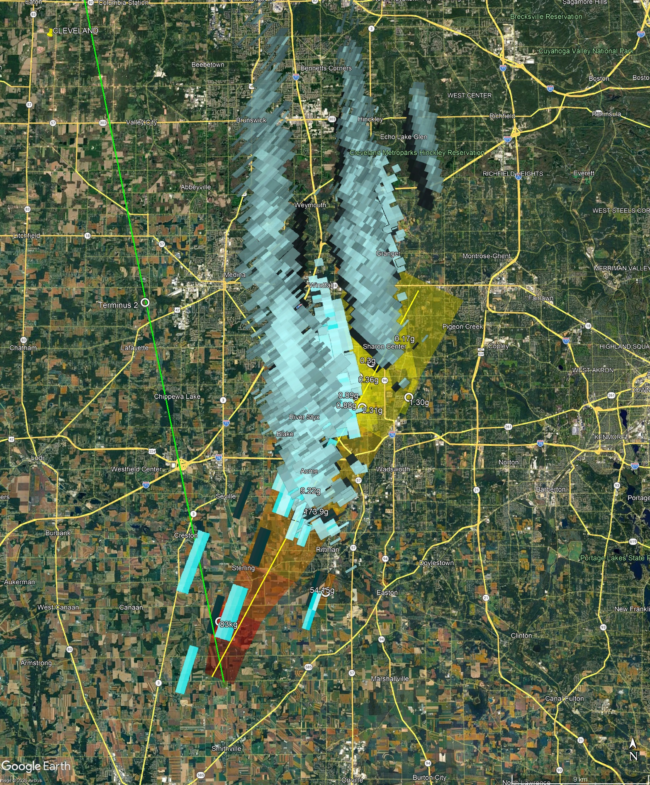
NASA has shared a strewn field map (above) showing the possible location of the debris. Meteorite-hunters are flocking there!
Radar data suggests the space rock was initially about 185 pounds (84 kg) and about 6.5 feet (2 meters) in diameter. As it broke up, the lightest and smallest pieces broke off and fell to the ground first, with the largest pieces landing farthest south. The meteor was tracking from north to south as it entered our atmosphere.
NASA said:
The ground track passed north to south over western Cleveland, producing sonic booms heard across that city. This fall is important because an asteroid fell over a large city without the forewarning that skywatch programs have become increasingly adept at providing. Evidence from orbital reconstruction indicates this asteroid approached Earth from a high angle, while skywatch programs tend to focus their attention along the solar system’s equatorial plane.
These meteorites are stony
Experts have determined the meteorites are stony, or achondrite. This is a rarer type of meteorite. Only 8% of all meteorites reaching Earth have been classified as achondrite. The source of achondrite meteors might be the asteroid Vesta, Mars or the moon.
Meteorite hunters are sharing their finds online. The image below is of a confirmed meteorite. Many are still awaiting confirmation.
First confirmed meteorite. Roberto Vargas, a Meteorite Hunter from Connecticut was the first to find an official fragment from the St. Patrick's Day (17.3.26) Asteroid Explosion in Medina County Ohio. It weighs 10 grams.Sourewww.facebook.com/groups/meteo… www.facebook.com/RVCollection…
Sonic boom from a meteor shakes Ohio and Pennsylvania
KABOOM! Did you hear it? Around 9 a.m. EDT on St. Patrick’s Day, March 17, 2026, residents of Ohio and Pennsylvania began flooding the 911 line with reports of an “earthquake like” explosion. The National Weather Service out of Pittsburgh was quick to report:
We’re receiving reports across western Pennsylvania and eastern Ohio of a loud boom and a fireball in the sky. Our satellite data suggest it was possibly a meteor entering the atmosphere.
And the National Weather Service out of Cleveland followed up with data confirming the meteor. Looking at satellite imagery from the Geostationary Lightning Mapper (GLM), there’s a bright streak over the Cleveland area that would be consistent with a meteor entering the atmosphere. NWS Cleveland said:
The latest GLM imagery (1301Z) does suggest that the boom was a result of a meteor.
So satellites saw the bright flash of a meteor entering Earth’s atmosphere near Cleveland, Ohio.

Some people also saw the daylight fireball
The American Meteor Society ended up with more than 200 meteor reports pending from Ohio, Pennsylvania and as far away as Virginia and Wisconsin. One observer, Nicole T., from Northfield, Ohio, recounts both seeing the fireball and hearing it. Nicole wrote:
The low rumbles I heard were maybe a minute or two after if disappeared.
Alec H., reporting from Cincinnati, Ohio, saw the meteor but didn’t hear the sonic boom. Alec wrote:
It was cool looking, felt like that Russian meteor video without any boom.
Maybe you also remember the Chelyabinsk meteor that broke apart over Russia on February 15, 2013? It was a small asteroid with an estimated size of 65 feet (20 meters) that grabbed the attention of many as it sailed overhead. As people rushed to look at it out their windows, the resulting sonic boom shattered glass and injured observers. Fortunately, there were no such reports with the Ohio meteor.
Video of the fireball
Some dashcams and security cameras caught the fireball entry. Check out the video below. The meteor enters the field of view toward the end of the 22-second video.
A News 5 viewer sent this video of the meteor burning up over Northeast Ohio.
— News 5 Cleveland (@news5cleveland.bsky.social) 2026-03-17T14:27:37.654Z
And here’s the view from a dashcam:
Someone in PA caught the Cleveland meteor on his dashcam driving towards NE Ohio.Source: x.com/hankf330togo…
And you can listen to the boom in this video:
A meteor hit Cleveland?????? From a friend:
NASA confirmation
NASA confirmed that a meteor was the source of the fireball and sonic boom. The space agency said:
A very bright daylight fireball was observed by witnesses from the northeast U.S. and Canada this morning, March 17. An analysis of currently available data places first visibility of the meteor above Lake Erie. The fireball – caused by a small asteroid nearly 6 feet [1.8 m] in diameter and weighing about 7 tons [6,300 kg] – moved southeast at 45,000 mph [72,000 kph] before fragmenting over Valley City. The fragments continued on to the south, producing meteorites in the vicinity of Medina County, Ohio.
It also said:
The asteroid unleashed an energy of 250 tons of TNT when it fragmented, resulting in a pressure wave which propagated to the ground, causing the booms and explosive noises heard by many of the public. It may have also shaken houses north of Medina.
Bottom line: The meteor that shook parts of Ohio and Pennsylvania on St. Patrick’s day also dropped meteorites on the landscape. See a strewn field map here and some meteorites.
Read more: Meteor shower guide 2026: Up next … the Lyrids
Read more: Meteorite hunting? Here’s tips on how to find one
Like what you read?
Subscribe and receive daily news delivered to your inbox.
More from
Kelly Kizer Whitt


Why does anything exist? New theory emerges

Visible planets and night sky guide for October
Euclid was mapping the universe. Then it found a comet
Auriga the Charioteer and bright Capella on October evenings