Giant iceberg breaking up in South Atlantic springtime
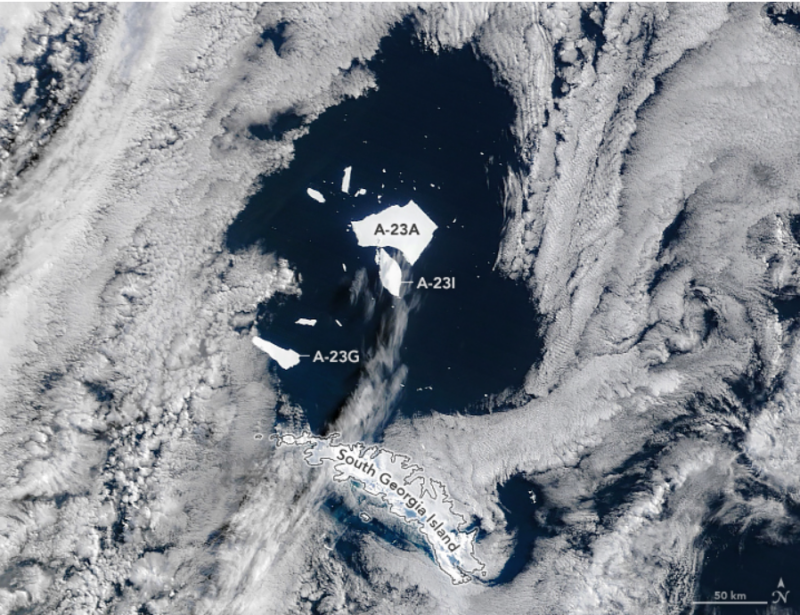
As spring arrives in the Southern Hemisphere, a massive iceberg – once considered the world’s largest iceberg – is breaking up in the South Atlantic. This iceberg separated from the Antarctic ice shelf in 1986! On September 11, 2025, NASA’s Terra satellite (with its MODIS instrument, aka the Moderate Resolution Imaging Spectroradiometer) captured the view above of the iceberg – called A-23A – and its fragments.
And, though much-diminished from its size just a few years ago, its largest piece is still a whopping 580 square miles (1,500 square km). It’s about the size of the city of Chicago.
Soon after the iceberg broke free from the Filchner Ice Shelf in 1986, it became stuck on the seafloor of the Weddell Sea. It remained lodged there until the early 2020s. Then, it slowly drifted northward, toward shipping lanes.
By March 2023 it was confirmed to be floating, which meant it could be measured as a “free-drifting iceberg” rather than a grounded one. It briefly held the title for largest iceberg when it measured 1,700 square miles (4,400 square km).
Now that the iceberg is on the move again, it is drifting into warmer waters and fragmenting. The U.S. National Ice Center – which names, tracks and documents Antarctic icebergs – has named two of its fragments Iceberg A-23G and Iceberg A-23I.
It’s currently drifting north of South Georgia Island. So what will be A-23A’s eventual fate? NASA Earth Observatory said:
Like so many other large bergs that have ventured into ‘iceberg alley,’ it will eventually succumb to the relentless effects of warmer air and water.

Bottom line: A giant iceberg – named A-23A – has drifted northward from Antarctica and is breaking up in warmer waters as spring comes to the Southern Hemisphere.
Like what you read?
Subscribe and receive daily news delivered to your inbox.
More from
Kelly Kizer Whitt


Is the Mars Grand Canyon still tectonically active?

Visible planets and night sky guide for October
Why does anything exist? New theory emerges
Euclid was mapping the universe. Then it found a comet