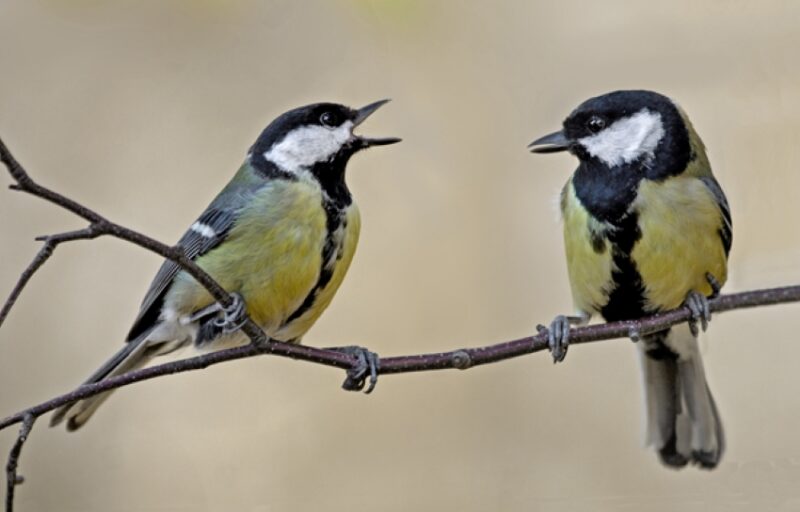
- Birds of a single species don’t all sound the same.
- There’s considerable individual and regional variation between birds.
- Adaptation to humans is one key reason that birds have different accents, scientists believe.
By Louise Gentle, Nottingham Trent University
Do birds have accents? Regional differences in birdsong
The dawn chorus is beautiful anywhere. But your local birdsong might sound different from birdsong in nearby areas. Even in the same neighborhood, birds of the same species don’t always sound exactly alike.
I was recently teaching undergraduate students about bird song, and they recorded blue tits singing around campus. The students found plenty of differences between individual birds. Some blue tits sang their classic song, which sounds a bit like they are saying “he-llo, I’m a little blue tit.” Some sang a more elaborate “he-llo, I’m a little blue tit, blue tit,” and some only bothered with “he-llo.”
Alongside individual differences, birds have regional differences in song. For example, take the birdsong that sounds a bit like my toe bleeds Be-tty, commonly sung by the woodpigeon. In some parts of the U.K. it’s “my toe bleeds Ju-li-a” instead, with an extra syllable to the final section of the song. These sorts of regional dialects have been reported in several British bird species, including blackbirds and great tits.
Interesting yellowhammer dialects
However, one of the most interesting accents comes from a farmland bird, the yellowhammer. This bird’s song typically sounds like a little bit of bread and no cheese please. In the U.K., the yellowhammer largely has two distinct dialects, differing in the final “cheese please” part of the song. In the east of England, “cheese” has a lower pitch than “please,” and this is reversed in south and west England.
The yellowhammer was introduced to New Zealand from the U.K. in the 1860s and 70s. But, unlike the U.K., the New Zealand yellowhammers have around seven dialects, despite originating from the south of England. These five extra dialects have also been detected in birds across Europe, indicating that the New Zealand birds still sing the 19th century British dialects that have since disappeared in the U.K.
This is likely due to the large decline in the number of yellowhammers in the U.K., which caused some populations to go extinct. An ongoing project allows you to view a map of yellowhammer dialects or help with citizen science research on their song.
Learning accents
Most birds only sing one dialect, learned from parents or neighbours, resulting in a geographical mosaic of regional accents. Dialects often overlap but can dominate certain areas, essentially producing Geordie (from Newcastle), Brummie (from Birmingham), Cockney (from London’s East End) and Scouse (from Liverpool) birds.
Although some bird species have an innate ability to sing the song of their species (the cuckoo, for example), species with more elaborate song must learn to sing. Young birds inherit a template which they add to from listening to songs around them.
For example, chaffinches that have been hand-reared in isolation produce simple songs, whereas wild chaffinches learn complexities from their parents or immediate neighbours in their first weeks of life. Finer details of their song are acquired the following breeding season when they come into contact with neighboring territory owners.
Interestingly, the corn bunting, a farmland bird, sings the same song as its nearest neighbor rather than its parents, seeming to learn most after dispersing from the nest.
Adapting to humans
Birds are also adapting to humans. In urban areas, wildlife is subjected to human-made noise such as cars and machinery. Consequently, urban birds now sing at a higher pitch than rural birds as higher-pitched songs carry better over low-pitch urban noise. And it’s not just the pitch of the song that has been altered.
Great tits sing shorter and faster songs in cities compared to forests, and blackbirds sing louder in urban areas.
However, even when cities are quiet, like in the early hours, urban birds maintain these song features, which suggests that sounds echo off large buildings and don’t travel as far in urban areas.
Birds are singing earlier in response to traffic noise, with city blackbirds starting their dawn chorus up to five hours earlier than rural birds.
The effect of artificial light also leads to an earlier start of dawn singing, with song thrushes starting ten minutes earlier, and robins and great tits 20 minutes earlier than in areas without street lighting. And, artificial light causes blackbirds to sing around an hour earlier than those exposed to natural light.
Male or female?
Scientists still have much to learn about the differences in birdsong within a species. When you hear birdsong, it’s easy to assume that it’s a male. And it is more usually males that sing. Females choose males with the best song so that their offspring will inherit his high quality genes.
But female birds have been massively under-represented in archives and scientific studies. A 2016 analysis found that for 3,500 out of 4,814 species we don’t even have enough data to know whether or not the females of the species sing. As researchers take a closer look at female birdsong, we may learn of even more differences.
Next time you listen to a bird singing, see if you can hear the nuances in the dialect, or spot the difference between urban and rural birds.
By Louise Gentle, Principal Lecturer in Wildlife Conservation, Nottingham Trent University
This article is republished from The Conversation under a Creative Commons license. Read the original article.
Bottom line: Yes, birds have accents. From individual to geographical variation, birds of the same species don’t always sound the same.
Read more: A change of tune: Birdsong evolves, says AI-powered study
Like what you read?
Subscribe and receive daily news delivered to your inbox.
More from
EarthSky Voices


Why leaves change color in the autumn

How a helium leak in an exoplanet atmosphere hints at life
Would a Yellowstone supervolcano eruption end humanity now?
Neptune discovered on this date 180 years ago