Watch: Being able to recognize different cloud shapes can help you forecast the weather.
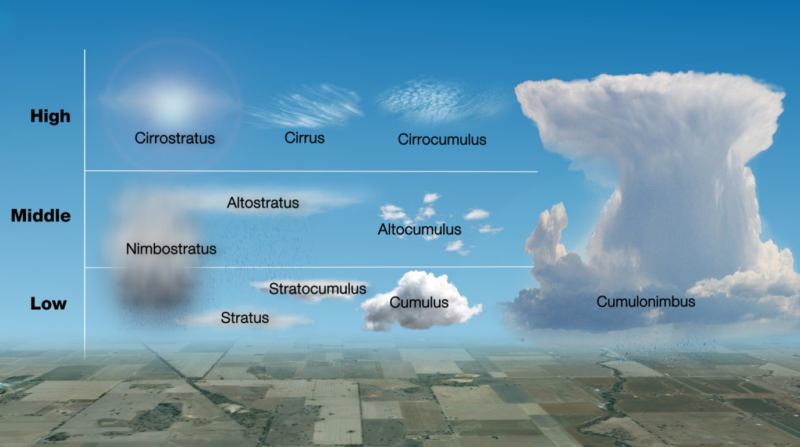
- Clouds come in a wide variety of shapes. Some are wispy, some are puffy, some are towering. They’re also categorized by how high or low to the ground they are.
- Clouds are made of air parcels saturated with water vapor. It’s when water droplets become big enough that rain or snow or other precipitation can fall from clouds.
- When you understand how certain clouds develop their shapes, you can take a step toward forecasting the weather.
By Ross Lazear, University at Albany, State University of New York
Using cloud shapes to predict the weather
I’m a meteorologist, and I’ve been fascinated by weather since I was eight years old. I grew up in Minnesota, where the weather changes from wind-whipping blizzards in winter to severe thunderstorms – sometimes with tornadoes – in the summer. So, it’s not all that surprising that I’ve spent most of my life looking at clouds.
All clouds form as a result of saturation. That’s when the air contains so much water vapor that it begins producing liquid or ice.
Once you understand how certain clouds develop their shapes, you can learn to forecast the weather.
Cotton ball cumulus clouds
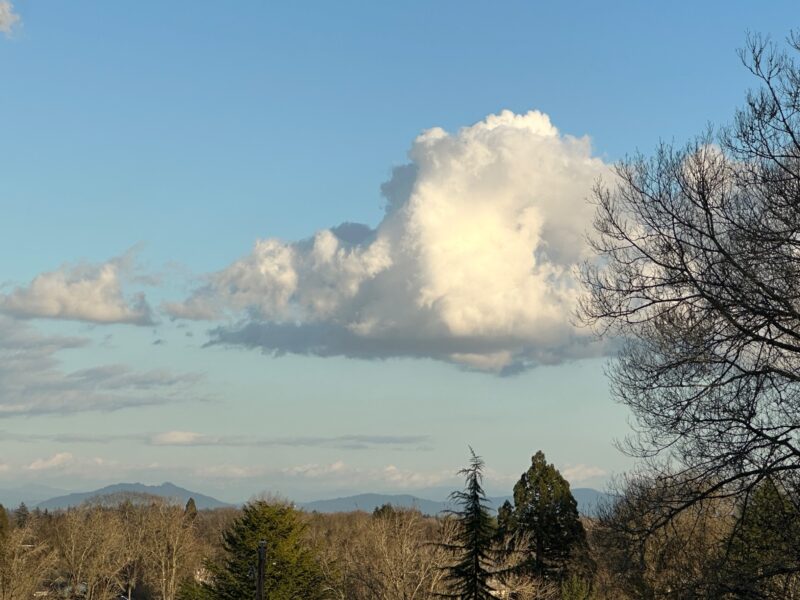
Clouds that look like cartoon cotton balls or cauliflower are made up of tiny liquid water droplets and are called cumulus clouds.
Often, these are fair-weather clouds that form when the sun warms the ground and the warm air rises. You’ll often see them on humid summer days.
However, if the air is particularly warm and humid, and the atmosphere above is much colder, cumulus clouds can rapidly grow vertically into cumulonimbus. When the edges of these clouds look especially crisp, it’s a sign that heavy rain or snow may be imminent.
Wispy cirrus are ice clouds
When cumulonimbus clouds grow high enough into the atmosphere, the temperature becomes cold enough for ice clouds, or cirrus, to form.
Clouds made up entirely of ice are usually more transparent. In some cases, you can see the sun or moon through them.
Cirrus clouds that form atop a thunderstorm spread outward and can form anvil clouds. These clouds flatten on top as they reach the stratosphere, where the atmosphere begins to warm with height.
However, most cirrus clouds aren’t associated with storms at all. There are many ice clouds associated with tranquil weather that are simply regions of the atmosphere with more moisture but not precipitation.

Fog and stratus clouds
Clouds are a result of saturation. But saturated air can also exist at ground level. When this occurs, we call it fog.
In temperatures below freezing, fog can actually deposit ice onto objects at or near the ground, called rime ice.
When clouds form thick layers, we add the word “stratus,” or “layer,” to the name. Stratus can occur just above the ground, or a bit higher up … we call it altostratus then. It can occur even higher and become cirrostratus, or a layer of ice clouds.
If there’s enough moisture and lift, stratus clouds can create rain or snow. These are nimbostratus.
Cloud shapes above mountains
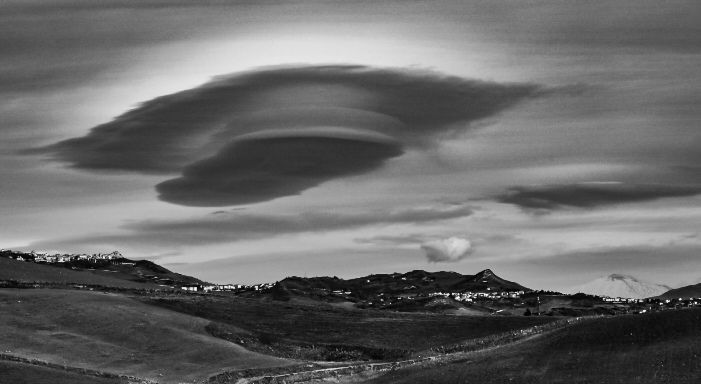
There are a number of other unique and beautiful cloud types that can form as air rises over mountain slopes and other topography.
Lenticular clouds, for example, can look like flying saucers hovering just above, or near, mountaintops. Lenticular clouds can also form far from mountains, as wind over a mountain range creates an effect like ripples in a pond.
Rarer are banner clouds, which form from horizontally spinning air on one side of a mountain.

Wind plays a big role
You might have looked up at the sky and noticed one layer of clouds moving in a different direction from another. Clouds move along with the wind, so what you’re seeing is the wind changing direction with height.
Cirrus clouds at the level of the jet stream – often about 6 miles (10 kilometers), above the ground – can sometimes move at over 200 miles per hour (320 kilometers per hour). But because they are so high up, it’s often hard to tell how fast they are moving.
Ross Lazear, Instructor in Atmospheric and Environmental Sciences, University at Albany, State University of New York
This article is republished from The Conversation under a Creative Commons license. Read the original article.
Bottom line: If you become familiar with cloud shapes, it can help you know what type of weather might be coming. Read more to find out how to predict the weather by reading the shapes of the clouds.
Watch: See a thrilling ghost rainbow (fogbow)

Like what you read?
Subscribe and receive daily news delivered to your inbox.
More from
EarthSky Voices


Would a Yellowstone supervolcano eruption end humanity now?

Neptune discovered on this date 180 years ago
Earth images from space: 13 incredible photos of our planet
International Observe the Moon Night 2026 is tonight