



Science matters. Wonder matters. You matter.
Join our 2025 Donation Campaign today.
The language of the bonobo
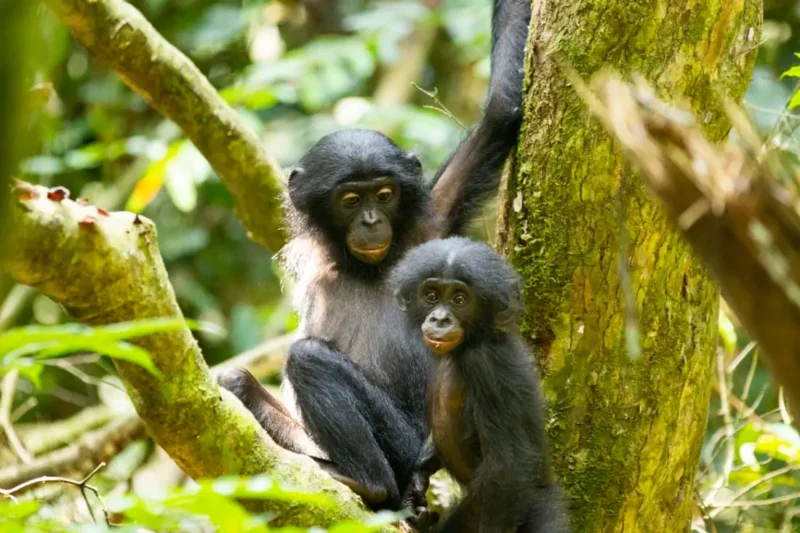
The bonobo (Pan paniscus), humanity’s closest cousin, appears to communicate in a way scientists believed was exclusive to humans. Researchers from the University of Zürich and Harvard University said on April 3, 2025, that bonobos combine their vocalizations – peeps, grunts, whistles and more – to create more complicated meanings. The researchers said it’s similar to the way humans string words together to make unique sentences.
This is a communication pattern known as “nontrivial compositionality.” And the researchers said it’s widely used by bonobos. Combining these words or vocalizations is an advanced feature of communication, creating depth of meaning.
The researchers published their new study in the peer-reviewed journal Science on April 3, 2025.
A new clue to the evolution of language
The only other animal known to employ this kind of language pattern is us (Homo sapiens). In other words, humans and bonobos can rearrange their various calls to create unique and new complex meanings. This is how humans create meaningful speech, combining words into never before spoken sentences anyone can understand. Because the bonobo shares this trait, it may reveal the evolutionary past of language.
Lead author Mélissa Berthet, a postdoctoral researcher at the Department of Evolutionary Anthropology of the University of Zurich (UZH), said:
This suggests that the capacity to combine call types in complex ways is not as unique to humans as we once thought.
How to create a bonobo dictionary
Many animals use trivial compositionality in their communication. But there is gap between bonobos and humans, and the rest of the animal kingdom. It allows both species to communicate more data with the same number of utterances. UZH’s press release explains it this way:
Compositionality is the capacity to combine meaningful words into phrases whose meaning is related to the meaning of the words and the way they are combined. In more trivial compositionality, the meaning of the combination is the addition of its parts: for example, ‘blond dancer’ refers to a person who is both blond and a dancer. However, in more complex, nontrivial compositionality, one part of the combination modifies the other. For example, ‘bad dancer’ does not refer to a bad person who is also a dancer: ‘bad’ in this case does not have an independent meaning but complements ‘dancer’.
And so “the blond dancer” could also be called “the tall dancer.” Both phrases tell us nothing about the quality of the dancing. Even when not dancing, the dancers are still tall and blond. But the phrase “the bad dancer” is more specific: That person doesn’t dance well. Separating the words destroys their meaningful relationship.
The researchers applied a linguistic tool normally used to study human language to the bonobo chatter. Researchers needed a dictionary of bonobo calls in order to study the depth of the compositionality. This was a milestone in field research, Berthet said:
This allowed us to create a bonobo dictionary of sorts, a complete list of bonobo calls and their meaning. This represents an important step toward understanding the communication of other species, as it is the first time that we have determined the meaning of calls across the whole vocal repertoire of an animal.
Compositionality is older than we once believed
Bonobos and humans descend from an older species in the Hominini taxonomic tribe. (A tribe is rank above genus, but below family in the standard biological naming convention.) The only other member of Hominini is the chimp.
This shared ancestry leads the study’s authors to conclude their work might explain how language evolved in humanity. Co-author Martin Surbeck of Harvard University explained:
Since humans and bonobos had a common ancestor approximately 7 to 13 million years ago, they share many traits by descent, and it appears that compositionality is likely one of them.
This could mean compositionality is an ancient trait. It likely arose millions of years before humanity learned to speak. It’s probably even older than our species itself. Co-author Simon Townsend of UZH said:
Our study therefore suggests that our ancestors already extensively used compositionality at least 7 million years ago, if not more.
More about bonobos
Bonobos also have the nickname “pygmy chimpanzees,” but they’re no smaller than the more widespread chimp (Pan troglodytes). Instead, the name may refer to their habitat. The bonobo lives in the rainforests of the Democratic Republic of the Congo in an area where indigenous hunter-gatherers, primarily the Mbuti (Bambuti) and Batwa (Twa), live. The Forest People of Central Africa, as they’re called today, were once referred to as “African pygmies.”
Bonobos are hairier than chimps and longer-limbed, especially in the legs. Although they walk primarily on their feet and knuckles, they also walk upright at times.
Male bonobos are larger than females on average, but the sexual difference is much less pronounced than in other ape species. They also tend to be darker skinned than chimps, with longer hair, especially on their bearded cheeks. They range in size from 60 to 135 pounds (27 to 61 kg), and stand about 4 feet (120 cm) tall.
They’re famously promiscuous apes. Females will mate with any male but their own offspring. Scientists have labeled the species female-centered and egalitarian. Sex often replaces aggression in bonobo social interactions.
Humans and bonobos – and chimps too – share 97.8% of their DNA. So by studying bonobo evolution, we are also studying our own.
Bottom line: The bonobo – humanity’s closest cousin species – can combine its vocalizations for a language with more depth, a characteristic scientists previously thought was unique to humans.
Source: Extensive compositionality in the vocal system of bonobos
Read more: Orphaned bonobos can develop social skills and empathy
Like what you read?
Subscribe and receive daily news delivered to your inbox.
More from
Dave Adalian


Fall hummingbird migration in progress across North America

Venus rings found high above the planet’s thick clouds
Save the Frogs Day is today, Tuesday, April 28
Join the worldwide 2026 City Nature Challenge this weekend!



