Astronomy Essentials

Venus brightest in the morning sky this week

Sequence of crescents increasing in size and decreasing in width as the crescents get bigger.
View at EarthSky Community Photos. | P Govardhana Siddartha of India submitted this composite image of Venus taken over 4 months. Venus was recorded from December 2024 to March 2025 as it raced toward inferior conjunction in March. You can see how the size of Venus increased and the phase decreased during that time. Thank you, P Govardhana!

Venus brightest? Now’s the time

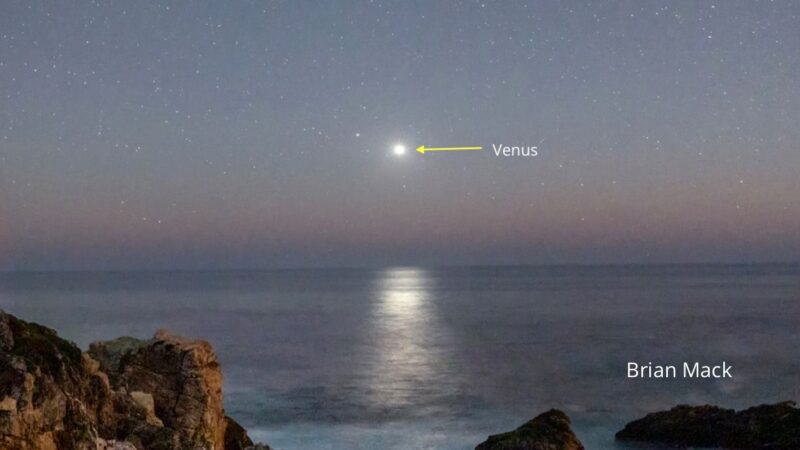
Venus is blazing in the evening sky now. You’ll see it easily in the west after sunset. It lives up to its reputation of outshining all other objects in our sky, except the sun and moon. UFO reports are probably increasing! But you’ll know better. Venus recently passed between us and the sun. So it’s now nearing greatest brilliancy, when we’ll see it at its brightest in our evening sky for all of 2026. Venus will reach peak brilliancy on September 18. But start watching now! You can’t miss it.

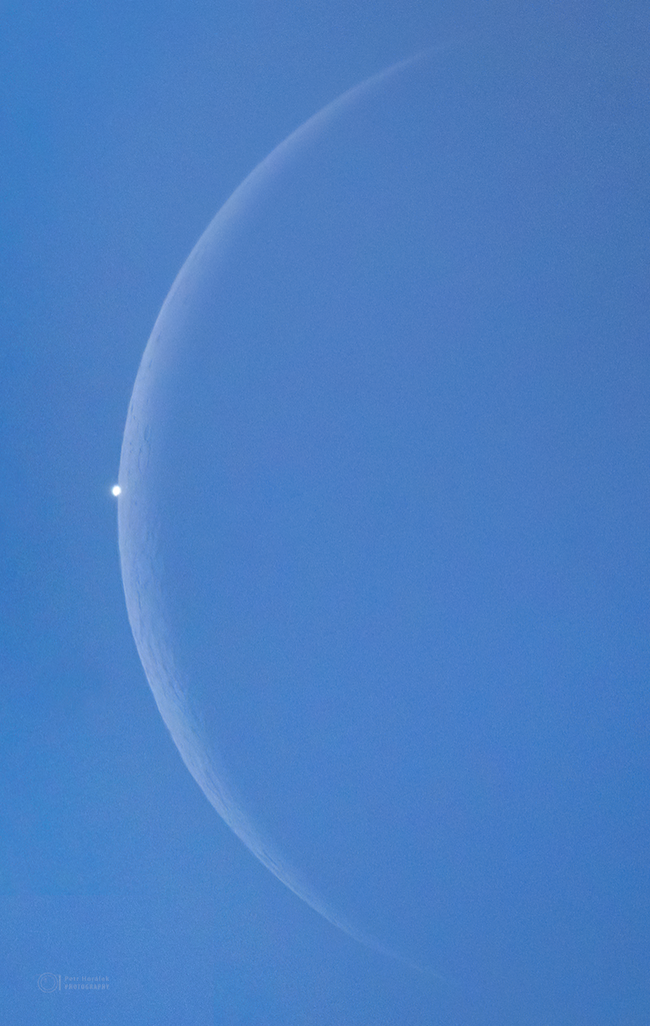
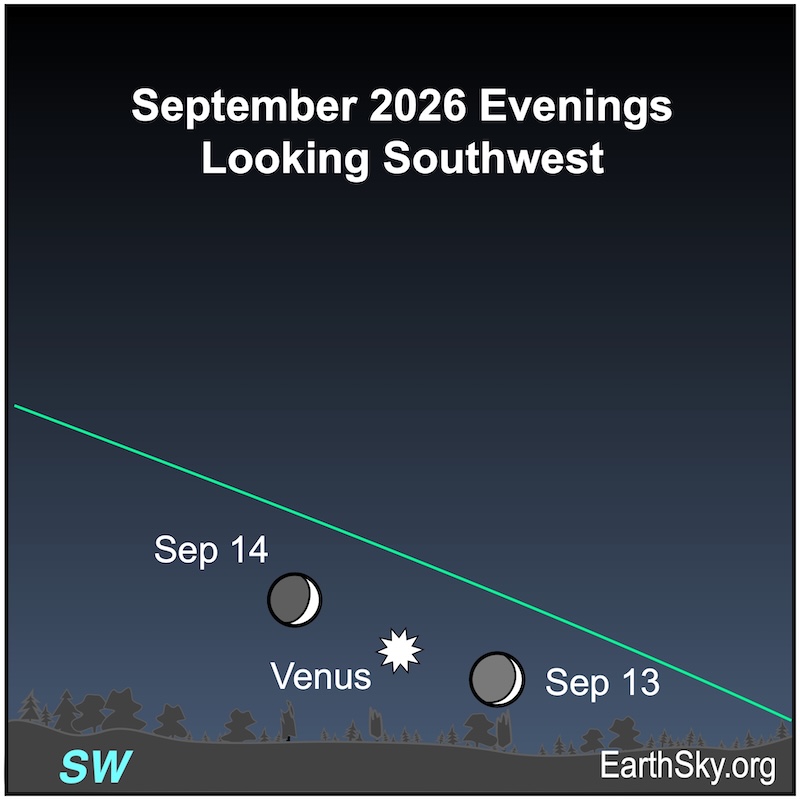
The waxing crescent moon will be near Venus on the evenings of September 14 and 15. In fact, observers in Europe and Africa can see a daytime lunar occultation of Venus.

Look for Venus in the sunset direction on any clear evening now. It’s visible not just in a dark sky, but in bright evening twilight as well.

Read more: How to see Venus in the daytime

Need an exact measure? At greatest brilliancy on September 18, 2026, Venus will shine at magnitude -4.4. That’s super bright! It’ll reach this brightness at 23 UTC on September 18.

Venus won’t appear this bright to us again in the evening sky until April 2028.
When does it happen?

Venus was at greatest brilliancy last in the evening sky on February 14, 2025. Then, Venus sank toward the sunset as it raced toward its sweep between the Earth and the sun – its inferior conjunction – on March 23, 2025.

Afterwards, this bright planet quickly emerged into the morning sky and reached its greatest brilliancy on the morning of April 27, 2025. Earth and Venus are constantly moving in their orbits around the sun. Venus moves faster, and its orbit is smaller than Earth’s orbit. So Venus “laps” Earth every so often. Venus comes to inferior conjunction about every 19.5 months, or roughly 584 days. When it does this, it always moves from our evening to our morning sky. And there are always two times of greatest brilliancy surrounding inferior conjunction, one in the evening, followed by one in the morning.

Venus’ greatest brilliancy always happens about a month before – and after – Venus reaches inferior conjunction. Its next inferior conjunction – when it’ll move to the morning sky – is October 24, 2026. Then Venus will reach greatest brilliancy in the morning sky around November 27, 2026.

Orbits of Venus and Earth with sightlines from Earth to Venus on different days.
Earth and Venus orbit the sun counterclockwise as seen from the north side of the solar system. Venus reaches its greatest eastern elongation in the evening sky about 72 days before inferior conjunction and its greatest western elongation in the morning sky about 72 days after inferior conjunction. Greatest illuminated extent for Venus comes midway between a greatest elongation and an inferior conjunction. Adapted from an image by Wmheric/ Wikimedia Commons (CC BY-SA 3.0).

Why does it happen?

Greatest brilliancy for Venus is a combination of two factors: illumination and disk size. Venus reached superior conjunction – on the opposite side of the sun from Earth – on January 6, 2026. At superior conjunction, when Venus is on the far side of the sun from us, it’s at full phase and its disk size is always small. It emerged in the evening twilight in late March 2026. Then its disk size increased as its phase decreased and it will reach its greatest brilliancy in the evening sky on September 18, 2026.

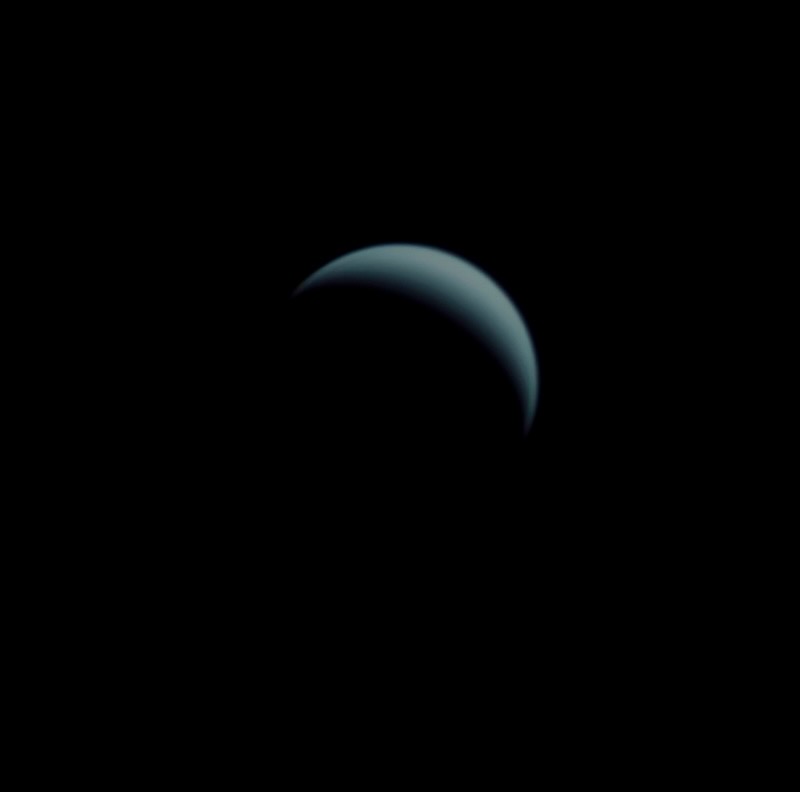
Now at greatest brilliancy in the evening sky, we’re not seeing a fully illuminated Venus. Instead, as seen through telescopes – as Earth races away from Venus – its phase has been decreasing, like a waxing crescent moon. Meanwhile, again as seen through telescopes, the disk size of Venus has been increasing as the Venus races ahead of Earth in orbit around the sun.

Venus brightest is a combination of phase and size

Greatest illuminated extent. It’s only when we see Venus as a crescent that this world comes close enough to us to exhibit its greatest illuminated extent, at which time its daytime side covers the greatest area of sky. And that means that Venus is brighter around now than at any other time during its approximate 8-month reign in the evening sky.

Disk size. Remember, again as seen through a telescope, the disk of Venus decreases after inferior conjunction. In January 2026, Venus was around a 9.8-arcsecond gibbous disk through telescopes. At its greatest brilliancy in the September evening sky, Venus will be around a 40-arcsecond crescent disk.

So greatest brilliancy for Venus is a combination of maximum phase and disk size. The two combine to give us a bright planet Venus.

Then, as it races away from us, the phase continues to increase … but the disk size decreases. So Venus will start to appear a smidgen fainter to us following September 18, and fainter still (but still very bright!) until it slips away in the sun’s glare in October 2026.

Diagram: 8 positions of Venus around its orbit, sun centered, with Venus' phases as seen from Earth.
The phases of Venus – and its locations at inferior and superior conjunction – as viewed from Earth. Adapted from an image by NASA/ Chmee2/ Wikimedia Commons (CC BY-SA 3.0).

Venus charts for 2026, from Guy Ottewell
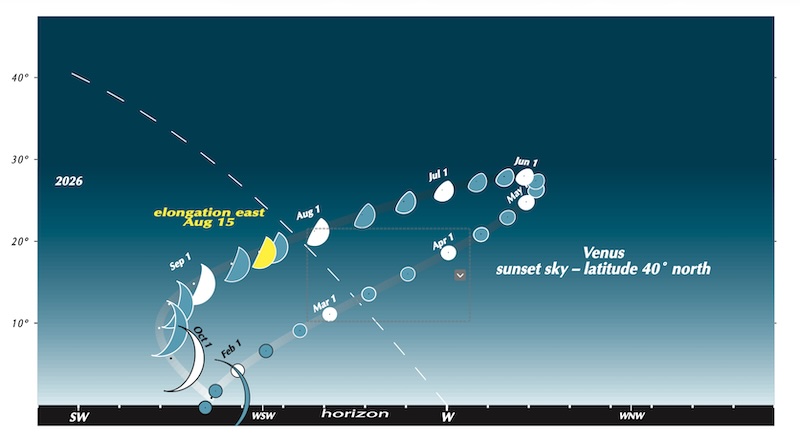
Diagram: Arced path of Venus over the horizon, phases showing, with dates beside them.
Venus’ greatest evening elongation in 2026 from the Northern Hemisphere as viewed through a powerful telescope. The planet images are at the 1st, 11th, and 21st of each month. Dots show the actual positions of Venus every day. Chart via Guy Ottewell’s 2026 Astronomical Calendar. Used with permission.
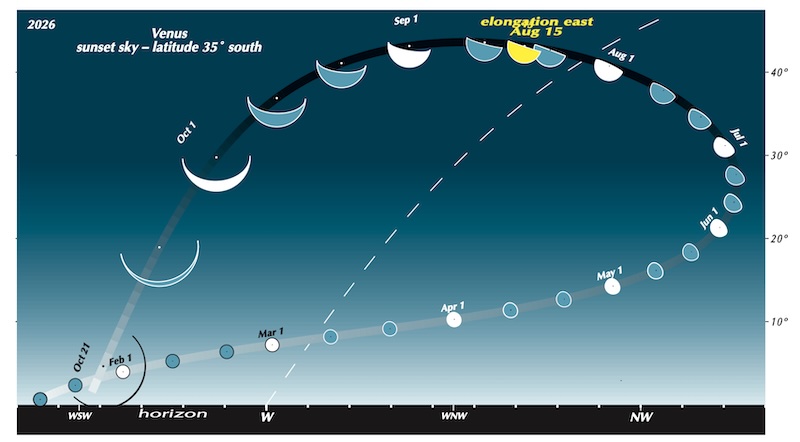
Diagram: Arced path of Venus over the horizon, phases showing, with dates beside them.
Venus’ greatest evening elongation in 2026 from the Southern Hemisphere as viewed through a powerful telescope. The planet images are at the 1st, 11th, and 21st of each month. Dots show the actual positions of Venus every day. Chart via Guy Ottewell’s 2026 Astronomical Calendar. Used with permission.

Venus photos from our community

A large but thin fuzzy crescent on a black background.
View at EarthSky Community Photos. | Eliot Herman of Arizona submitted this photo on February 17, 2025, and wrote: “Venus at -4.87 magnitude and 43.1 arcseconds diameter. This is about the maximum brightness of Venus for 2025 evening planet.” Thank you, Eliot!
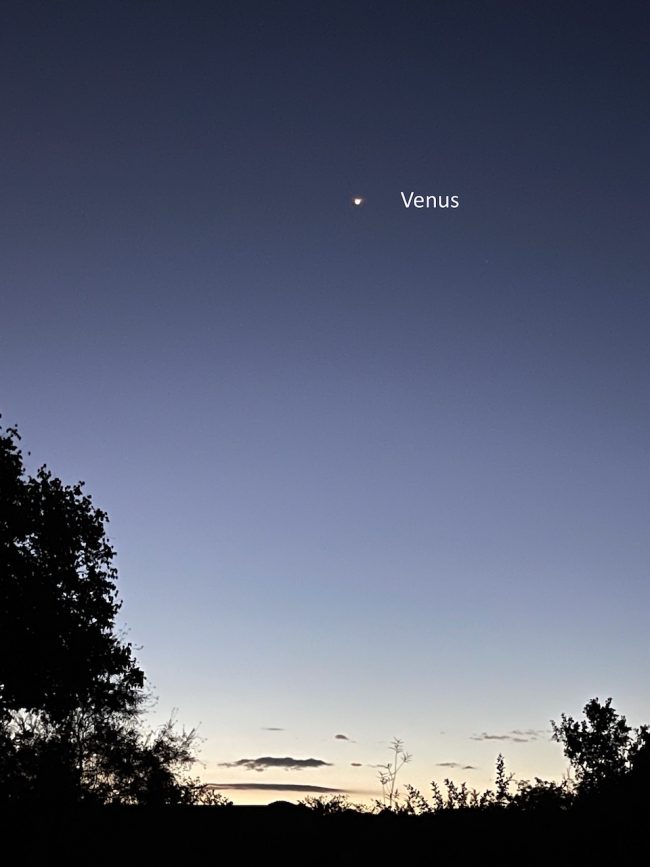
Venus brightest: Blue morning twilight, and a very bright planet high in the cobalt sky, labeled Venus.
View at EarthSky Community Photos. | EarthSky’s Deborah Byrd caught Venus with an iPhone over the desert west of Santa Fe, New Mexico, on September 14, 2023. It was super bright! It’s easy to see, even from cities.
venus-phases-Vedant-Pandey-Varanasi-India-Feb2023-to-August-2023.
View at EarthSky Community Photos. | Vedant Pandey in India wrote: “I captured Venus over the span of 8 month’s using my telescope and smartphone camera. I made this composition to show how Venus changes it’s phases in our night sky.” Wow! Thank you, Vedant!

More Venus images

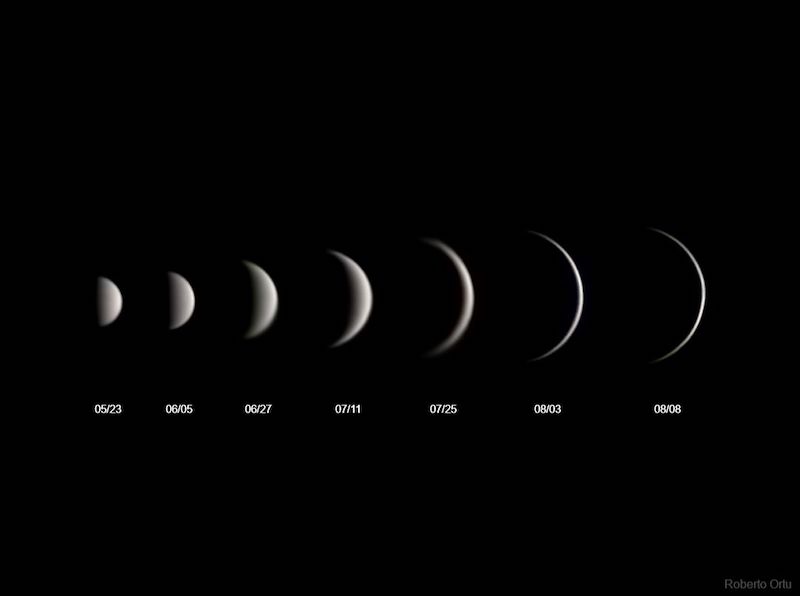
Venus phases, from a small half-Venus to a large but very thin crescent, all dated.
View at EarthSky Community Photos. | Roberto Ortu of Cabras, Sardinia, Italy, captured these images of Venus and wrote: “This is a mosaic with the best photos of the planet that I got from May 23, 2023, until August 8, 2023. The images show its phases, very similar to those of the moon, and the increase in its apparent diameter caused by the approach to the Earth.” Thank you, Roberto!
Three increasingly larger but thinner white crescents, with dates and percent illuminated.
View larger. | This composite image shows how Venus changes in size and phases as it gets closer to Earth. Image via Tom and Jane Wildoner/ Dark Side Observatory. Used with permission.
Thin, fuzzy but bright crescent on dark background.
This image of Venus was captured during daylight when Venus was 6% illuminated. Image via Tom and Jane Wildoner/ Dark Side Observatory. Used with permission.

Bottom line: Venus will be brightest in the evening sky around September 18, 2026. After that, Venus will next be at its brightest again – this time in the morning sky – in November 2026.

Planet-observing is easy: Top tips here

EarthSky’s monthly planet guide, updated daily: Visible planets and more

Posted 
September 15, 2026
 in 
Astronomy Essentials

Like what you read?
Subscribe and receive daily news delivered to your inbox.

Your email address will only be used for EarthSky content. Privacy Policy
Thank you! Your submission has been received!
Oops! Something went wrong while submitting the form.

More from 

Editors of EarthSky

View All