



Pole stars aren’t permanent
Under a dark sky tonight, you’ll be able to pick out the constellation Draco the Dragon winding around the star Polaris. Polaris is Earth’s northern pole star today … but it hasn’t always been.
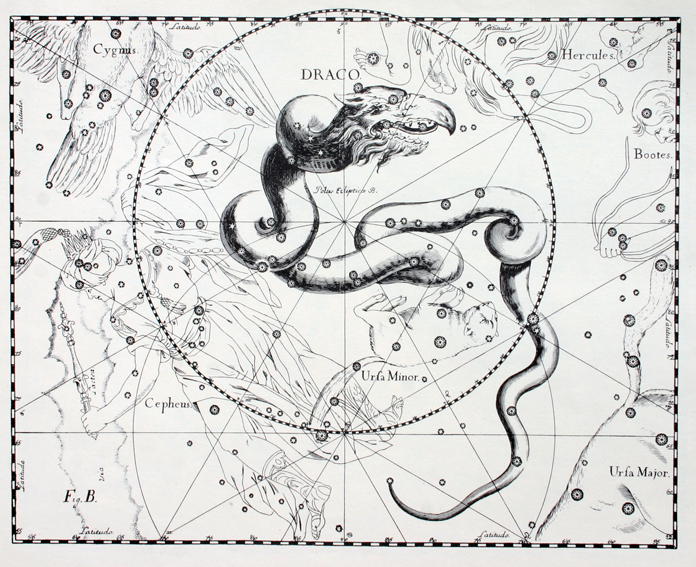
The image at the top of this post shows Draco as depicted in an old star atlas by Johannes Hevelius in 1690. See the circle? It indicates the changing position of the north celestial pole over a cycle of 26,000 years.
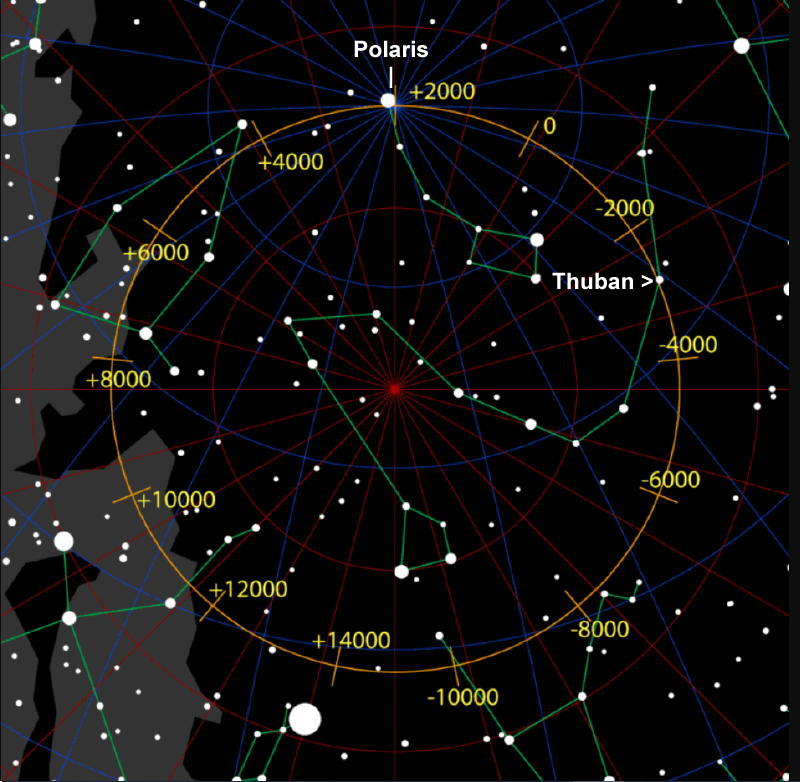
The 26,000-year cycle is known as precession. Basically, it’s a slow, smooth wobble that causes a change in the orientation of Earth’s axis over time. Precession causes Earth’s axis to trace out a circle among the stars. Thus, over time, Earth’s north pole points to various stars, and the identity of our North Star changes.
So to our ancient ancestors, the star we now call Polaris was an unremarkable star called Phoenice. And a star in Draco, called Thuban, was the pole star when the Egyptians built the pyramids some 4,500 years ago.
Precession of the Earth's Rotation Axis and North Star. The Earth's rotation axis is not fixed in space. Like a rotating toy top, the direction of the rotation axis executes a slow precession with a period of 26,000 years. https://t.co/h7nS1BCuOl pic.twitter.com/SRVQGQDYP0
— Space Explorer Mike (@MichaelGalanin) March 27, 2021
Draco winds between the Big and Little Dippers
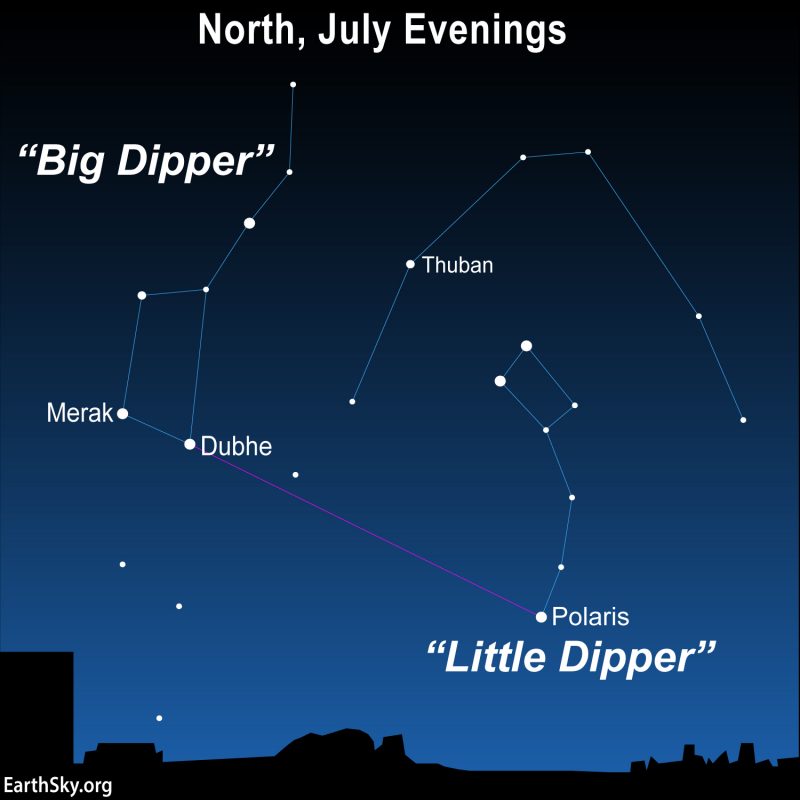
The famous Big Dipper can help guide you to Draco and its star Thuban. Just remember … the entire Dragon requires a dark sky to see. You’ll find the Big Dipper high in the north on June evenings. The two outer stars in the Dipper’s bowl point to our modern-day Polaris, the North Star, which marks the end of the Little Dipper’s handle.
The Little Dipper is relatively faint. If you can find both Dippers, then your sky is probably pretty dark. And you’ll need that dark sky to see Draco. You’ll have to let your eyes and imagination drift a bit to see the entire winding shape of the Dragon in the northern heavens.
See how the tail of Draco winds between the Big and Little Dippers on the chart below?
And here’s Draco the Dragon and the Little Dipper. The four stars that make up Draco’s head usually are the easiest pattern to pick out.
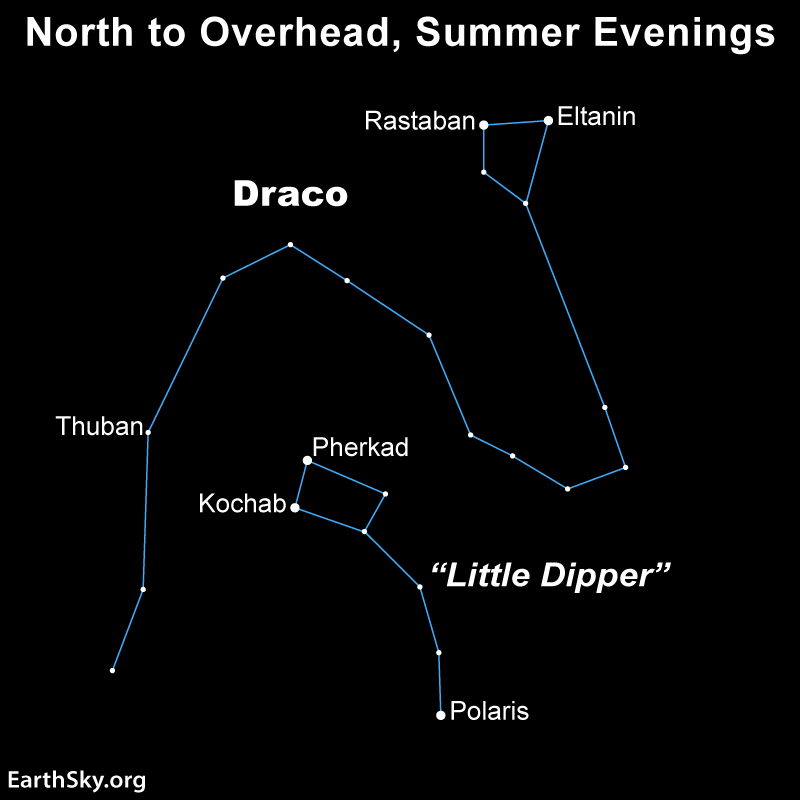
Our charts are mostly set for mid-latitudes in the Northern Hemisphere. To see a precise view – and time – from your location, try Stellarium Online.
Ex-pole star Thuban is easy to find
If you can find both Dippers, and if your sky is relatively dark, you can easily pick out Thuban. The star is four times fainter than Polaris, but it’s easy to find by looking between the Dippers.
Thuban is famous for having served as a pole star around 3,000 BCE. This date coincides with the beginning of the building of the pyramids in Egypt. In fact, it’s said that the descending passage of the Great Pyramid of Khufu at Gizeh was built to point directly at Thuban. So, our ancestors knew and celebrated this star. Now, the descending path points toward Polaris, the current North Star.
Overall, Thuban reigned as the pole star for more than a thousand years. It was closest to the pole in the year 2,830 BCE, at a distance of only 10 arcminutes, or 1/6 of a degree. This easily beats Polaris, which will get no closer than 27 arcminutes to true north next century.
Thuban was within 1 degree of true north for 200 years. Its reign as North Star is long over, but it will get its turn again in the year 20,346 CE. Don’t wait up for it!
Through a telescope, Thuban is a blue-white star, magnitude 3.67. It is located 303 light-years away, is about five times larger than our sun and shines 240 times brighter. It also has a companion, but it is too close to the primary star to observe.
The reign of Polaris
And Polaris? Its reign as North Star began in 1547 when Gemma Frisius first referred to it as “that star which is called polar.” In July 2016, the International Astronomical Union‘s (IAU) Working Group on Star Names made the name Polaris official.
In a few thousand years, Polaris will no longer be the North Star. Perhaps then the IAU will assemble the Working Group of Star Names and change the name back to Phoenice. (P.S. Dear Pluto, there is hope!)
Brilliant Sirius, a future southern Pole Star
Via Daniel Gaussen, Founder & Guide – Stargaze Mackenzie – New Zealand
The slow wobble of Earth’s axis affects the Southern Hemisphere, too. Today, southern skywatchers have no bright equivalent to Polaris. The faint star Sigma Octantis lies closest to the south celestial pole, but it is so dim (around magnitude 5.5) that many observers struggle to find it. As a result, the southern sky currently lacks an obvious pole star.
But that won’t always be the case. As we’ve seen with Polaris and Thuban, Earth’s 26,000-year cycle of precession means that different stars take turns marking the celestial poles. Around the year 9,250 CE, the star Delta Velorum in the constellation Vela the Sails will pass within just 0.2 degrees of the south celestial pole, making it an even more accurate pole star than Polaris is today.
Looking much farther into the future, the brightest star in the night sky will briefly claim the title. Around the year 66,270 CE, Sirius, the dazzling Dog Star in the constellation Canis Major, will pass within 1.6 degrees of the south celestial pole. Although not as precise a marker as Delta Velorum, Sirius will be far more conspicuous. For the first time in tens of thousands of years, southern observers will have an exceptionally bright star close to the celestial pole, serving as a prominent guide to the south.
Sirius is relatively close to Earth, at just 8.6 light-years away. This closeness means it has a noticeable motion across our sky. And because of this motion, Sirius does not return to the same position relative to the celestial poles every precessional cycle. It was not a southern pole star in the distant past, and after its future reign near the south celestial pole, it will continue drifting onward through the Milky Way, making its role as a southern pole star a unique and temporary chapter in the long story of Earth’s changing skies.
Bottom line: Tonight, look for the winding shape of Draco the Dragon in the northern sky. This constellation contains Thuban, a former pole star.
Read more about Sirius as a future southern pole star
Like what you read?
Subscribe and receive daily news delivered to your inbox.
More from
Editors of EarthSky


Mercury after sunset and great for Southern Hemisphere!

Meteor shower guide 2026: Up next … the Orionids
We fly between the sun and Saturn. At opposition today
October birthstone: Colorful opal and tourmaline



