



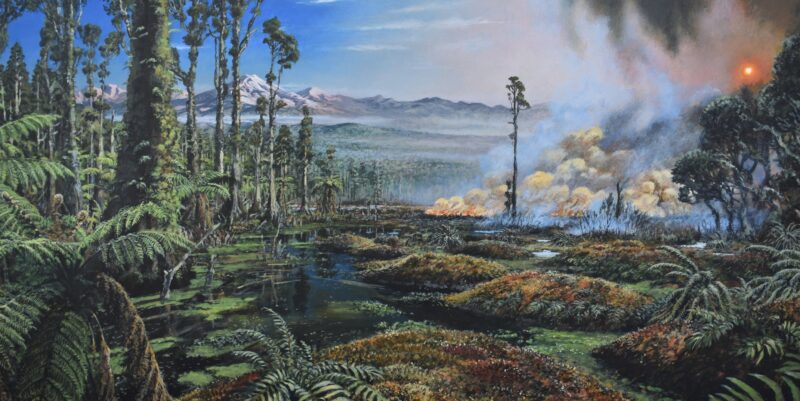
Wildfires near the South Pole burned 90 million years ago
Today, Antarctica is a vast, frozen landscape. A miles-thick ice sheet covers some 90% of the continent. But some 90 million years ago, during the Late Cretaceous period, scientists say this land was a rainforest where dinosaurs roamed. And on September 7, 2026, researchers with the Alfred Wegener Institute in Bremerhaven, Germany, said wildfires happened here regularly. In fact, they said they have found evidence in sediment cores of the southernmost wildfires ever recorded on Earth.
The researchers published their peer-reviewed paper in the journal Communications Earth and Environment on September 7, 2026.
The South Pole was once a rainforest
Back in 2020, researchers with the Alfred Wegener Institute (AWI) said they found evidence that a rainforest once existed in what is now Antarctica. They extracted a sediment core in an area that is currently in West Antarctica. That sediment core showed clear signs that a lush environment once existed here. Co-author Johann Klages of AWI said:
In a sediment core from the Amundsen Sea in West Antarctica, we found an extremely well-preserved forest soil dating back around 90 million years, containing abundant pollen and spores and a dense network of roots. During the Cretaceous, tectonic conditions meant that this temperate rainforest lay even farther south, just 900 kilometers [560 miles] from the South Pole.
Today, average annual temperatures at this location are around -30 Celsius [-22 F] and everything is covered by an ice sheet several kilometers thick. Our discovery showed that during the warmest period of the Cretaceous, when atmospheric CO2 levels were four to six times higher than today, a relatively warm and humid climate prevailed, even close to the South Pole.
In the new study, the researchers took a closer look at the sediment core and found clear evidence of recurring wildfires.
A closer look at the sediment core
The team found three pieces of evidence in the sediment core from the Late Cretaceous that pointed to recurring fires in this former rainforest.
First, the researchers found minute particles of charcoal. These tiny pieces became more abundant in the younger sediments. Their analysis showed the charcoal was mostly coming from soft conifer wood burning at low temperatures. These fires would be on the surface and not raging across the forest canopy.
Second, the researchers found amber. This amber is fossilized tree resin. In particular, the former tree resin here seems to have flowed over the tree trunks to protect and seal fire-damaged areas.
Third, the researchers found lots of spores of peat moss. Peat moss is a spongy soil made from dead plant matter. It decays slowly over thousands of years. This peat moss was the evidence that there were once raised bogs in Antarctica. The researchers link the formation of the bogs to the recurring fires.

Imagining Antarctica from the past
So now imagine what Antarctica looked like 90 million years ago. First, the land was still partially connected to what is present-day Australia. The average temperature was 53 F (12 C). There were seasons of light and dark below the Antarctic Circle, along with dry periods and monsoon seasons. And sometimes, the monsoon season brought thunderstorms and associated lightning. The lightning struck Earth, igniting what would develop into large-scale fires.
Co-author Ulrich Salzmann of Northumbria University in England said:
90 million years ago, just 900 kilometers [560 miles] from the South Pole, a temperate and very swampy Antarctic rainforest with pronounced dry and monsoon seasons gradually silted up and developed into a peatland dominated by peat mosses.
Wildfires, which became increasingly frequent, clearly played a decisive role in this process. They kept the vegetation open and enabled the development of a peat bog where ground-level smoldering fires then occurred repeatedly, similar to those that have become increasingly common in German peatlands in recent years.
Wildfires near the South Pole and climate
The researchers explain how these boggy peatlands are important in climate change. Peatlands are a carbon sink, or a place where Earth stores its carbon. As co-author Thorsten Bauersachs of RWTH Aachen University said:
Peatlands play a key role in the climate system, both then and now, as highly effective long-term stores of carbon. In a warm climate, wetlands dry up more quickly and fires that prevent forest development occur more frequently. This can promote the formation of peatlands, where carbon-rich plant material accumulates over long periods.
Klages added:
The Late Cretaceous was extremely warm and prone to frequent fires. We were surprised to find evidence in our core of an early Antarctic ecosystem that, in many respects, resembled today’s Arctic raised bogs and also experienced regular fires.
Bottom line: Researchers have found evidence in a sediment core in Antarctica that wildfires near the South Pole were a regular occurrence some 90 million years ago.
Source: Co-evolution of wildfires and early Sphagnum-peatlands near the Cretaceous South Pole
Read more: A rainforest in Antarctica during the age of dinosaurs
Read more: Wildfires becoming more frequent in the north: See the maps
Like what you read?
Subscribe and receive daily news delivered to your inbox.
More from
Kelly Kizer Whitt


Mercury is shrinking up to 30% more than expected

Does this Mars image show an alien in a hallway?
Atlantic hurricane season sets a record: No hurricanes yet!
Did the sun swallow a planet early in its history?


