Do the planets revolve around the sun?
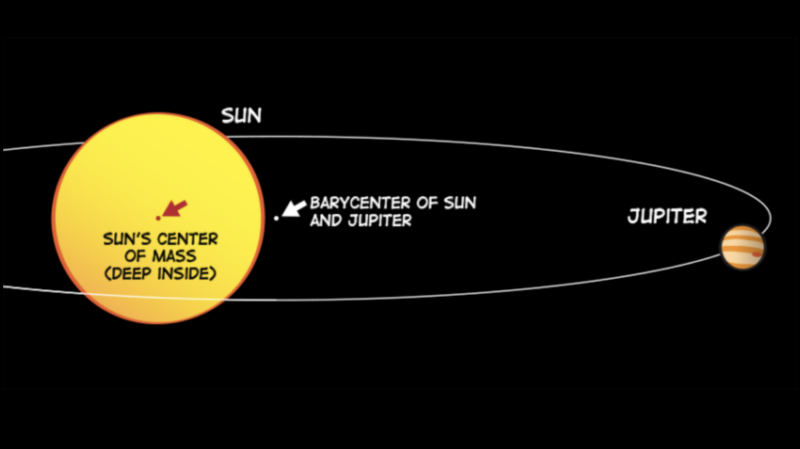
What if I told you that the planets don’t revolve around the sun? At least, not exactly. You were probably taught in grade school that Earth and the other planets do revolve around the sun. And generally speaking, it’s true, or not far from being true. But, strictly speaking, the physics of the situation is slightly different. The planets and the sun revolve around a common center of mass. This location or point is called the barycenter. Because the sun is so much more massive than the planets, the center of mass between them is often a point inside the sun’s giant ball of gas. But not always!
Right now, the solar system’s barycenter is outside the sun’s surface. And, because of the constantly changing location of the planets, the barycenter won’t return to being inside the sun until late January or early February 2027.
And most of that shifting is thanks to Jupiter. The sun contains about 99.86% of the solar system’s mass. Jupiter contains about 0.1%. That might sound tiny. But Jupiter is massive enough – and at just the right distance from the sun – to tug the solar system’s center of mass substantially outside the sun’s surface.
But this isn’t unusual. In fact, the solar system’s barycenter (or common center of mass) spends roughly 60% (or more) of its time outside the sun and only about 40% (or less) of its time inside!
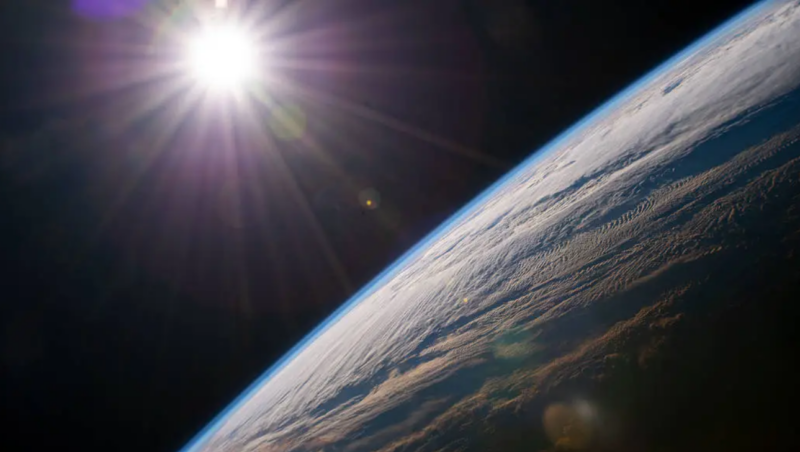
The location of the planets
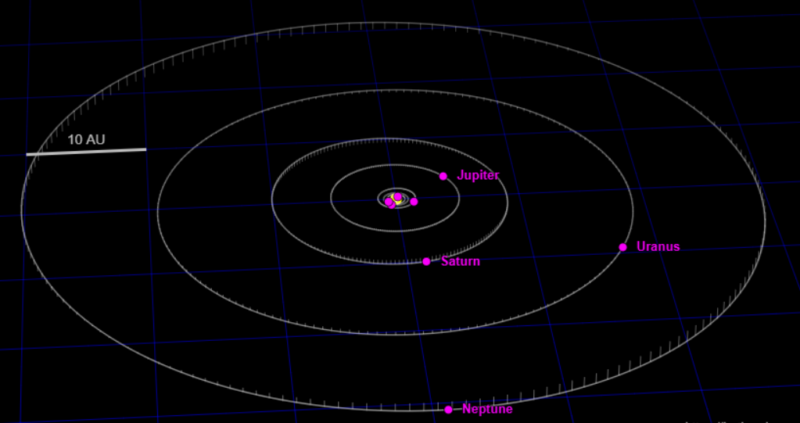
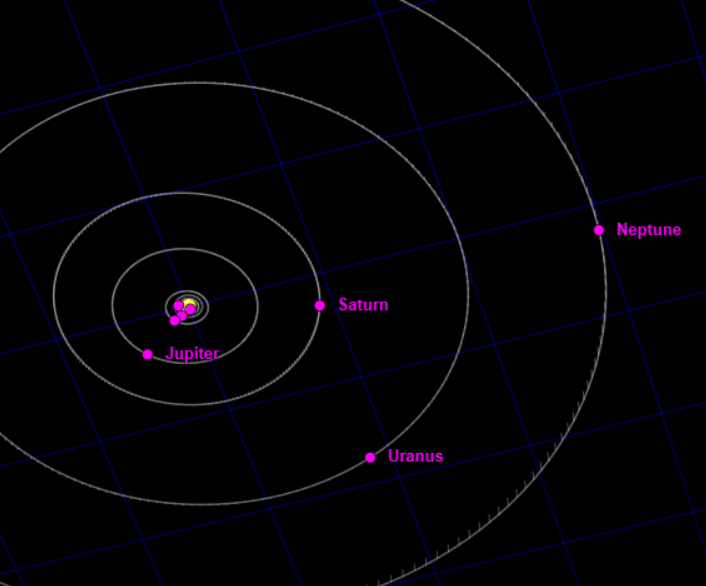
So, where are the planets currently in relation to the sun? In the two diagrams below, we’ve zoomed out so you can see the location of where the largest gas giant planets are currently orbiting. The first diagram is the location of the planets in late August 2026. The second diagram shows where the planets will be in relation to each other and the sun on February 7, 2027.
Other planetary systems
Not just our sun and planets, but all stars and their planets move around a barycenter … a common center of mass for that system as a whole. If you looked from afar, you’d see a distant star with planets appear to “wobble” for this reason. Detecting that wobble is one of the tried-and-true way astronomers look for and find planets orbiting around farflung stars.
The wobble method is also called the radial velocity method. Radial velocity refers to the speed at which a star moves directly toward or away from an observer on Earth along our line of sight.
The wobble that astronomers see in systems like this is revealed through an analysis of the star’s spectrum, the rainbow array of its light broken into colors. As the star – orbiting with its companion planet – slightly moves toward us, we see its light waves compress toward shorter, bluer wavelengths. As the star slightly moves away, its light waves stretch toward longer, redder wavelengths.
This is the classic Doppler shift that also occurs with sound. It’s what causes the siren of an approaching ambulance to sound higher in pitch than when the same ambulance is moving away. And, clearly, with stars, it works best for systems that are aligned edge-on to us! If we’re looking at a system face-on, we can’t detect the shift.
Plus, the wobble method works best for massive planets close to their stars. Earth-mass planets are much harder to detect because their weaker gravitational tug produces a much smaller wobble in the star.
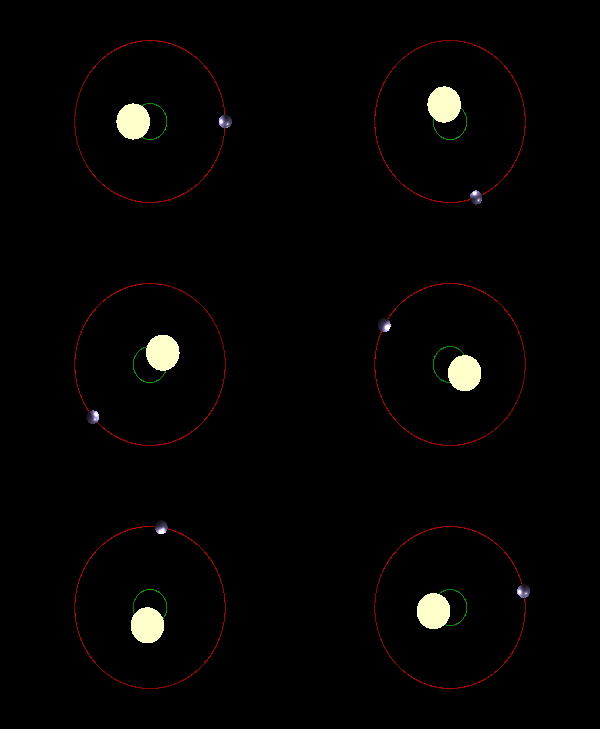
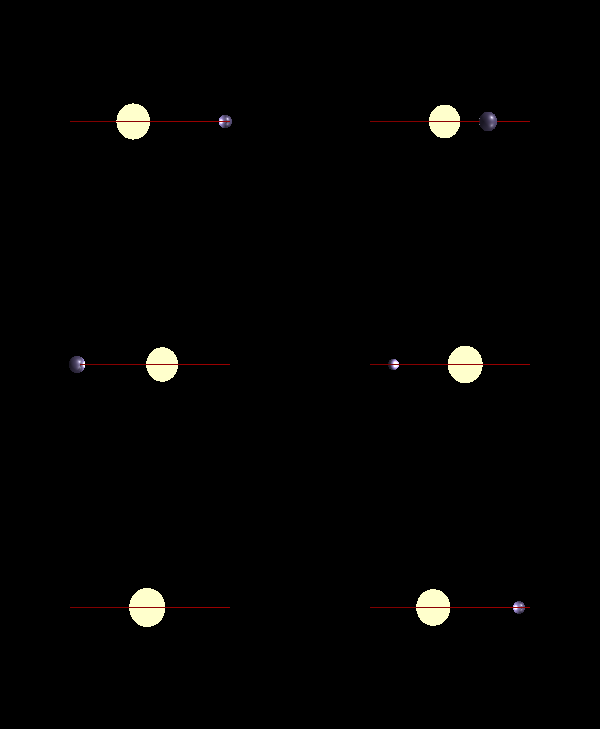
Bottom line: Do the planets revolve around the sun? Not exactly. The sun and planets orbit a common center of mass (or barycenter), which, right now, is outside the sun. This will change in 2027, when Jupiter’s gravity will pull the barycenter back within the sun.
Like what you read?
Subscribe and receive daily news delivered to your inbox.
More from
Kelly Kizer Whitt


Telescopium the Telescope is below the Teapot

Nepal flash flood nightmare: What caused it?
Fastest star in the galaxy could unlock black hole secrets
Delphinus the Dolphin has a graceful kite shape