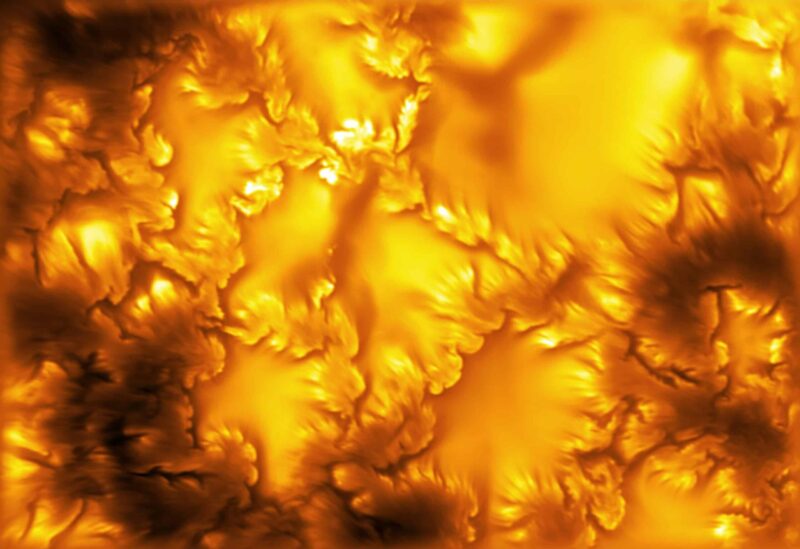
Scientists used the Daniel K. Inouye Solar Telescope – on the summit of the Haleakal? volcano on the island of Maui, Hawaii – to obtain this image of the sun. It’s the highest-resolution images of the sun’s surface (photosphere) yet. In the process they also discovered Kelvin-Helmholtz instability on the sun’s surface. Video via NSO.
- The world’s most powerful solar telescope – the Daniel K. Inouye Solar Telescope in Hawaii – combined with computer simulations to find the signature of Kelvin-Helmholtz instability.
- It happens when 2 fluid or gas layers slide past each, creating friction (or “shear”) along their boundary. The curling, vortex patterns resembling breaking ocean waves or wind-driven clouds on Earth.
- The discovery helps reveal the fundamental physics of the sun and other stars, these scientists say. It also can help people prepare for solar bursts that can affect satellites, power grids and other earthly technology.
The National Solar Observatory published this original story on August 5, 2026. Edits by EarthSky.
Highest-resolution images of the sun’s surface
On August 5, 2026, the U.S. National Science Foundation National Solar Observatory (NSF NSO) announced what they said is a groundbreaking discovery in the field of solar physics. They said it could fundamentally change how we understand the physical mechanisms driving solar activity and its impacts on life on Earth.
A team of international researchers has discovered Kelvin-Helmholtz instability in the form of small, swirling, whirlpool-like patterns on the surface of the sun (the photosphere).
The researchers from the National Solar Observatory, the NCAR High Altitude Observatory , and the German Max Planck Institut für Sonnensystemforschung published their study in the journal Nature on August 5, 2026.
And the research is based on data collected with the world’s largest solar telescope, the NSF Daniel K. Inouye Solar Telescope. It’s built and operated by the National Solar Observatory on the island of Maui, Hawaii.
Ground-breaking new images
The time-lapse video (above) and images released reveal a solar landscape unlike any seen before.
They uncover small-scale and dynamic swirls everywhere at the edges of magnetic areas. This allowed for the unambiguous identification of Kelvin-Helmholtz instability in the photosphere.
And it provides the first experimental confirmation of a phenomenon that has long been predicted by theory. David Boboltz, Deputy Director at the National Solar Observatory, said:
We believe that the discovery of Kelvin-Helmholtz instability in the solar photosphere, backed up by analysis of numerical simulations, is a major step forward in our understanding of the dynamics and evolution of solar and stellar plasma, and will serve as a basis for future discoveries.
An explanation of Kelvin-Helmholtz instability
An effect caused by fluid motion, KHI occurs when two fluids slide past each other at different velocities. This creates a “shear” at the interface. And it causes small disturbances to grow into striking, wave-like or spiraling vortices that look like breaking ocean waves.
Since its original formulation by Lord Kelvin and Hermann von Helmholtz around 1870, KHI has been observed and investigated across many areas of physics, including fluid dynamics, meteorology, oceanography, heliosphysics, and astrophysics. We can observe the instability at a variety of scales. This includes small lake and ocean waves (in windy conditions) and cloud formations on Earth to the atmospheres of gas giants like Jupiter and Saturn. And we can even see the interaction of the solar wind with planetary magnetospheres within our solar system.
The sun’s explosive events
The swirling vortices of magnetic solar plasma have become an area of increased interest for solar physicists. They could be an effective source of free magnetic energy. This energy powers major solar activity. That includes explosive events from tiny nano-flares to massive flares, jets and coronal mass ejections. These are the main contributors to space weather. And they can severely disrupt our modern technological infrastructure, including power grids, satellites, GPS navigation and global communications.
The leading theory on how the sun builds up magnetic energy is called flux braiding. As magnetic field lines twist around each other – like braiding hair – they create a tense, unstable setup. When that tension is rapidly released, the tangled magnetic lines snap, cross over each other and reconnect in new shapes (a process called magnetic reconnection). This sudden rearrangement releases a burst of energy as the system settles into a calmer, lower-energy state.
Kelvin-Helmholtz instability may drive the activity
What scientists don’t fully understand yet is what causes the twisting and braiding to happen in the first place. This new discovery – those small swirling patterns (from the Kelvin-Helmholtz instability) – might be part of the answer. Since the swirls seem to be happening constantly and everywhere on the sun’s surface where there is a strong enough magnetic field, they could be the everyday “engine” that keeps twisting the magnetic field lines and setting the whole process in motion.
Friedrich Wöger, Senior Scientist at the National Solar Observatory, said:
We are only at the beginning of recognizing the wide-reaching impact the discovery of Kelvin-Helmholtz instability has on our understanding of the connection between the magnetized plasma motion and the energy transport and release into the upper solar atmosphere.
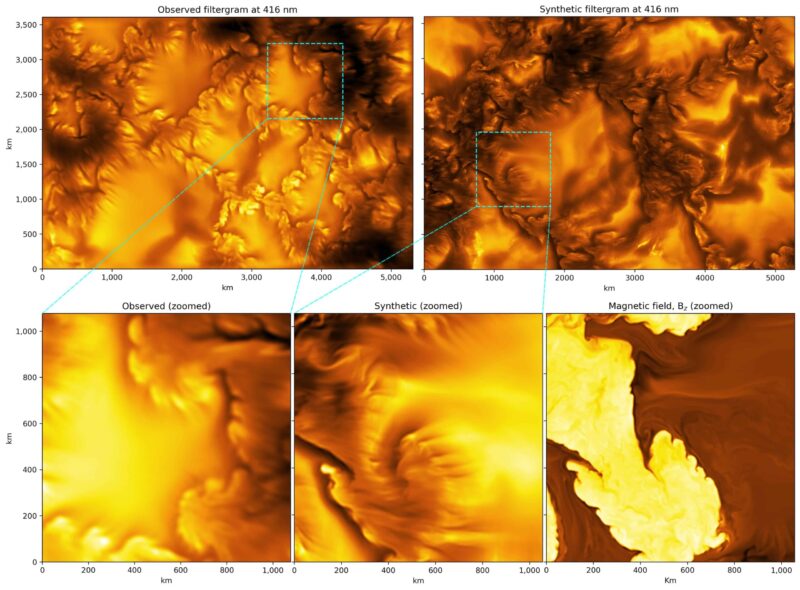
Inouye Solar Telescope data obtained at the wavelength 416 nm, with 3 zoomed regions. Three selected close-up areas show the Kelvin-Helmholtz instability on the sun. Video via NSF/NSO/AURA/MPS.
Inouye observations, simulations and theory align
In their Nature paper, the team analyzed and compared the high-resolution Inouye observations with computer simulations of the solar photosphere created with a highly specialized code built and maintained by international teams including HAO and MPS (MPS/University of Chicago Radiative MHD, or “MURaM”).
These computer simulations provided by HAO are built using basic physics equations. The equations describe what’s happening in the sun’s atmosphere and are an important tool in the interpretation of scientific data. The simulations allow the scientists to “see” things that are hard or impossible to measure directly by observation. It gives insight into processes that would otherwise stay hidden.
Combination of data from the NASA/SDO satellite, the NSF Inouye Solar Telescope VBI instrument, the MPS camera and the HAO MuRAM simulation. This demonstrates the high detail from the Inouye Solar Telescope. In the last part of the movie, the HAO MURaM simulation data is overlaid for both the synthesized intensity and the vertical magnetic field component that is finally displayed in three dimensions. Video via NSF/NSO/AURA/MPS/HAO/NASA/SDO/AIA.
Observations meet simulations
In the case of this work, the scientists found dozens of vortex-like structures along the edges of magnetic areas both in the observations and simulations. And they had strikingly similar characteristics and dynamics. For example, the average distance between vortices, known as the “instability wavelength,” ranged between 50–65 km in both cases. The study shows that the sun’s constantly bubbling surface, or granulation, interacts with magnetic structures to create areas where neighboring layers move at different speeds. And that provides the conditions necessary to trigger KHI.
Matthias Rempel, Senior Scientist at the High Altitude Observatory, said:
It is very exciting to see that the highest-resolution observations of the solar photosphere revealed a new dynamical regime in the form of KH vortices at the edges of magnetic field concentrations. These observations also provide the highest resolution validation of solar magnetohydrodynamic simulations to date, and the agreement in physical details is impressive.
The team’s advanced analyses of the Inouye observations and the computer simulations, combined with their agreement with analytical theory, led to the conclusion that the swirling vortices, and the fast-moving, finest-scale dark stripes (“striations”), found in both the observations and simulations are without a doubt produced by KHI.
Implications for the solar atmosphere and coronal heating mystery
Thomas Rimmele, Chief Technologist at the National Solar Observatory, said:
Kelvin-Helmholtz instability is likely a mechanism that contributes to the heating of the outer atmosphere and is part of the solution of the longstanding enigma of why stars have a million-degrees-Kelvin-hot corona.
The data also shows that this swirling effect (KHI) efficiently mixes magnetized and non-magnetized plasma on the sun’s surface. It enhances the spreading out or diffusion of magnetic fields throughout the solar atmosphere. The diffusion resulting from the KHI is a key factor scientists use when building models to predict how magnetic activity changes over time. This is not just for our sun, but for other stars too.
David Kuridze, Astronomer at the National Solar Observatory, said:
The sun’s magnetic field is generated by dynamo processes that act like giant cosmic engines that turn the star’s rotational energy into magnetic fields. However, because the solar magnetic cycle is only 11 years, a remarkably rapid timescale in cosmic terms, the generated magnetic flux must dissipate efficiently. Current models struggle to explain this rapid diffusion. The Kelvin-Helmholtz instability we discovered in the solar photosphere can act as a key source of this missing magnetic diffusion.
Looking ahead
Scientists are now moving toward the next phase of analysis. This phase includes using computer programs that can automatically spot and study these swirling patterns. And they are aided by the high resolution data from the Inouye Solar Telescope.
This next phase of research will help in two main ways. It’ll show scientists more about how much energy these KHIs can carry up into the sun’s higher atmosphere, where it helps heat things up. And it’ll also help scientists figure out just how much they affect the way magnetic fields spread out in the lower parts of the sun’s atmosphere.
Jacqueline Keane, NSF Program Director for the National Solar Observatory, said:
To understand the dynamic space weather that affects Earth, we have to see the small-scale processes driving it. For decades, seeing these vortices at such tiny scales remained elusive. By pairing a massive four-meter mirror with state-of-the-art optics and instruments, the NSF Inouye Solar Telescope delivers the resolving power needed to reveal these ultrafine details for the first time, enabling discoveries that were once beyond our reach.
Bottom line: The Inouye Solar Telescope has captured the highest-resolution images of the sun’s surface yet. These images show Kelvin–Helmholtz instabilities, which may help explain why the sun’s surface gets so hot and explosive.
Source: Ubiquitous Kelvin–Helmholtz instabilities driving plasma mixing on the Sun
Watch: See Haleakala National Park, stunning from summit to sea
Like what you read?
Subscribe and receive daily news delivered to your inbox.
More from
EarthSky Voices


Why leaves change color in the autumn

How a helium leak in an exoplanet atmosphere hints at life
Would a Yellowstone supervolcano eruption end humanity now?
Neptune discovered on this date 180 years ago