- Io, a moon of Jupiter, is the most volcanically active body in the solar system. So it is hot on the inside, despite being freezing cold on the near-airless surface.
- NASA’s Juno spacecraft, orbiting Jupiter, has now measured the temperature of Io just below the surface.
- Juno found that the temperature rose by more than 40 degrees Fahrenheit every few feet going deeper into the crust.
Measuring Io’s subsurface temperature
Jupiter’s moon Io is the most volcanically active body in the solar system. The gravity of Jupiter squeezing Io generates massive amounts of heat within the moon, powering the volcanoes that burst through its crust. And at long last scientists have obtained the first temperature measurements from below Io’s surface.
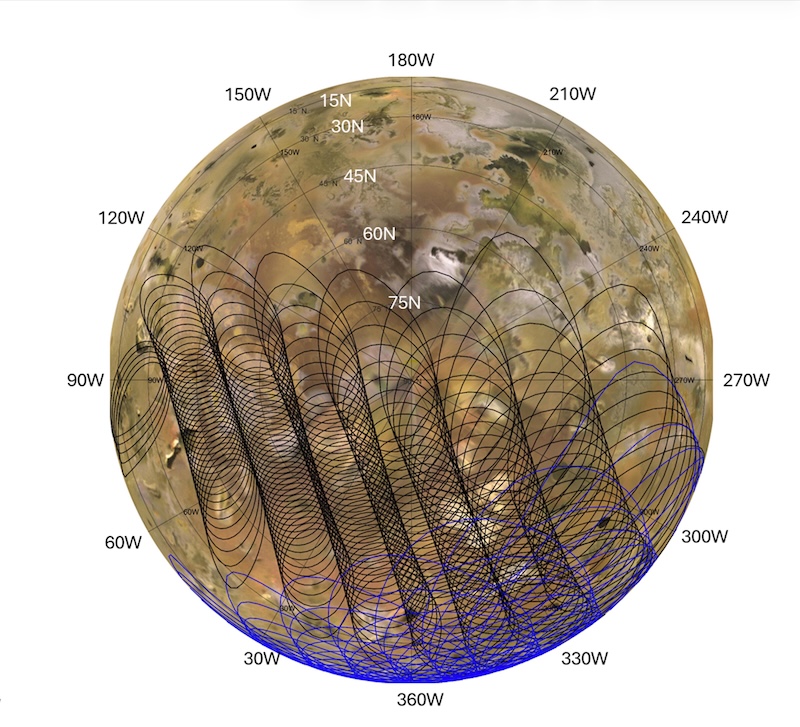
NASA said on July 22, 2026, that the Juno spacecraft found significant heating in the shallow subsurface of Io during two flybys of the moon.
Io is sometimes referred to as the “pizza moon” because its surface resembles a pizza, with its colorful surface pockmarked by its volcanoes and other volcanic features. The Voyager, Galileo and Juno probes have all taken images of some of Io’s volcanoes actually erupting, too.
The researchers published their peer-reviewed findings in the journal JGR Planets on July 22, 2026.
Io’s temperature below the surface
We know Io is naturally hot inside. This comes from tidal heating, which powers the moon’s many volcanoes. As Io orbits Jupiter, the giant planets pulls and squeezes Io, creating heat inside the moon.
But scientists hadn’t been able to determine the temperature of Io’s subsurface until this new study. The new measurement comes courtesy of the Microwave Radiometer instrument on the Juno spacecraft.
Co-author Scott Bolton, at Southwest Research Institute (SwRI) in San Antonio, Texas, said:
The Juno Microwave Radiometer directly observed Io’s heat output by looking below the surface. The surprising discovery that we could see below a rocky moon’s surface has important implications for studying Earth’s volcanoes. Juno has taught us that if we look with a Microwave Radiometer-type instrument near a volcano on Earth, we might see a similar signature in the subsurface temperature gradient, providing new information on how terrestrial volcanoes work.
A hot new technique
Scientists originally designed the Microwave Radiometer to examine the deep atmosphere of Jupiter itself. It has six microwave antennas, which work together to detect microwave radiation. But in Juno’s extended mission phase, it has also looked at the moons Ganymede, Europa and Io. As Bolton explained:
The technique is novel in that each wavelength explores different depths, providing a new way to characterize the deep atmosphere of giant planets and the subsurface crusts of icy and rocky moons. At Ganymede and Europa, we explored tens of miles below the surface, assuming their ice shells were mostly pure water, but the ability to probe into the volcanic rock at Io was an unexpected discovery.
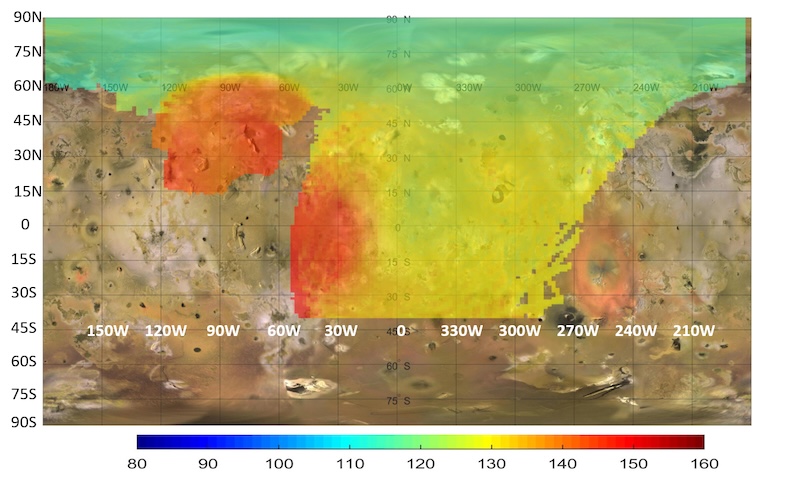
The Microwave Radiometer measured Io’s thermal emission: the process where an object with a temperature above absolute zero gives off energy as thermal radiation, mainly in the form of infrared waves. The measurements ranged from a few inches (several centimeters) to tens of feet (several meters) below the surface. Shannon Brown, lead author of the new paper at NASA’s Jet Propulsion Laboratory in California and Caltech, said:
Everywhere we looked, we found the temperature rising by more than 40 degrees Fahrenheit [22 C] just several feet into the surface; a gradient far steeper than solar heating alone can explain.

Where is the excess heat coming from?
The researchers found that Io has an unexpected extra background flow of heat in its interior. The background heat flow itself is small, 0.1 to 0.3 watts per square foot (1 to 3 watts per square meter). But when measured across the entire moon, the amount is much greater, about 30 times that of Earth on average.
Where is the excess heat coming from? The researchers present two possibilities. The first is that the heat is steadily rising upward through a conductive crust. The other possibility is that the heat is coming from cooling lava flows. These lava flows are about 30 to 35 feet (9 to 11 meters) below a layer of solidified crust.
Overall, Io provides valuable values as to how tidal heating works on different bodies in the solar system and beyond. Bolton explained:
Io provides a unique window into learning how tidal heating works throughout the cosmos, a fundamental process that provides energy and heat to worlds that are far from their parent star. This process can not only create the most volcanic body in the solar system, in the case of Io, but also fuels the subsurface oceans on the moons of giant planets, such as Europa and Ganymede. Up until this point we could only observe the heat escaping at the surface or through eruptions. Now we can characterize how the heat is moving from the interior toward the surface.

A smooth world
Juno also found that Io is quite smooth, overall. It does have mountains and volcanoes, but there are also vast smooth patches that extend 60 miles (100 km) or more. The surface material is also of surprisingly low density. Brown said:
Away from its mountains, the surface is more like the Great Plains of North America, and even though Io is a rocky body, the surface material has a very low density, more like pumice or a fluffy volcanic ash than solid rock.
What would it be like to walk on that surface?
Bottom line: NASA’s Juno spacecraft has measured Jupiter’s moon Io’s subsurface temperature for the first time, providing new clues about the tidally-heated volcanic world.
Source: Io Sub-Surface Temperature Profile Observed by the Juno Microwave Radiometer
Read more: Jupiter’s moon Io has a new volcano! See pics here
Read more: Juno spots most extreme volcanic activity on Io to date
Like what you read?
Subscribe and receive daily news delivered to your inbox.
More from
Paul Scott Anderson


The rings of Chariklo are unexpectedly dynamic and changing

Did Venus have a moon for nearly 2 billion years?
Alien tech on the moon? Scientists propose search for microscopic debris
Peptides in Venus’ clouds could form life-giving shapes