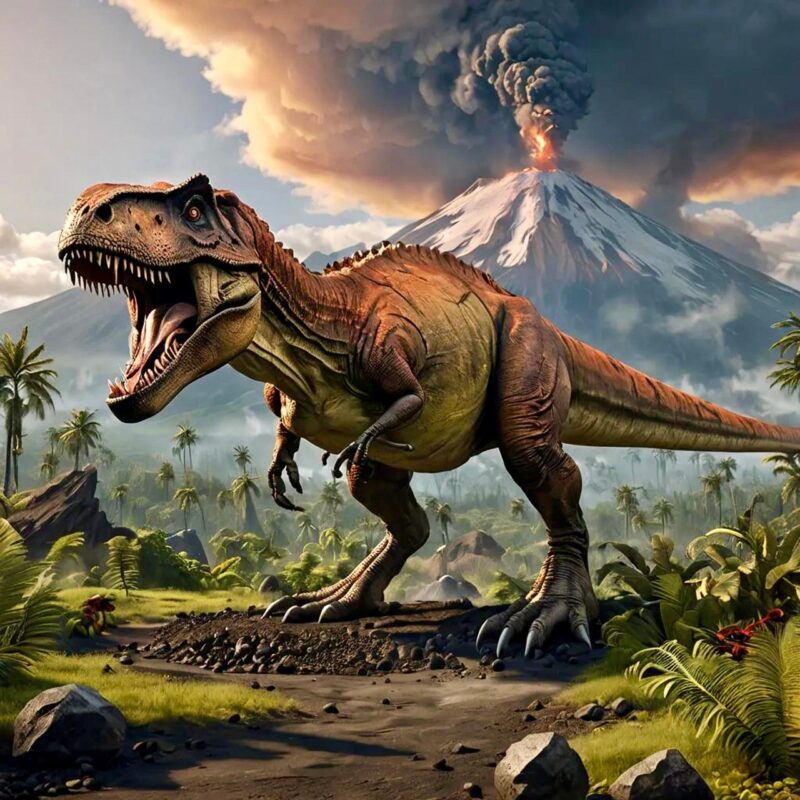
Use it or lose it, T. Rex
Aside from being one of the most fearsome dinosaurs, Tyrannosaurus rex is known for its stubby arms. In fact, T. Rex arms were so short that they couldn’t reach the dino’s mouth! But T. Rex wasn’t the only dinosaur with short arms. And new research might explain why some of the mightiest dinosaur species evolved such puny arms.
On May 20, 2026, researchers from the University of Cambridge said that as dinosaur heads became more robust and important in taking down prey, the need for the arms shrank. And, thus, so did the arms themselves. The researchers called it a “use it or lose it” scenario.
Co-author Elizabeth Steell of Cambridge University said:
People have long been fascinated by why big meat-eating dinosaurs like T. Rex have such tiny arms. We’ve just confirmed what many people have suspected, which is that if you’ve got a big skull and you’re tackling big prey, then you don’t need your arms as much, and arms become a bit redundant.
The researchers published their peer-reviewed study on May 20, 2026, in the journal Proceedings of the Royal Society B.
Dinos with short arms
The researchers found there were five groups of theropods – or two-legged, meat-eating dinosaurs – that had short arms. Those dinos were the tyrannosaurids (which includes the T. rex), abelisaurids, carcharodontosaurids, megalosaurids and ceratosaurids. For these dinosaurs, the researchers found the smaller arms were linked to what they called skull robustness.
The team measured skull robustness by the following criteria: how tightly connected the bones of the head were, the dimensions of the skull (more compact is stronger) and bite force. They found that as the dinosaurs’ prey got larger, their heads needed to get larger. Lead author Charlie Roger Scherer of University College London said:
These adaptations often occurred in areas with gigantic prey. The head took over from the arms as the method of attack. It’s a case of ‘use it or lose it’: the arms are no longer useful and reduce in size over time.
Some of the large prey these dinosaurs devoured included gigantic sauropods, like the Brontosaurus, and other large herbivores such as the Triceratops.
The researchers found the overall body size of these short-armed predators was less important. In fact, some of the predators, such as the Majungasaurus (an abelisaurid), was only 1/5 the size of T. rex.

Arms that had no use?
So the researchers have linked the growth of these predators’ robust heads with their arms getting shorter. Scherer said:
Our study identifies correlations and so cannot establish cause and effect.
At a later stage of evolution for these dinosaurs, the arms might have stopped serving any purpose. They could be vestigial, or a body part that no longer has a function. Sarah Sheffield of Binghamton University in New York wrote about how T. rex‘s short arms could be vestigial for The Conversation and compared them to a whale’s hindlimbs:
Whales evolved from mammals that lived on land that had large legs to move around. The bones are still present in today’s whales, but have gotten much smaller over millions of years and have no function.
What we are left with is a giant, meat-eating dinosaur with a fierce, robust head and its famed little dangling arms.
Bottom line: The Tyrannosaurus rex and similar predators might have evolved to have small arms because their large heads became more important in taking down prey.
Source: Drivers and mechanisms of convergent forelimb reduction in non-avian theropod dinosaurs
Like what you read?
Subscribe and receive daily news delivered to your inbox.
More from
Kelly Kizer Whitt


Does this Mars image show an alien in a hallway?

Atlantic hurricane season sets a record: No hurricanes yet!
Did the sun swallow a planet early in its history?
International Cloud Appreciation Day is September 11