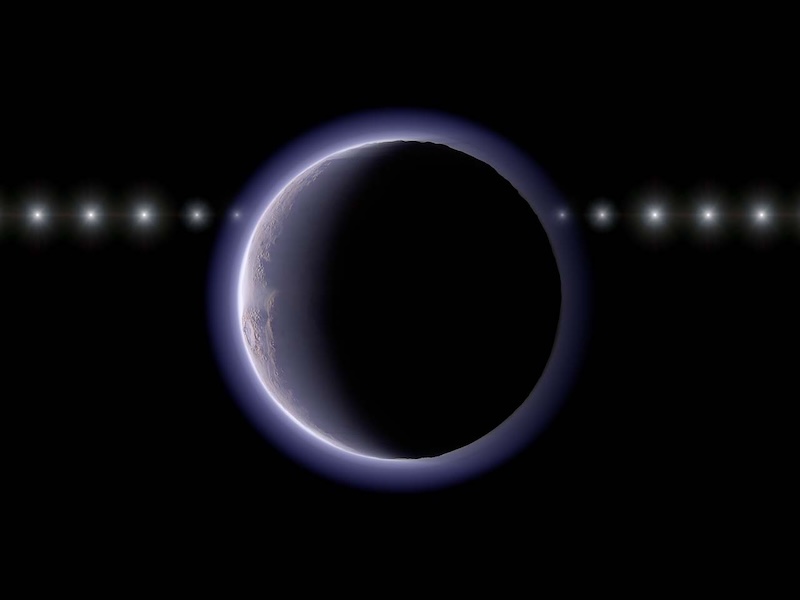
- Most objects in our solar system are too small to sustain atmospheres, scientists have long thought.
- But now, astronomers have spotted a tiny world with an atmosphere beyond the orbit of Neptune. It should be too small for an atmosphere to be possible.
- Researchers in Japan discovered this by watching the object, 2002 XV93, pass in front of a distant star.
This tiny world has an atmosphere … but shouldn’t
Every planet in our solar system apart from Mercury has an atmosphere. The dwarf planet Pluto also has one, as does Saturn’s moon Titan. But most of the objects in our solar system don’t. That’s because smaller bodies don’t have enough mass to hold onto any kind of atmosphere … Or so we thought.
Astronomers in Japan have just discovered that the tiny world 2002 XV93, orbiting in the icy reaches beyond Neptune, does have a thin atmosphere. That’s despite the fact that this space rock is just some 310 miles (500 km) in diameter. That’s about 7 times smaller than our moon.
The researchers said on May 5, 2026, that they detected the atmosphere when the tiny world passed in front of a star. Using multiple telescopes, they saw that the light from the star gradually faded instead of just suddenly winking. That’s evidence for a thin atmosphere around 2002 XV93.
The researchers published their peer-reviewed findings in Nature Astronomy on May 4, 2026. A preprint version, with no paywall, is also available on arXiv.
Observations of a distant object beyond Pluto suggest that it is surrounded by a thin atmosphere, potentially fuelled by ice volcanoes or produced by the impact of a comet-like body, according to research in Nature Astronomy. go.nature.com/4n5Kgup ??
— Nature Portfolio (@natureportfolio.nature.com) 2026-05-05T13:15:00.888Z
Spotting an atmosphere by starlight
This tiny world is what’s known as a trans-Neptunian object (TNO). That’s an object that orbits the sun beyond the orbit of Neptune. Most of these bodies are much too small, with too little gravity, to hold on to any kind of atmosphere. Pluto, also classified as a trans-Neptunian object, is an exception.
When researchers noticed that 2002 XV93 was going to transit – pass in front of – a distant star, they decided to make the most of it. They used the transit as a chance to see if, unexpectedly, 2002 XV93 happened to have any trace of an atmosphere. 2002 XV93 passed in front of the star on January 10, 2024.
And, surprise: It did! The light from the star gradually dimmed as 2002 XV93 passed in front of it. If it didn’t have an atmosphere, the light would have blinked out much more suddenly. So this indicated that 2002 XV93 does, in fact, have a thin atmosphere.
Lead author Ko Arimatsu at the National Astronomical Observatory of Japan mentioned in Live Science:
The observation data showed a smooth change of the star’s brightness near the edge of the shadow, lasting about 1.5 seconds. This kind of smooth brightness change is naturally explained if the starlight was bent by a very thin atmosphere around the object.
But an object like 2002 XV93 should be too small to have an atmosphere. So what’s going on here? Scientists don’t know for sure yet.
This video depicts how the light from a background star changes when an object with an atmosphere passes in front of it. This happened with the small outer solar system object 2002 XV93, showing that it has a thin atmosphere. Video via NAOJ.
Atmosphere might last less than 1,000 years
Unless the atmosphere can be replenished somehow, then the researchers estimate it will last for less than 1,000 years. And just the fact that it exists now shows that it must have either been replenished or created fairly recently. But how?
Notably, the observations by the James Webb Space Telescope showed no evidence of icy frozen gases on the world’s surface. Such ices, common in the outer solar system, could sublimate – turn directly from ice to gas – and form a thin atmosphere. So how could an atmosphere exist otherwise?
The researchers have two main hypotheses. One is that frozen or liquid gases somehow came to the surface from deep below. Or perhaps, a comet impacted 2002 XV93. That would release cometary gases that could form a temporary atmosphere.
Arimatsu said:
That is why future monitoring is so important. If the atmosphere fades over the next several years, that would support an impact origin. If it persists, or varies seasonally, that would point more toward ongoing internal gas supply.
More small worlds with atmospheres?
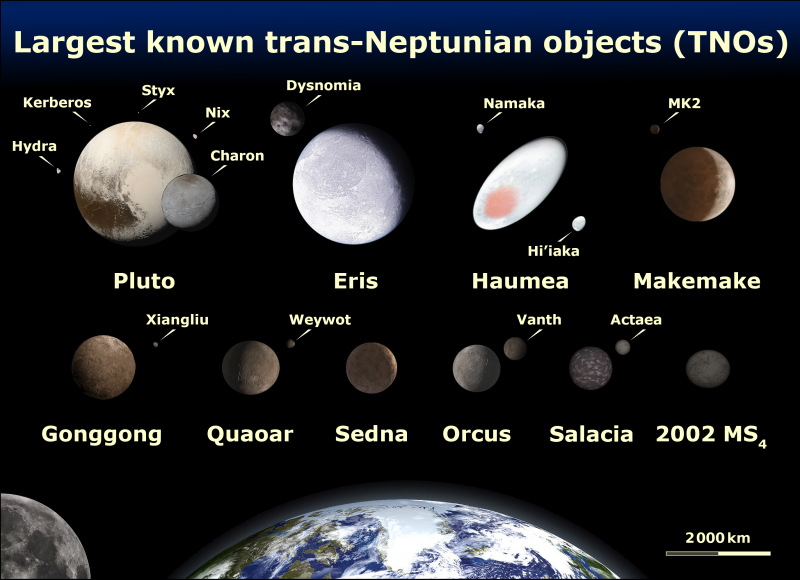
Makemake is another small trans-Neptunian object where astronomers have detected gases, possibly forming a very thin atmosphere. In 2025, astronomers using the Webb telescope detected hints of methane. And as with 2002 XV93, the origin of this gas is still unclear.
Now, this new discovery suggests that perhaps more of these objects have atmospheres than first thought.
The paper says:
Our findings suggest that a fraction of distant icy minor planets can exhibit atmospheres, potentially sustained by ongoing cryovolcanic activity or produced by a recent impact of a small icy object.
Bottom line: In a surprise discovery, researchers in Japan found that a tiny outer solar system object – 2002 XV93 – has a thin atmosphere. But it shouldn’t. How did this atmosphere form?
Source: Detection of an atmosphere on a trans-Neptunian object beyond Pluto
Source (preprint): The first detection of an atmosphere on a trans-Neptunian object beyond Pluto
Read more: 11,000 new asteroids! Astronomers call it ‘tip of iceberg’
Read more: New evidence for Planet 9 at the fringes of our solar system
Like what you read?
Subscribe and receive daily news delivered to your inbox.
More from
Paul Scott Anderson


Is there enough water on the moon for future cities?

Baby exoplanet: Astronomers find the youngest world yet
6th batch of Pentagon UAP files: Air Force talk and more
The rings of Chariklo are unexpectedly dynamic and changing