



Total solar eclipse August 12, 2026. EarthSky livestream
On Wednesday, August 12, 2026, millions of people in Spain, Iceland, Greenland and beyond saw the moon entirely obscure the sun in a spectacular total solar eclipse. EarthSky broadcast this eclipse livestream on Wednesday, via the generosity of our friends at TimeandDate.com, which had streams coming in from multiple places in the world. EarthSky’s Deborah Byrd and sun scientist Dr. C. Alex Young (co-author of EarthSky’s daily sun news update) hosted. Watch in the player above or on YouTube.
August 12, 2026, total solar eclipse
On Wednesday, August 12, 2026, millions of people in Spain, Iceland, Greenland and beyond will see the moon entirely obscure the sun in a spectacular total solar eclipse.
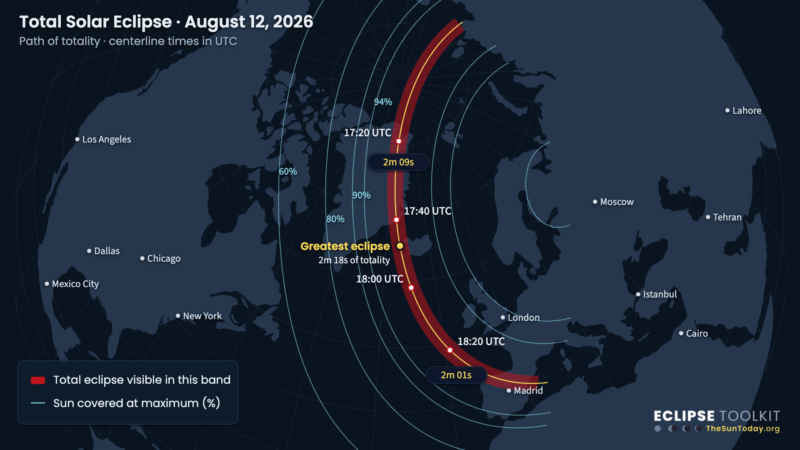
At its longest, near the centerline over the North Atlantic between Greenland and Iceland, the total part of the eclipse will last 2 minutes and 18 seconds. This is a relatively short eclipse! Compare the time of totality to that of the great North American eclipse of April 8, 2024 (4 minutes and 28 seconds). Or compare it to the upcoming total solar eclipse of August 2, 2027, in North Africa, one of the longest of the 21st century (6 minutes and 23 seconds).
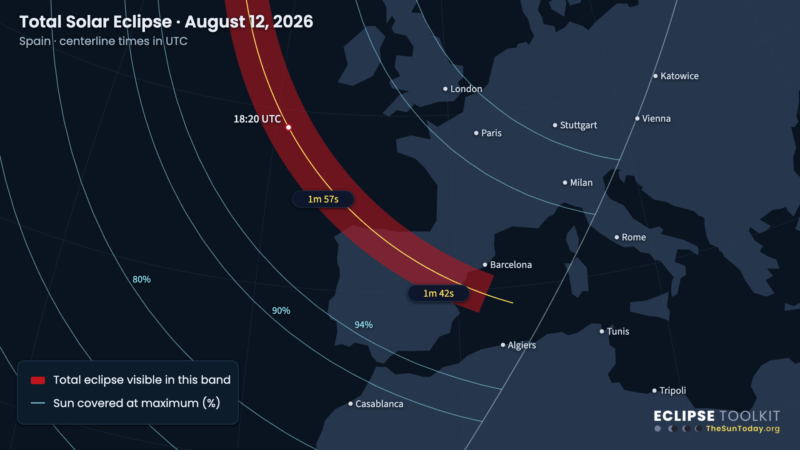
A popular eclipse destination in August 2026 will be Spain, where the eclipse will happen close to sunset. At most, observers in Spain will see 1 minute and 50 seconds of totality. And the sun will be only a few degrees above the western horizon during totality, creating the possibility of a spectacular darkened landscape below the eclipsed sun. And the last total solar eclipse visible from mainland Spain happened more than a century ago on August 30, 1905.
Perseid meteor shower on eclipse day
And if you’re anywhere along the path of totality, there’s a chance you’ll see a Perseid meteor shoot by during totality! That’s because the Perseid meteor shower is peaking on eclipse day. For all of us, because the moon is new that day, it’s going to be a great year for the Perseids.
Who will see the total eclipse?
Michael Zeiler at EclipseAtlas.com is an amazing resource for total solar eclipses. The maps here are just a selection of his extensive and informative collection.
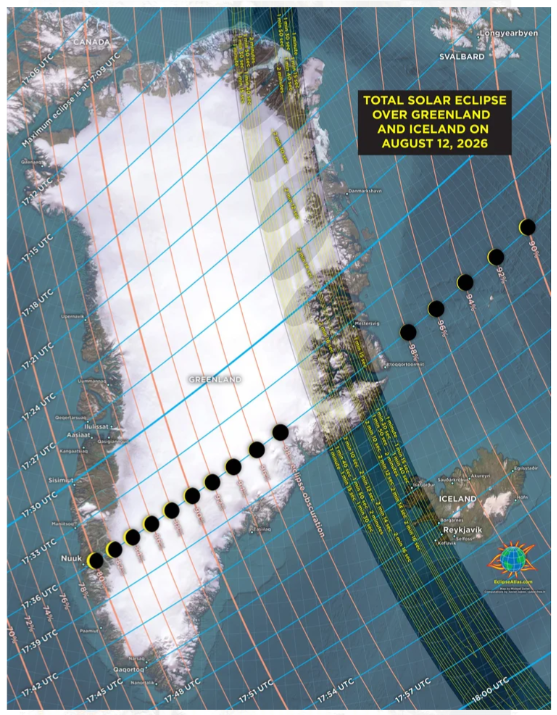
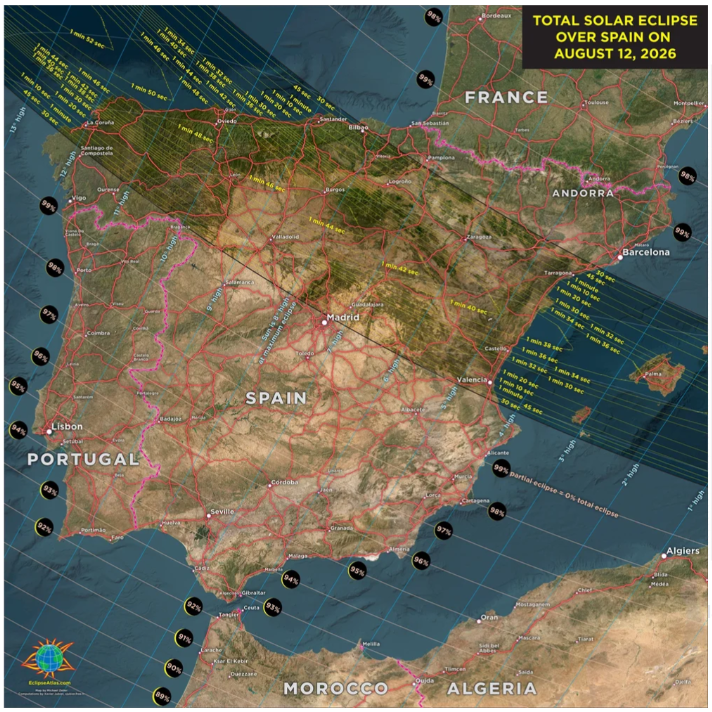
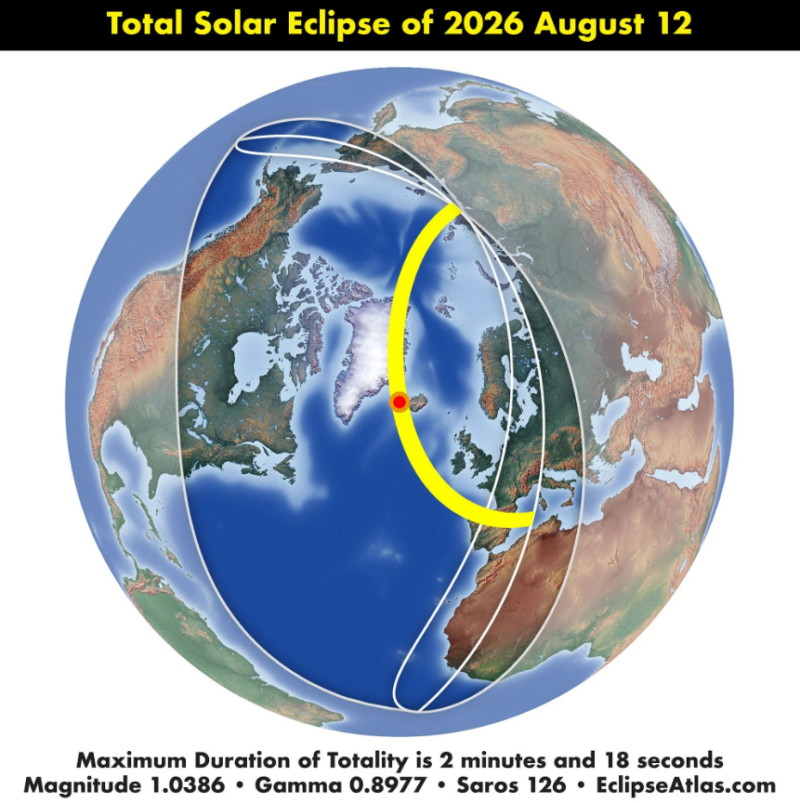
Michael Zeiler describes himself as an “eclipse cartographer.” You won’t believe the maps on his beautiful new website EclipseAtlas.com. Join EarthSky’s Deborah Byrd and Michael Zeiler for this preview of the upcoming total solar eclipse on August 12, 2026. Watch in the player above or on YouTube.
Who will see the partial eclipse?
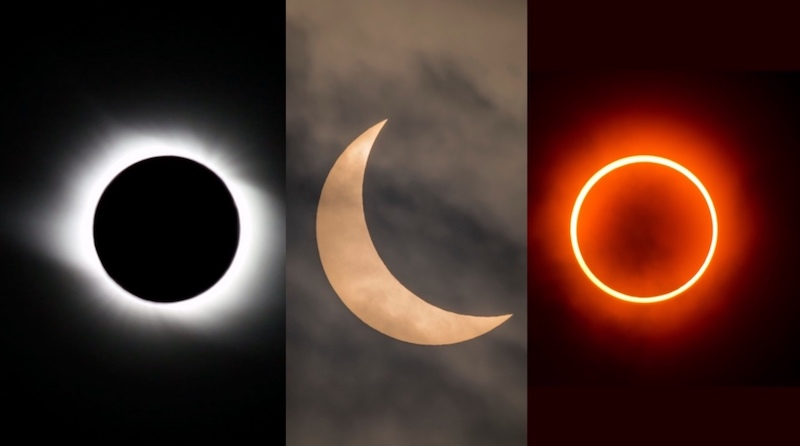
Parts of western Europe will see a deep partial solar eclipse. Approximate maximum obscuration (fraction of the sun’s diameter covered):
Dublin: ~20–30%
Rome: ~20–30%
London: ~30–40%
Brussels/Amsterdam: ~40–50%
Paris: ~45–55%
Lisbon: ~70–80%
Madrid: 90%+ (outside but close to the path of totality)
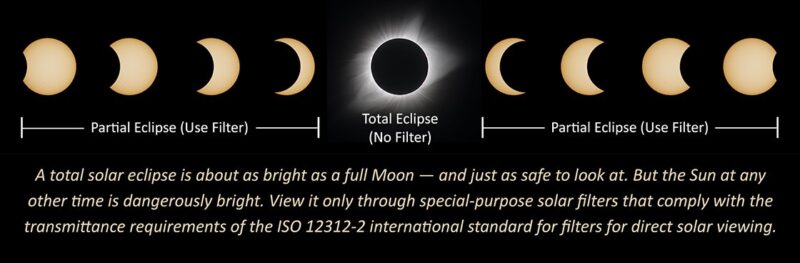
The farther south and west you are in Europe, the deeper the partial eclipse generally becomes. For example, in Spain, areas just outside the path of totality will see the sun reduced to a very thin crescent. Remember: never look directly at any partial eclipse, no matter how thin the sun appears. Here’s how to safely watch an eclipse.
Greenland: 80–100% (totality in parts)
Northern Labrador: Roughly 40–70%, depending on location
Newfoundland: Generally under 30%, with northeastern parts seeing the deepest partial eclipse
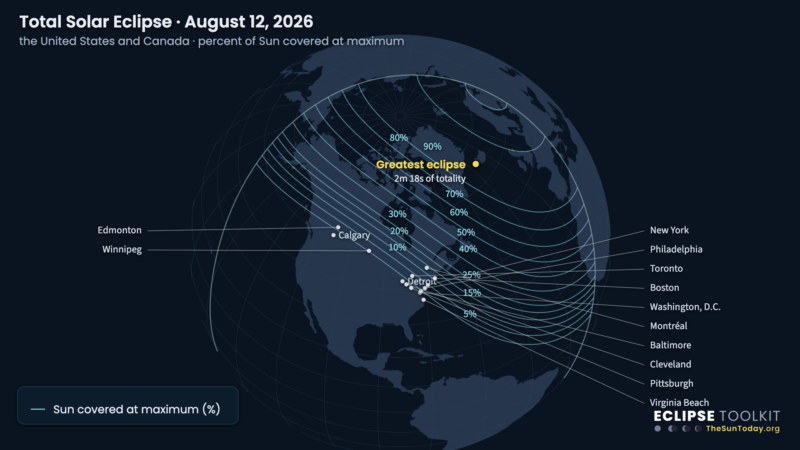
Eastern Canada: Kuujjuaq (far north): Just over 50% obscuration. Québec City: Around 24% obscuration.
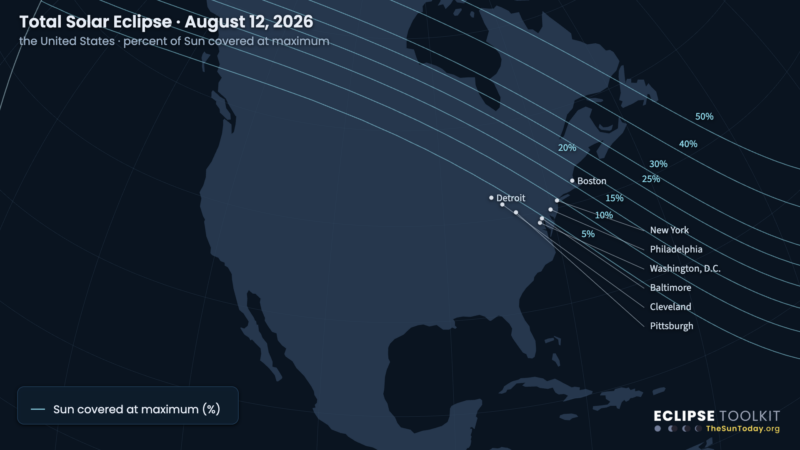
Continental U.S. (lower 48): Best views from Maine (~19% in Portland). Boston 16%, New Haven, Connecticut (12%), New York City (9.5%), Washington, D.C. (3.7%).
Visit timeanddate.com for eclipse times in your location
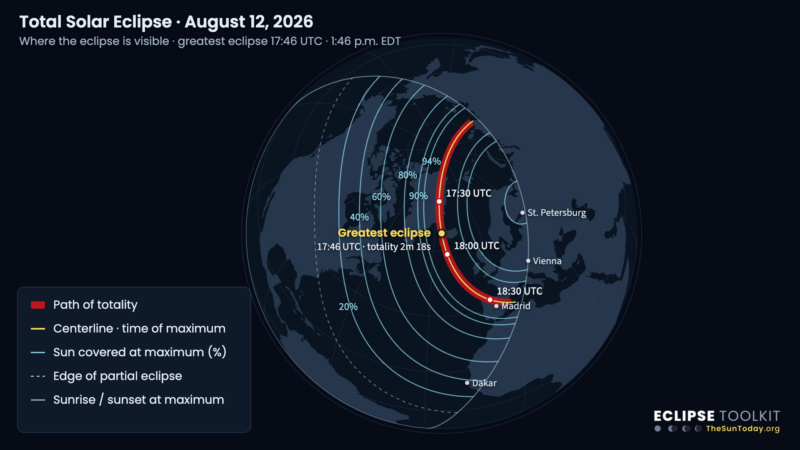
Percentages of partial eclipse viewed from U.S. states
The eclipse barely reaches North America. The total solar eclipse won’t be visible from here at all. But northeastern North America will see a slight partial eclipse. And the farther north you go on the North American continent, the deeper the partial eclipse will be.
Alaska (Fairbanks 37% coverage, Anchorage up to 28% coverage)
Maine (best view in the contiguous U.S., with up to 29% coverage in the north)
Vermont (around 17% coverage)
New Hampshire (around 17% coverage)
Massachusetts (around 16% coverage)
Rhode Island (around 14% coverage)
Connecticut (around 12% coverage)
New York (around 9% to 13% coverage depending on how far north/east you are)
New Jersey (around 9% coverage)
Pennsylvania (around 7% coverage)
Delaware (around 6% coverage)
Maryland (around 4% coverage)
Virginia (around 2% coverage)
Michigan (around 2% to 3% coverage)
Ohio (under 3% coverage)
Meanwhile, several states on the outer fringes of the eclipse’s path, such as North Carolina, Illinois, Indiana and Wisconsin, will catch only a tiny sliver of the sun covered, experiencing a bare minimum of 1% or less coverage.
Times of the August 12, 2026, total solar eclipse
These times reflect the 95-minute journey of the moon’s shadow across Earth on August 12. From any one location, as the shadow sweeps past, totality lasts less than 2 minutes. The maximum totality from any one location happens in the Greenland/ North Atlantic portion of the eclipse path (2 minutes 18.2 seconds).
Partial eclipse begins: 15:34 UTC
Total eclipse begins: 16:58 UTC
Greatest eclipse: 17:46 UTC
Total eclipse ends: 18:34 UTC
Partial eclipse ends: 19:58 UTC
The instant of greatest eclipse – when the axis of the moon’s shadow cone passes closest to Earth’s center – takes place at 17:46 UTC.
Animations and seeing the total solar eclipse from your location
Watch total solar eclipse animations and see maps at eclipseatlas.com
Watch an animation of the path of the annular solar eclipse at timeanddate.com
Animation of the path of the annular eclipse at in-the-sky.org
Another animation of the eclipse at eclipsewise.com
Information for your location at timeanddate.com
Path of totality
The path of totality begins at 17:00 UTC along the Arctic coastline. Then, it races north and passes near the North Pole at 17:06 UTC where it has 1 minute and 54 seconds of totality.
Next, it races to Greenland hitting the coastline at 17:15 UTC with 2 minutes 6 seconds of totality. Greatest eclipse (2 minutes 18 seconds) occurs at 17:45:57 UTC near the Denmark Strait. It continues on to Ireland, Portugal and Spain. Areas in northern Spain are just inside the path of totality and will see 20 seconds of totality. Then, it continues on over Spain to the Mediterranean coast where it finally reaches its last landfall on the Balearic Islands. The eclipse ends at 18:34:05 UTC.
The eclipse path will last over 92 minutes and cover 5,157 miles (8,300 kilometers) – or just 0.47% – of the Earth.
And remember to convert UTC to your time. Note the different between UTC and UT1. You can visit timeanddate.com to get an exact timing of the eclipse from your location. But the number one rule for solar eclipse observing is to make sure you protect your eyes by using an appropriate filter.
Moon, constellation, Saros
Greatest eclipse takes place a little over one day after the moon reaches perigee, its closest point to Earth for the month. During the August 12, 2026, eclipse, the sun is located in the direction of the constellation Leo.
This eclipse has a magnitude of 1.0386.
The Saros catalog describes the periodicity of eclipses. The eclipse belongs to Saros 126. It is number 48 of 72 eclipses in the series. All eclipses in this series occur at the moon’s descending node. The moon moves northward with respect to the node with each succeeding eclipse in the series.
Next eclipse and eclipse seasons
This total solar eclipse is followed in two weeks by a partial lunar eclipse on August 27-28.
These eclipses all take place during a single eclipse season.
An eclipse season is an approximately 35-day period during which it’s inevitable for at least two (and possibly three) eclipses to take place. The first eclipse season of 2026 had two eclipses: an annular solar eclipse on February 17 and a total lunar eclipse on March 2-3.
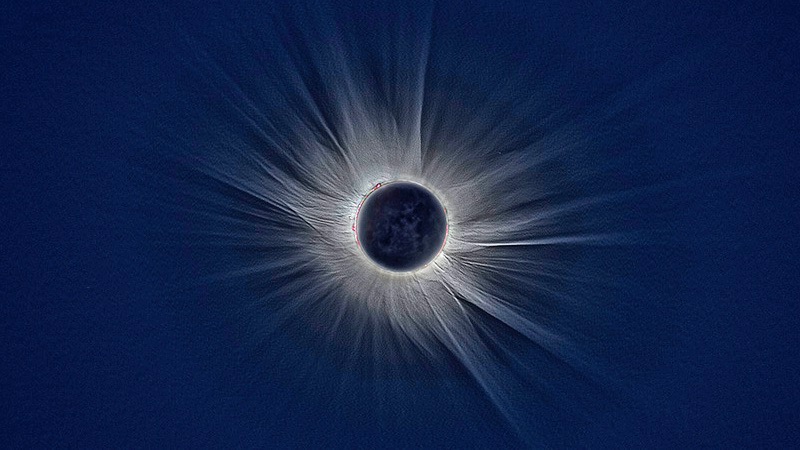
Bottom line: The Arctic, Greenland, Iceland and Spain will have a total solar eclipse on August 12, 2026. Parts of Europe and North America will see a partial.
Read more: How to watch a solar eclipse safely
Read more: Solar Eclipse: Top 5 tips for photographing an eclipse
Like what you read?
Subscribe and receive daily news delivered to your inbox.
More from
Marcy Curran


Visible planets and night sky guide late September and October

Meteor shower guide 2026: Up next … the Draconids
Deep partial lunar eclipse overnight
Teapot of Sagittarius points to the Milky Way’s center



