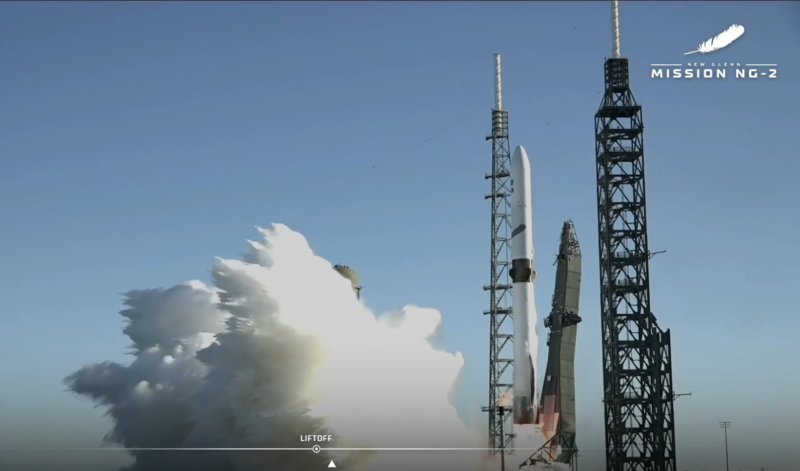
ESCAPADE mission launched to Mars on November 13
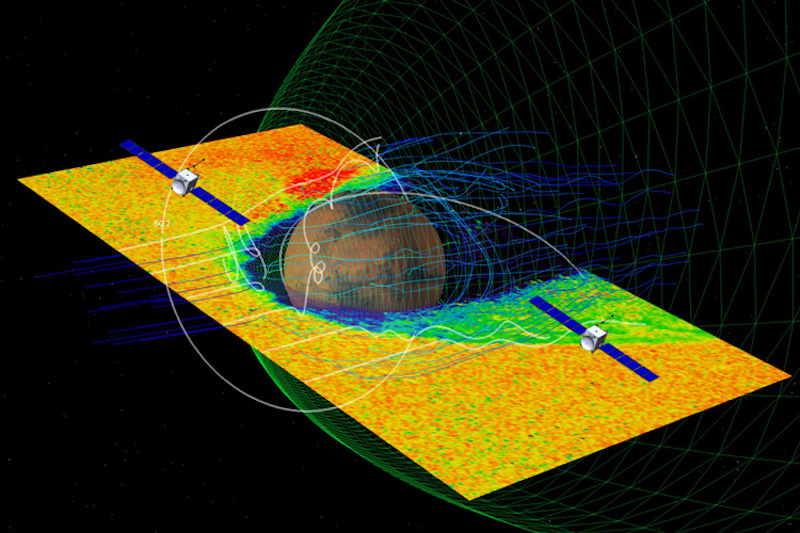
Blue Origin’s New Glenn rocket successfully launched the ESCAPADE mission toward Mars on November 13, 2025. This was after a weather delay on November 9 and a space weather delay on November 12. The mission left from Launch Complex 36 at Cape Canaveral Space Force Station in Florida. ESCAPADE stands for Escape and Plasma Acceleration and Dynamics Explorers. The mission will use twin spacecraft, nicknamed Blue and Gold, to study Mars’ magnetic environment.
This was just the 2nd launch for the New Glenn heavy-lift launch vehicle after its initial launch in January 2025. The roar from the team was deafening on the Blue Origin feed as the reusable New Glenn booster returned and safely landed on a platform back on Earth.

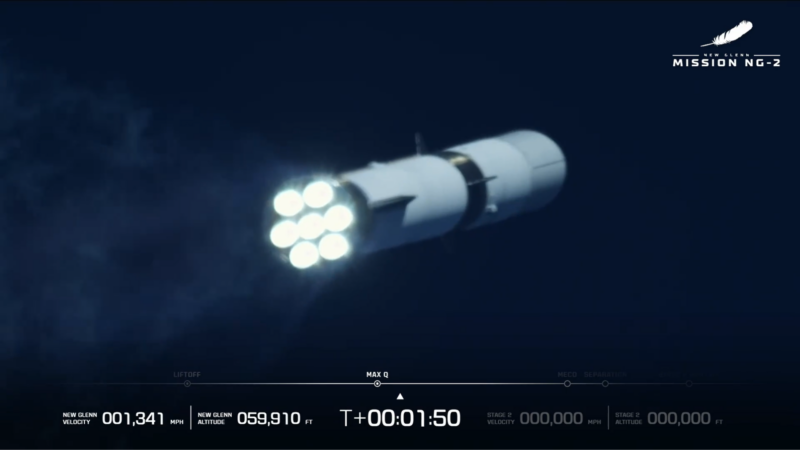
Rewatch the launch
Rewatch the launch in the player below or on YouTube.
Blue Origin launched the 2nd flight of its huge New Glenn rocket on November 13, with the ESCAPADE spacecraft aboard. Watch in the player above or on YouTube.
Mars’ electrically charged environment
The ESCAPADE mission aims to track the internal workings of Mars’ magnetic environment. Mars doesn’t have a global magnetic field in the same sense Earth does. It doesn’t have a single, planet-wide magnetic field generated by a molten, convecting iron core (a dynamo). Earth’s global magnetic field surrounds the whole planet and creates a strong magnetosphere that protects us from the solar wind. Mars doesn’t have this in quite the same way.
But Mars does have many localized magnetic fields frozen into patches of its crust. They are remnant magnetizations, or leftovers from an ancient global magnetic field that Mars apparently had billions of years ago. Mars orbits one step farther from the sun than Earth. And it’s a smaller and colder planet than Earth. When Mars’ core cooled and its dynamo shut down, the global field collapsed. But iron-bearing rocks that had solidified while the field still existed kept their magnetization. Those patches still create small, regional magnetic fields – some surprisingly strong – especially in Mars’ southern highlands.
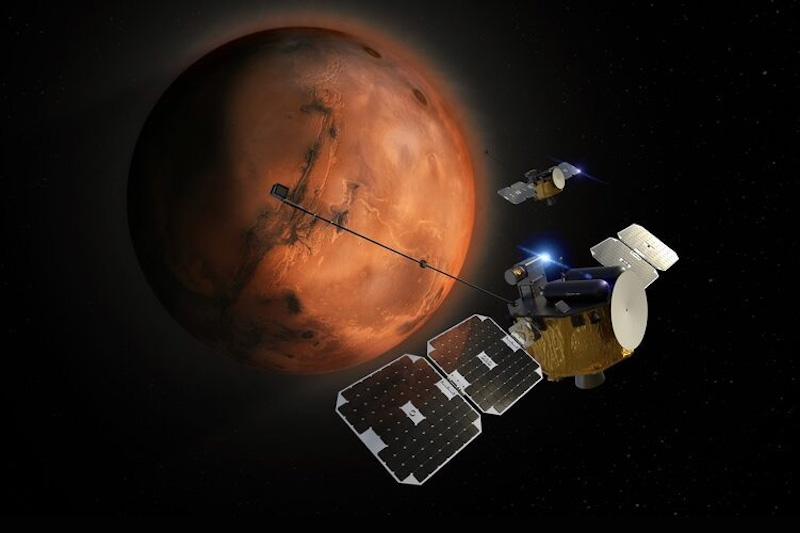

ESCAPADE’s goal
ESCAPADE’s goal is to study how those crustal magnetic fields interact with the solar wind. ESCAPADE’s twin spacecraft will orbit Mars to measure how solar particles and the Martian atmosphere behave around those regions of remnant magnetism. Scientists expect ESCAPADE will help them understand more of the details of how Mars lost most of its atmosphere over time, and how Mars lost its magnetosphere.
So Mars’ magnetic field is unlike those on other planets. It’s more of a hybrid. On the one hand, it’s a solar-induced magnetosphere, like that on Venus, created in part by the interaction of the solar wind with the Martian atmosphere. On the other hand, it also has localized areas of intrinsic magnetic fields from the planet’s crust. And there are larger-scale global influences as well.
Scientists want to know how energy and matter from the solar wind make their way in and out of Mars’ magnetic environment. NASA described the mission goals:
ESCAPADE will analyze how Mars’ magnetic field guides particle flows around the planet, how energy and momentum are transported from the solar wind through the magnetic environment and what processes control the flow of energy and matter into and out of the Martian atmosphere.
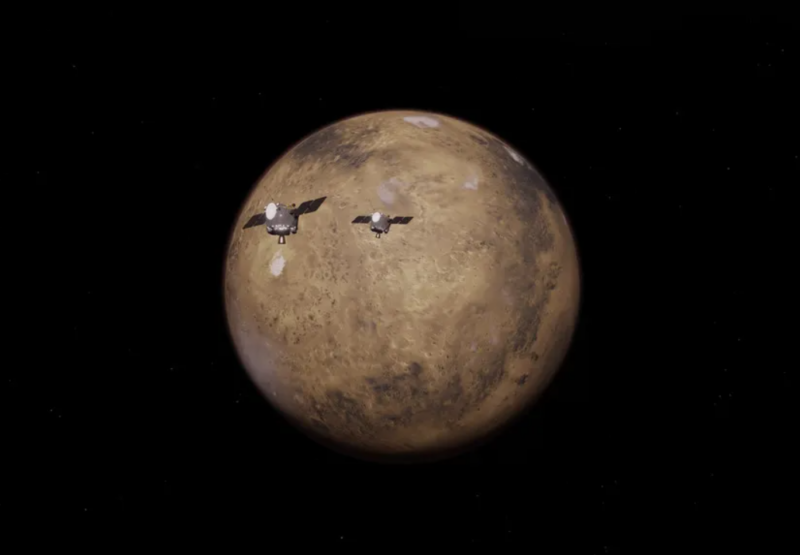
Details of the mission
The ESCAPADE mission is a relatively inexpensive mission with a design led by UC Berkeley. The twin spacecraft have a total cost of under $80 million. That’s only about 10% the cost of sending a typical spacecraft to Mars.
The Blue and Gold spacecraft are nicknamed for Berkeley’s school colors. The probes will orbit the red planet, taking simultaneous observations from different locations. Scientists hope to see the real-time response of Mars’ magnetic environment as it’s buffeted by the solar wind.
As with most questions astronomers aim to solve, this one also boils down to the big picture of life in our universe. Was Mars once habitable for some form of life? And could it be habitable in the future for a human population?
Bottom line: On November 13, 2025, a Blue Origin New Glenn rocket successfully launched the ESCAPADE mission and its twin probes – Blue and Gold – to study Mars’ magnetic environment.
Read more: Yeast on Mars could survive, unique new research shows
Read more: What etched these strange gullies on Mars into the sand?
Like what you read?
Subscribe and receive daily news delivered to your inbox.
More from
Kelly Kizer Whitt


Visible planets and night sky guide for October

Another satellite breakup raises concerns about space junk
Smile mission releases its stunning 1st aurora footage!
Hera mission hits the brakes to arrive at asteroid