



The year’s earliest sunrises don’t happen on the summer solstice. For much of the Northern Hemisphere, they’re happening now. In the Southern Hemisphere, it’s the earliest sunsets that come before the winter solstice in June. The yearly cycle of sunrise and sunset times is easy to miss. But once you start noticing this cycle, it reveals the deeper rhythm of Earth’s journey around the sun … and your place in it.
When to look: The exact dates of the earliest sunrises vary with latitude. For example, for the Northern Hemisphere, the earliest sunrises can come as early as late May. For the southern U.S., the earliest sunrises begin in early June and stretch for weeks. At more northerly latitudes, they happen closer to the summer solstice.
Southern Hemisphere? Your earliest sunsets happen before your summer solstice, too, in December. And right now, before your winter solstice, you’re having your earliest sunsets.
When is June solstice? The June solstice – summer solstice for the Northern Hemisphere, winter solstice for the Southern Hemisphere – will fall at 8:25 UTC (3:25 a.m. CDT) on June 21. Read: All you need to know about the June solstice.
For the Northern Hemisphere: Have you noticed how early your sunrises are? The dawn light is beautiful. Check a sunrise/sunset calendar for June. It’s likely your earliest sunrises are happening now, have just happened, or will happen in the coming week or so.
For the Southern Hemisphere: If you relish the daylight, as many do, you’ll be glad to know your sunsets will soon be shifting later! They’ll start shifting before your winter solstice – and shortest day – at the June solstice.
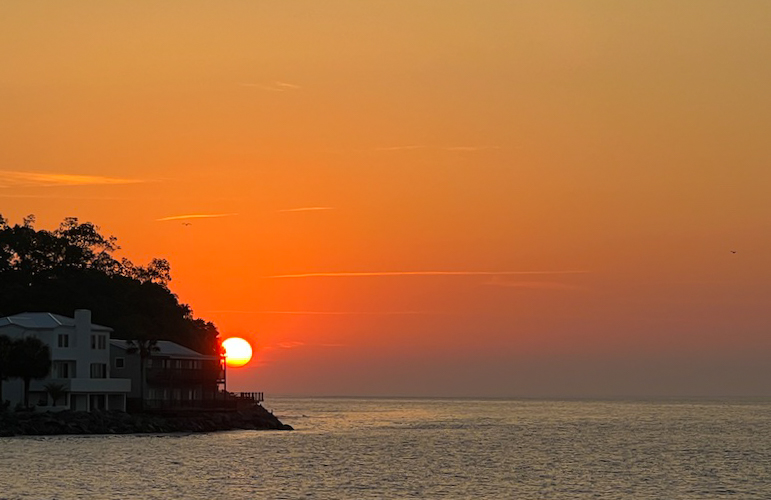
Earliest sunrises vary with latitude
The exact dates of your earliest sunrises (and earliest sunsets) vary with latitude.
- At the latitude of Mexico City (about 20 degrees north latitude) the earliest sunrises are in early June.
- At the latitude of New Orleans, Cairo in Egypt and Chengdu in China (about 30 degrees north), the earliest sunrises shift later, to around June 10.
- At the latitude of Philadelphia, Madrid in Spain or northern Japan (about 40 degrees north) the earliest sunrises of the year happen on and near June 14.
- And the farther north you go, the closer your earliest sunrises come to the June solstice. By the time you get up to Seattle or Vancouver, they happen only a few days before the solstice.
If you keep going north, you eventually reach a geographic boundary where the concept of “earliest sunrise before the summer solstice” completely breaks down. That is, you reach the Arctic Circle (66.5 degrees north latitude), above which the sun doesn’t rise or set in the weeks or months around the solstice. The concepts of daily “sunrise” and “sunset” disappear entirely, and you get one prolonged period of continuous daylight.

Why aren’t the earliest sunrises on the solstice?
To understand why the earliest sunrises aren’t on the day of the solstice, you have to think about clocks and the spinning Earth.
Earth’s spin gives us the length of the day. One spin of the Earth = one day. And we humans have made clocks to measure that day length.
But clocks click along regularly … and Earth’s spin isn’t as regular. If you were to measure the time it takes for the Earth to rotate once relative to the sun – spanning from one local solar noon (when the sun reaches its highest point in your sky) to the next – you’d find the time from one solar noon to another is rarely exactly 24 hours.
Why isn’t it? Two main reasons: the tilt of Earth’s axis and the shape of Earth’s orbit. It’s the continual overlapping of these two cycles that gives us the earliest sunrises before the summer solstice.
Look at it this way. In June, the day (as measured by successive returns of the midday sun) is nearly 1/4 minute longer than 24 hours. So the midday sun (solar noon) comes later by the clock on the June solstice than it does one week before. And that means the sunrise and sunset times also come later by the clock.
Want a deeper explanation? Look up the Equation of Time.
The table below might help you get a sense of it.
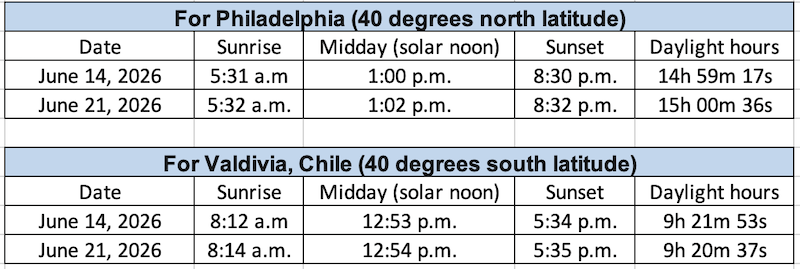
Why before the summer solstice, not after?
The primary reason for the earliest sunrise preceding the summer solstice is the inclination of the Earth’s rotational axis. For example, the earliest sunrise would take place before the solstice even if the Earth went around the sun in a circular orbit.
But the Earth’s elliptical orbit does make the phenomenon more extreme. At the June solstice, Earth in its orbit is rather close to our early July aphelion, our farthest point from the sun. We’re moving slowest in orbit. And this lessens the effect.
On the other hand, at the December solstice, Earth is rather close to our early January perihelion, our closest point to the sun. At that time, we’re moving fastest in orbit, and that accentuates the effect.
So there are little effects related to Earth’s orbit. But the sequence is always the same. Earliest sunrise, summer solstice, latest sunset in summer. Earliest sunset, winter solstice, latest sunrise in winter.
That’s true for you whether you’re in Earth’s Northern or Southern Hemisphere.
And it’s true whether your winter or summer happens when Earth is closest to the sun, or farthest from the sun.
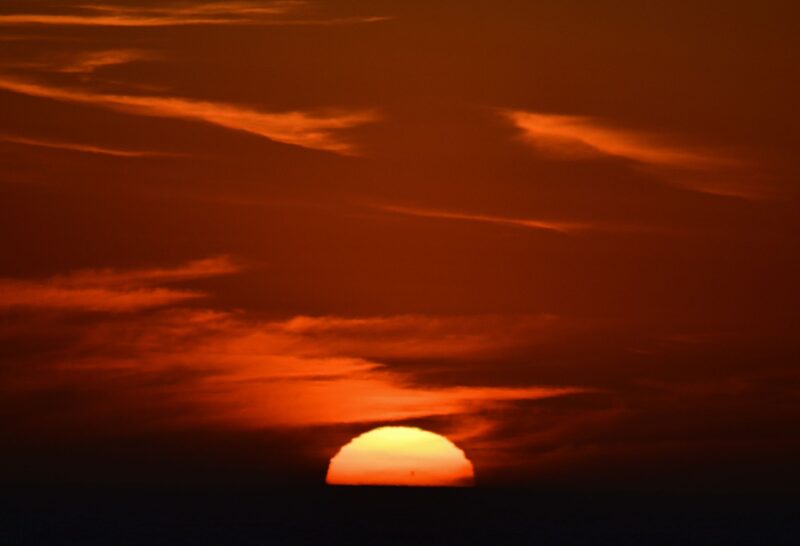

Bottom line: Are you an early riser? If so – and you live in the Northern Hemisphere – you might know your earliest sunrises of the year are happening now. Southern Hemisphere? Your earliest sunsets are around now.
Like what you read?
Subscribe and receive daily news delivered to your inbox.
More from
Editors of EarthSky


Noctilucent clouds are back: Look for them now!

Shoemaker-Levy 9 impact on Jupiter 32 years ago
Scorpius the Scorpion and its legendary stinger


