



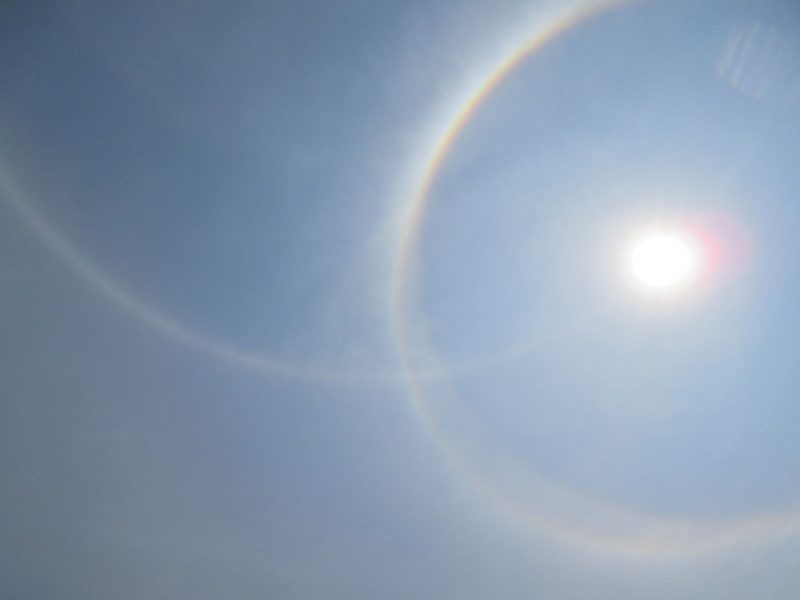
Parhelic circle and 2 halos
Gord Hurlburt captured this remarkable image on August 1, 2021, while hiking down from Burstall – Piggy Plus Col in Kananaskis, Alberta, Canada. You can see the sun on the far right of the image. Around it are two halos. The inner halo is known as a 22-degree halo. The outer is known as a circumscribed halo. Angling out from those two sun-circling halos is another arc. It’s called a parhelic circle. All of these phenomena – the 22-degree halo, the circumscribed halo, the parhelic arc – are caused by ice crystals in the air.
Check out this image from Les Cowley’s Atmospheric Optics website. It shows the same configuration of halos and circles over Tibet that you saw, Gord, over Alberta, Canada.
Plus Les Cowley has a illustration (below) that shows the parhelic circle and explains more.
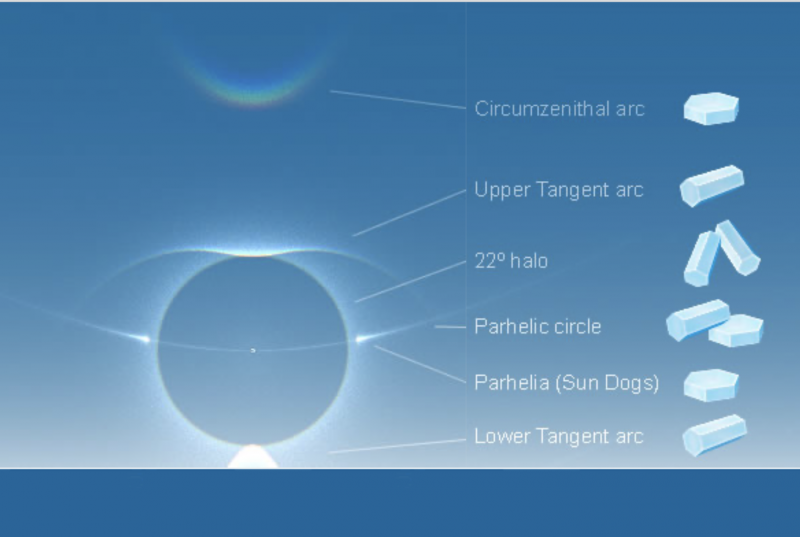
By the way, Gord, in your posting, you mentioned parhelia, aka sundogs. We’re not seeing the sundogs in this image, but, sure enough, the 2nd arc looks as if it’s cutting across the 22-degree halo (and circumscribed halo) just at the spot where a sundog might be.
Bottom line: A photo from an EarthSky community member showing portions of a 22-degree halo, circumscribed halo and parhelic circle.
Like what you read?
Subscribe and receive daily news delivered to your inbox.
More from
Deborah Byrd


Visible planets and night sky guide for October

Cassiopeia the Queen is overhead on autumn evenings
What star in the northeast flashes colorfully? It’s Capella!
Proxima Centauri is the closest star to our sun



