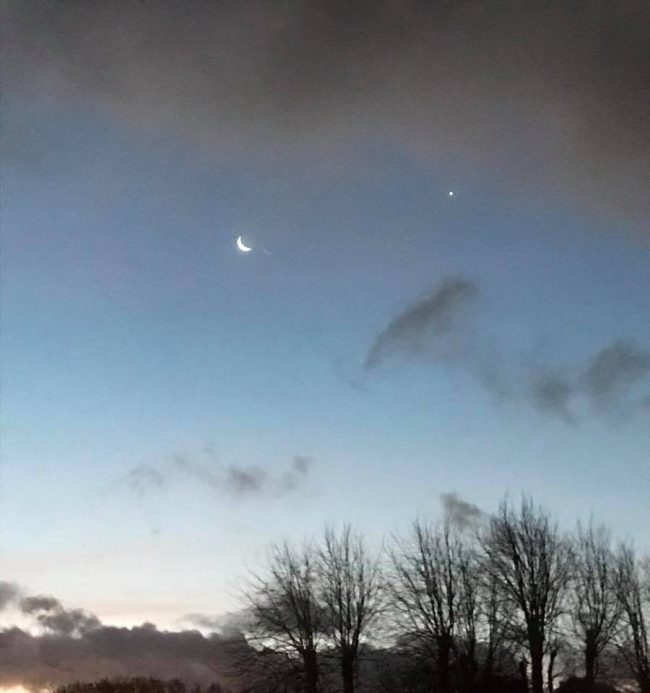
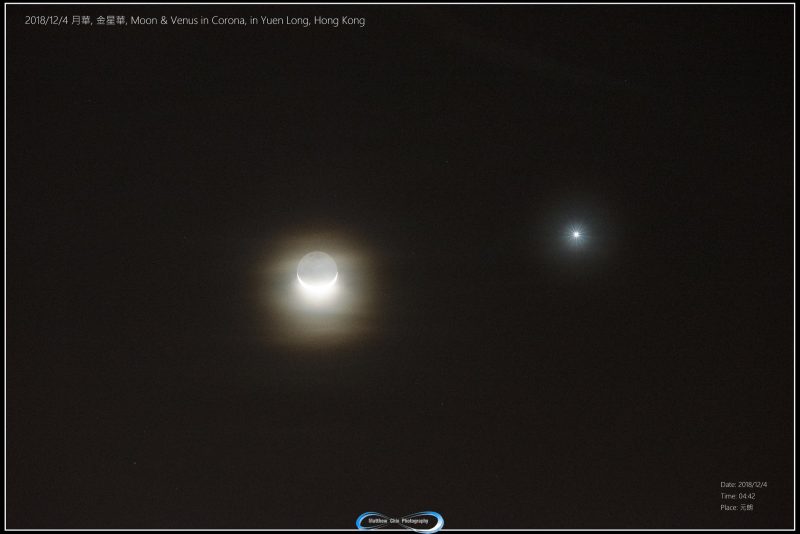
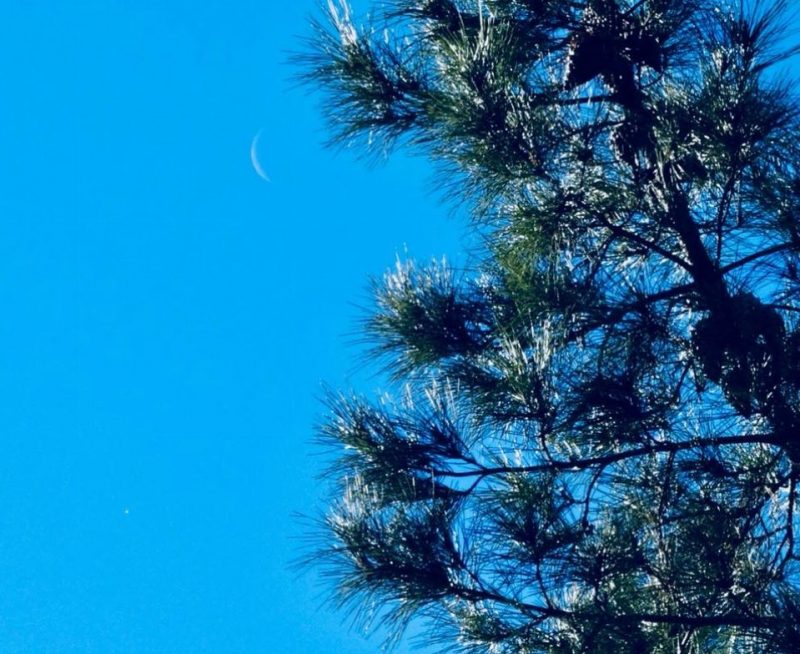
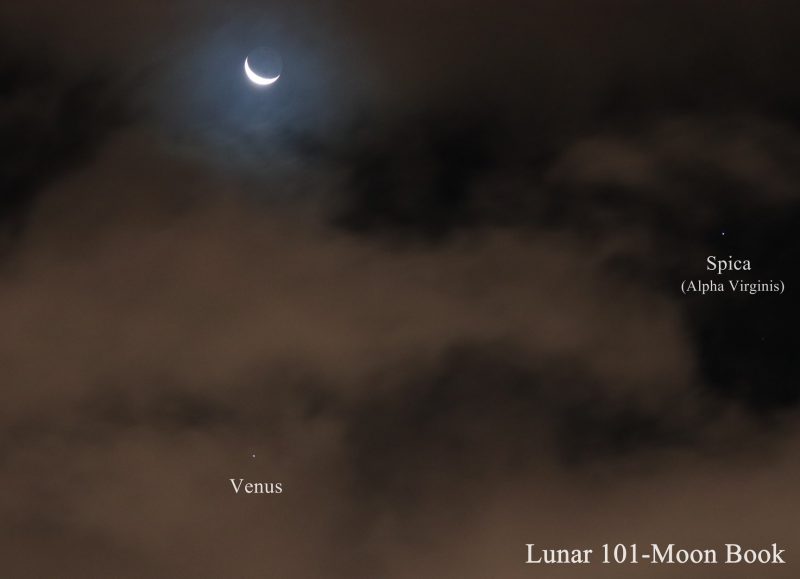
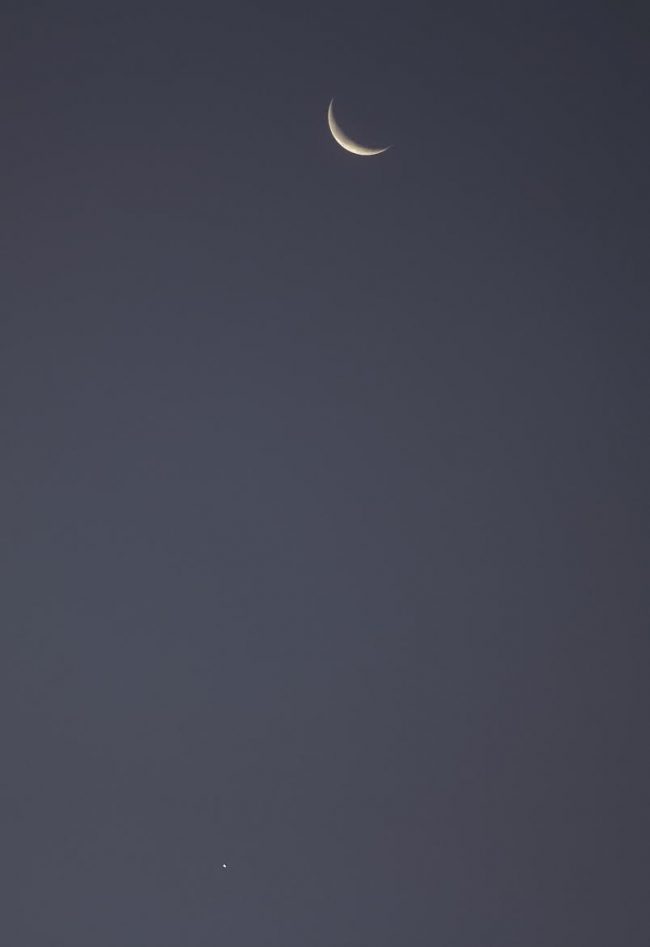
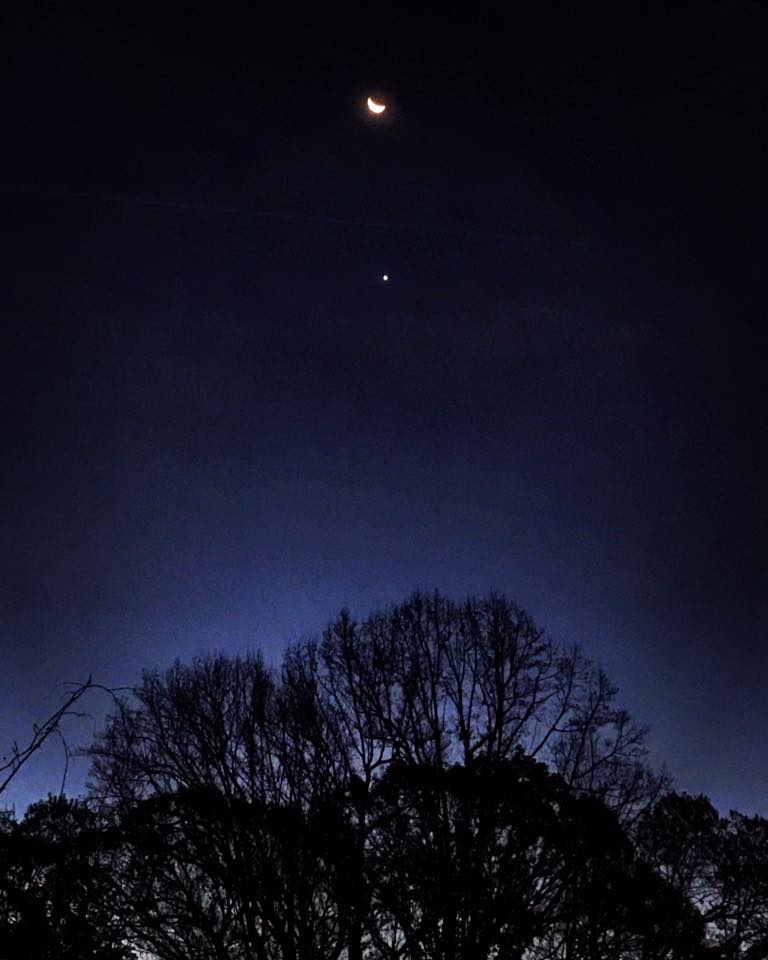
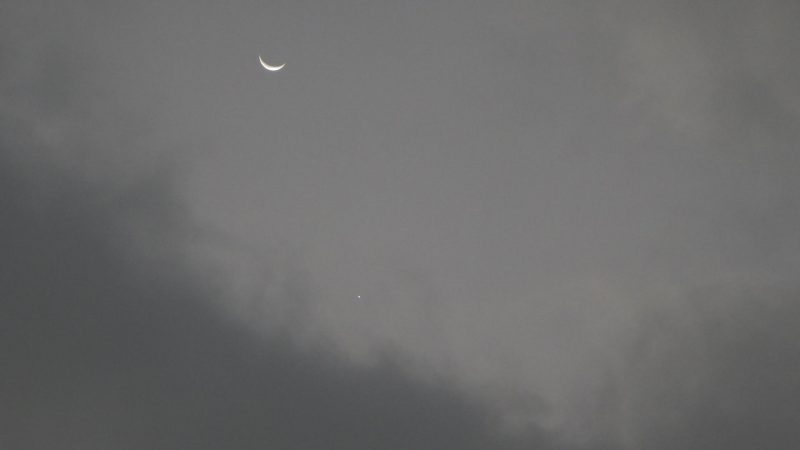
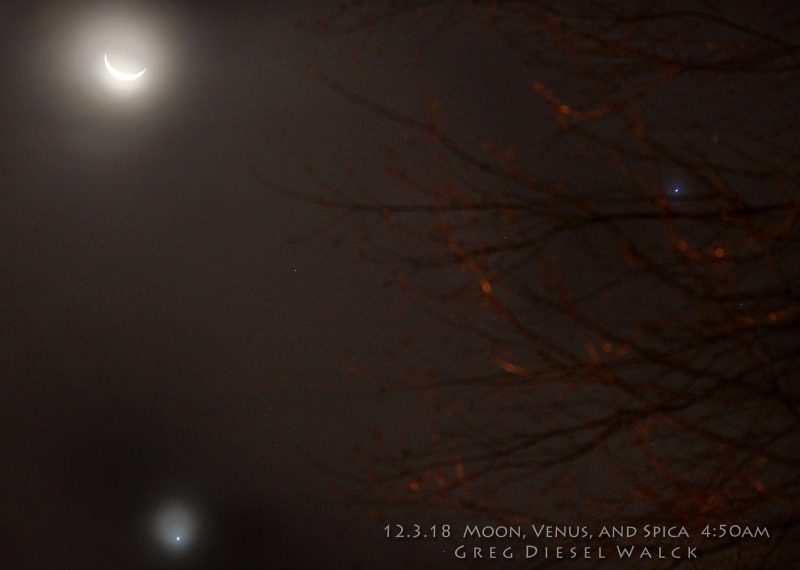
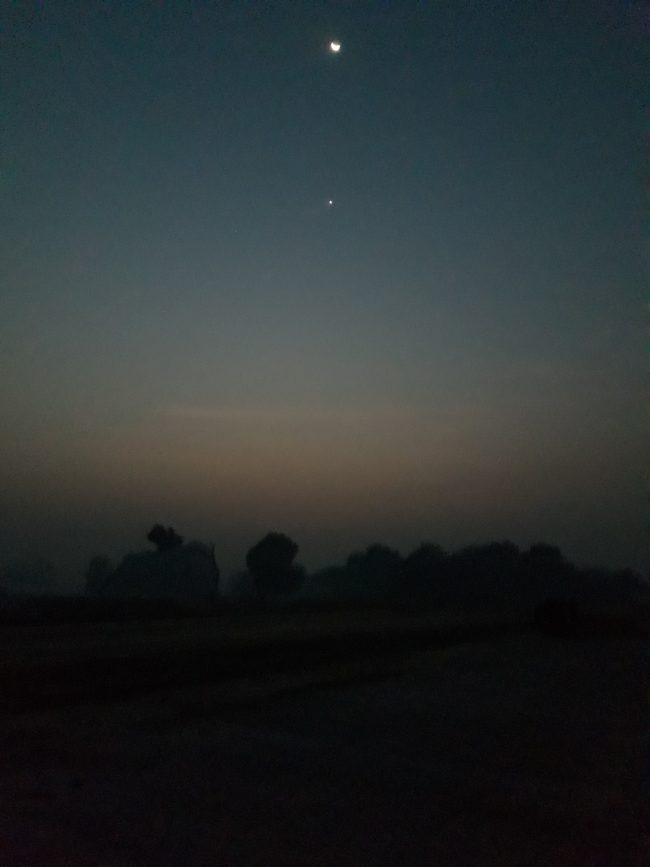
“Simply stunning!” wrote Andrew Bradley in Kirkham Lancashire, England, on December 4, 2018.Moon and Venus over Scotland – December 4, 2018 – from Yvonne S K Hendrie.Moon and Venus on December 4, 2018, from our friend Jenney Disimon in Sabah, N. Borneo.It was December 4 in Hong Kong when Matthew Chin caught the moon and Venus in a hazy sky.The moon, Venus, and Spica before sunup in Ocotillo Wells, California, via Claire L. Shickora.Moon and Venus on December 3, 2018, via Eliot Herman in Tucson, Arizona. He wrote: “It was quite a sight for a few minutes when the lighting was just right, dark enough for the moon and Venus to be brilliant and light enough to have some color in the clouds …”“Moon, Venus, Earth,” wrote Brett Joseph in San Anselmo, California, on December 3, 2018. Can’t see Venus in this daylight photo? It’s in the lower left of the photo. Here’s how to see Venus in daylight.The December 3, 2018, waning moon, planet Venus and bright star Spica via Lunar 101-Moon Book.December 3, 2018, moon and Venus from Steven Bellavia.Nikki Gregory posted this December 3, 2018, photo of the moon and Venus on EarthSky Facebook.Raul Cortes in Monterrey, Mexico, said he had a cloudy sky on December 3 and had to wait for a break in the clouds to catch the moon and Venus.Waning crescent moon sharing the sky with Venus (below) and Spica (right) on December 3, 2018 via Greg Diesel Walck – Lunar and Landscape Photographer, in Mount Vernon, Virginia.Venus and the moon on December 3, 2018, via DrArvind Mishra in Jaunpur, India.The moon, Venus, and Spica as captured by Melissa Seitz at dawn from Higgins Lake, Michigan, December 4, 2018.
Bottom line: December 2018 photos of the moon and Venus close together by members of the EarthSky community.
Deborah Byrd (asteroid 3505 Byrd) helps edit EarthSky.org and is a frequent host of EarthSky videos. Deborah created the EarthSky radio series in 1991 and founded EarthSky.org in 1994. Prior to that, she had worked for the University of Texas McDonald Observatory since 1976, and created and produced their Star Date radio series. She has won a galaxy of awards from the broadcasting and science communities, including having an asteroid named in her honor in 1990, a Public Service Award from the National Science Board in 2003, and the Education Prize from the American Astronomical Society in 2020. A science communicator and educator since 1976, Byrd believes in science as a force for good in the world and a vital tool for the 21st century. "Being an EarthSky editor is like hosting a big global party for cool nature-lovers," she says.
Like what you read? Subscribe and receive daily news delivered to your inbox.
Thank you! Your submission has been received!
Oops! Something went wrong while submitting the form.