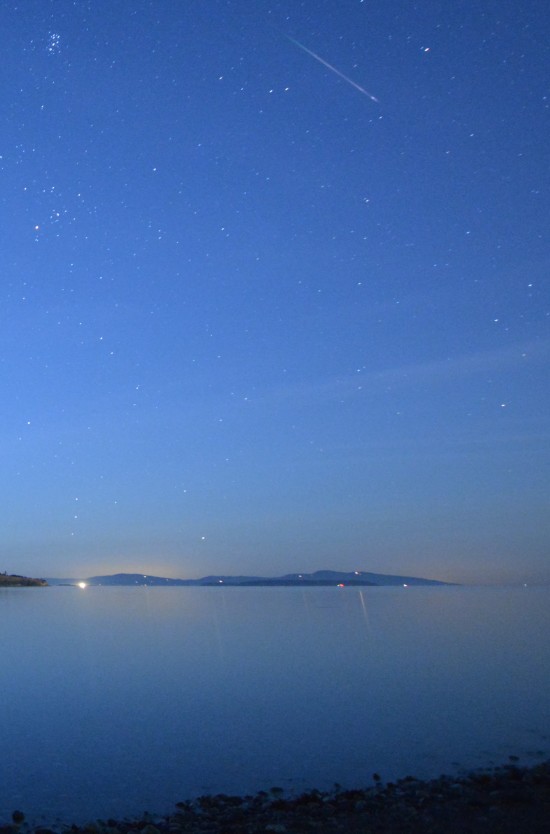
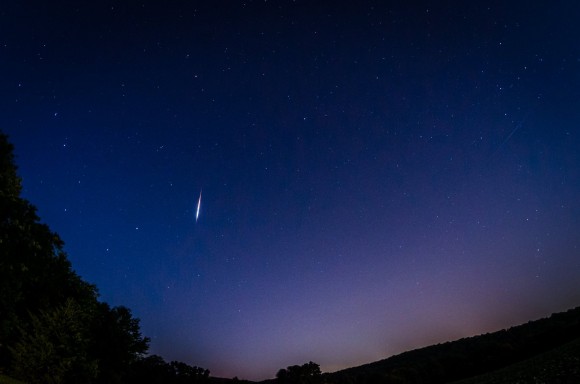
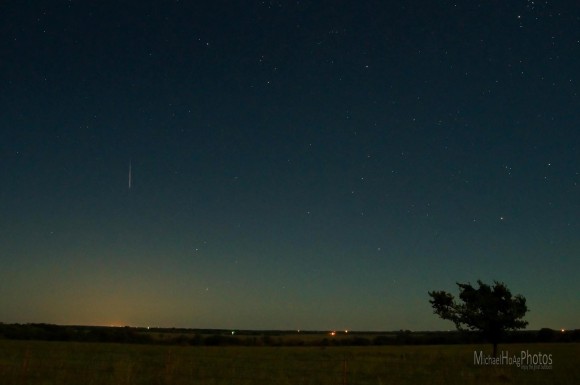
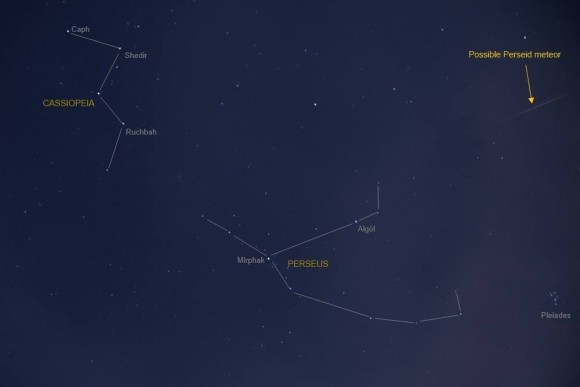
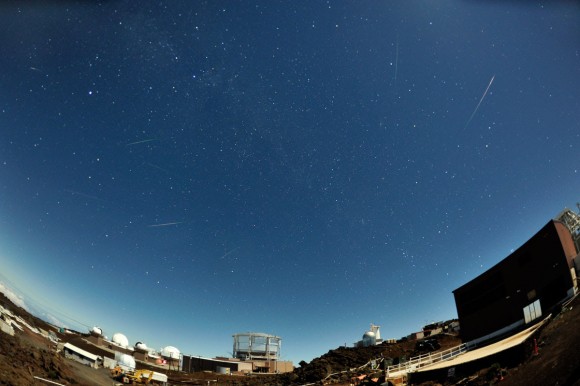
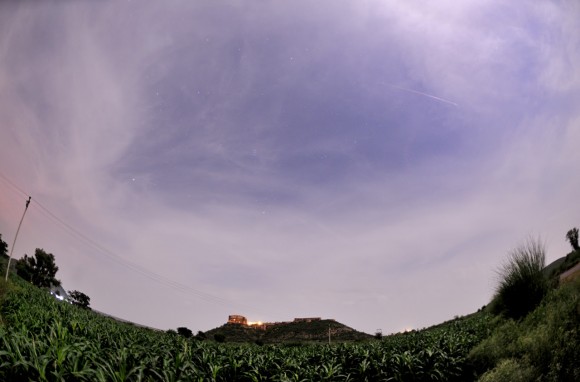
Perseid meteor. Notice the Pleiades and Hyades star clusters – a dipper-shaped pattern and a V-shaped pattern – on the photo’s upper left. Thank you to James Younger in Saanichton, British Columbia, Canada, who captured this beautiful shot on August 9, 2014.Liz Benek in Pennsylvania caught this very bright meteor, likely a Perseid fireball, on the morning of August 13. She wrote: “This was one of the BRIGHTEST meteors I’ve seen in my life… it brought tears to my eyes and made my heart skip… to the right of the shot is a second meteor … “ Barry and Nanette Simmons caught this earthgrazer on the evening of August 13. wrote: “For us, clouds and storms interfered with viewing during the early mornings of 11, 12 and 13 Aug. Captured this the night of the 13th before the moon came up and washed things out.” On the morning of the peak – August 13, 2014 – Mike Hoag in eastern Kanasa caught this shot. Thank you, Mike!Annie Lewis in Spain wrote: “With the bright moon and a thin cloud cover most of the time, it wasn’t the best night for watching meteors here in Madrid. I saw two and got another one with the camera.”Rob Ratkowski was at Haleakala Observatory on the island of Maui in Hawaii when he composed this image of meteors flying on the morning of August 13. They don’t all appear to be coming from the same point in the sky. Maybe some Perseids and some Delta Aquarids?Faint Perseid in upper right of this photo. Abhinav Singhai wrote: “Perseid meteor over Tijara Fort, Rajasthan, India. I feel I’m very lucky to capture even one meteor, especially with the big moon and awful weather full of thin clouds.” And we feel lucky you sent us your photo, Abhinav. Thank you!
We’re also grateful to the Sociedad de Astronomía del Caribe (Astronomical Society of the Caribbean) for the video below, showing a 2014 Perseid fireball.
Deborah Byrd (asteroid 3505 Byrd) helps edit EarthSky.org and is a frequent host of EarthSky videos. Deborah created the EarthSky radio series in 1991 and founded EarthSky.org in 1994. Prior to that, she had worked for the University of Texas McDonald Observatory since 1976, and created and produced their Star Date radio series. She has won a galaxy of awards from the broadcasting and science communities, including having an asteroid named in her honor in 1990, a Public Service Award from the National Science Board in 2003, and the Education Prize from the American Astronomical Society in 2020. A science communicator and educator since 1976, Byrd believes in science as a force for good in the world and a vital tool for the 21st century. "Being an EarthSky editor is like hosting a big global party for cool nature-lovers," she says.
Like what you read? Subscribe and receive daily news delivered to your inbox.
Thank you! Your submission has been received!
Oops! Something went wrong while submitting the form.