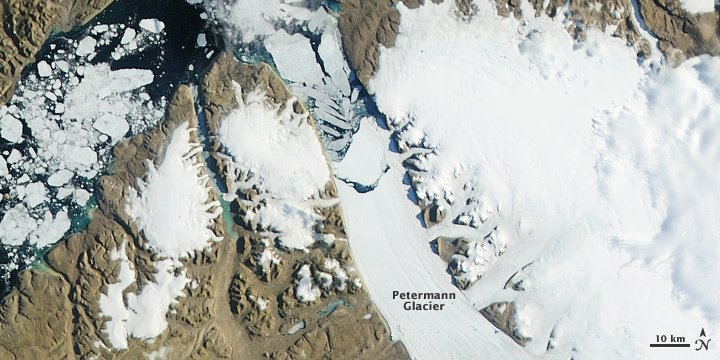
An ice island twice the size of Manhattan is visible breaking off a Greenland glacier this week. This is the second time in two years that this glacier has been seen to lose a massive chunk of ice. Scientists first reported this year’s calving on July 16, 2012. NASA’s Aqua satellite captured the view from space, below.
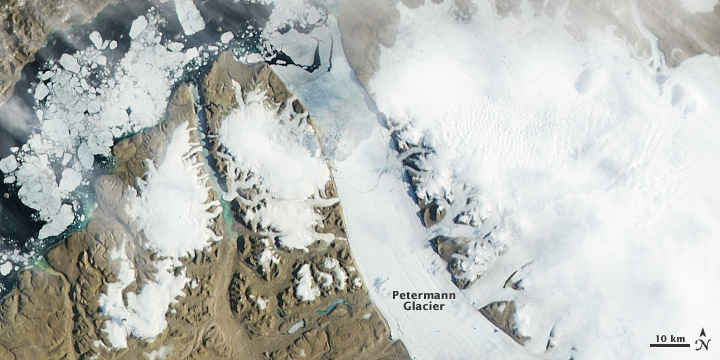
NASA’s Aqua satellite observed a new iceberg calving and drifting downstream from Peterman Glacier in Greenland on July 16–17, 2012. Because Aqua is a polar-orbiting satellite, it makes multiple passes over the Polar Regions each day. At 10:25 Coordinated Universal Time (UTC) on July 16 (top image), the iceberg was still close to the glacier.At 12:00 UTC that same day (July 16), the berg had started moving northward down the fjord. Thin clouds partially obscure the downstream view. Image via NASA’s Aqua satellite.One day later, at 09:30 UTC on July 17, NASA’s Aqua satellite spied a larger opening between the glacier and the iceberg, as well as some breakup of the thinner, downstream ice. The iceberg appears to have made a slight counter-clockwise turn.
Eric Rignot of NASA’s Jet Propulsion Laboratory and the University of California–Irvine said:
It is not a collapse but it is certainly a significant event.
Deborah Byrd (asteroid 3505 Byrd) helps edit EarthSky.org and is a frequent host of EarthSky videos. Deborah created the EarthSky radio series in 1991 and founded EarthSky.org in 1994. Prior to that, she had worked for the University of Texas McDonald Observatory since 1976, and created and produced their Star Date radio series. She has won a galaxy of awards from the broadcasting and science communities, including having an asteroid named in her honor in 1990, a Public Service Award from the National Science Board in 2003, and the Education Prize from the American Astronomical Society in 2020. A science communicator and educator since 1976, Byrd believes in science as a force for good in the world and a vital tool for the 21st century. "Being an EarthSky editor is like hosting a big global party for cool nature-lovers," she says.
Like what you read? Subscribe and receive daily news delivered to your inbox.
Thank you! Your submission has been received!
Oops! Something went wrong while submitting the form.