



Image above – first quarter moon – via Suzanne Murphy in Wisconsin. View full-sized image.
On February 12, 2019, the moon is at or near its first quarter phase, which means the portion of the moon we see from Earth is 50 percent illuminated by sunshine and 50 percent engulfed in the moon’s own shadow. It means that – for all of Earth – the moon rises around midday and sets around midnight.
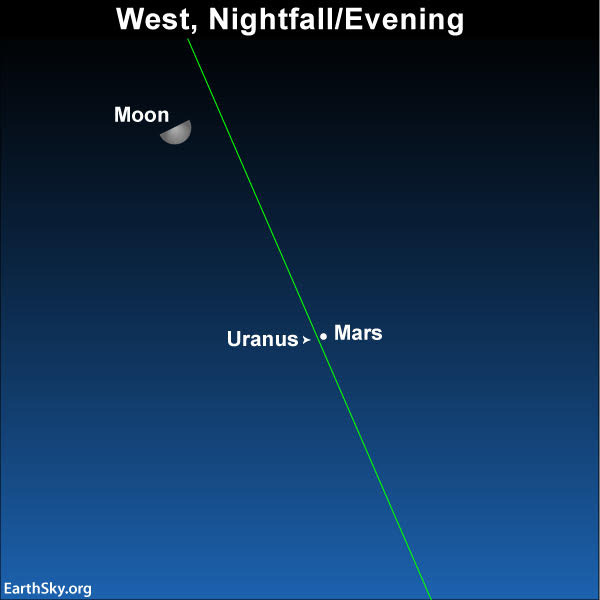
The illuminated side of the February 12 first quarter moon will be pointing right at the red planet Mars. With binoculars, Mars and Uranus can be seen to occupy a single field of view. See the chart below.
EarthSky lunar calendars are cool! They make great gifts. Order now.
For the whole Earth, the moon reaches its exact first quarter phase on February 12, 2019, at 22:26 UTC; translate UTC to your time. At U.S. time zones, that is 5:26 p.m. EDT, 4:26 p.m. CDT, 3:26 p.m. MDT, 2:26 p.m. PDT, 1:26 p.m. Alaskan Time and 12:26 p.m. Hawaiian Time.
It’s good to remember that half the moon is always illuminated in space. In other words, the moon has a day side and a night side, just as Earth does. At first quarter moon, we’re seeing about equal portions of the moon’s day side and night sides. Because a first quarter moon is a waxing moon, we’re bound to see more of its day side each evening for another week or so, culminating with full moon on February 19.
The part of the moon that isn’t in sunlight is often called the moon’s dark side. Just realize that all of the moon undergoes day and night, just as Earth does. Any given lunar location experiences night for about two weeks, followed by about two weeks of daylight. So there’s a permanent far side of the moon, but no permanent dark side.
The moon does rotate on its axis. But billions of years of Earth’s strong gravitational pull have slowed it down such that today the moon takes as long to rotate as it does to orbit once around Earth. Astronomers would say that the moon is tidally locked with Earth. For that reason, one side of the moon always faces Earth.
Incidentally, the moon’s gravitational effects on Earth are much smaller, but – given billions of years of time – the Earth will slow down and keep one face always toward the moon.
Bottom line: The moon reaches its exact first quarter phase on February 12, 2019, at 22:26 UTC; translate UTC to your time. For the whole Earth, a first quarter moon rises around midday and sets around midnight.
Like what you read?
Subscribe and receive daily news delivered to your inbox.
More from
Larry Sessions


Summer Triangle star: Altair is variable and spins fast!

Summer Triangle star Deneb is distant and luminous
Summer Triangle star: Vega is bright and blue-white


