How to see the Big Dipper

10mar09_430

Tonight for March 11, 2012

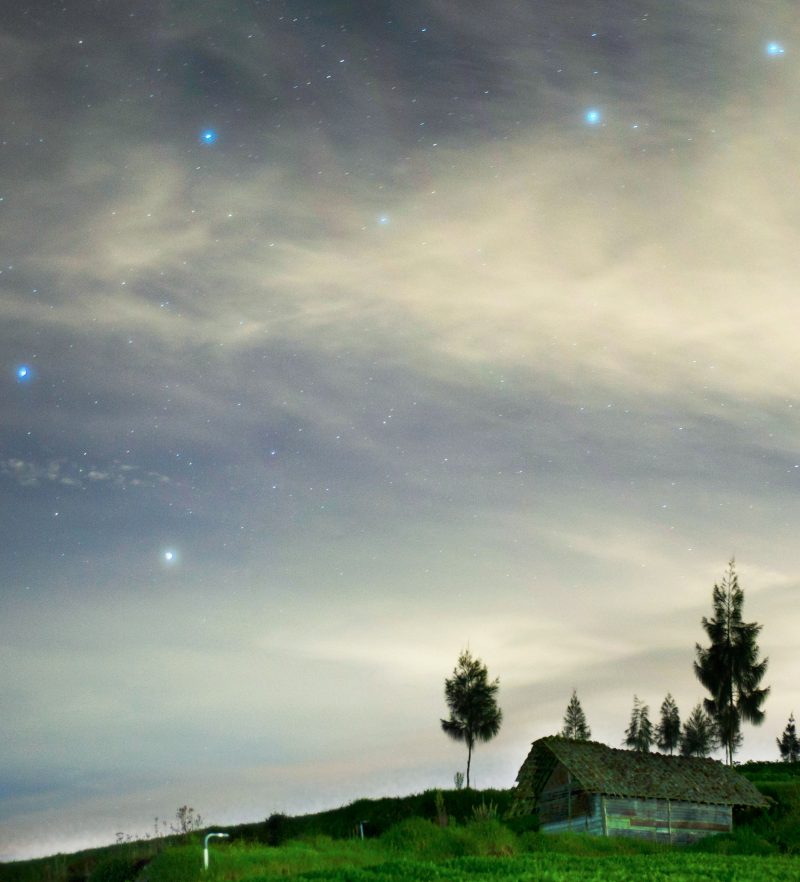
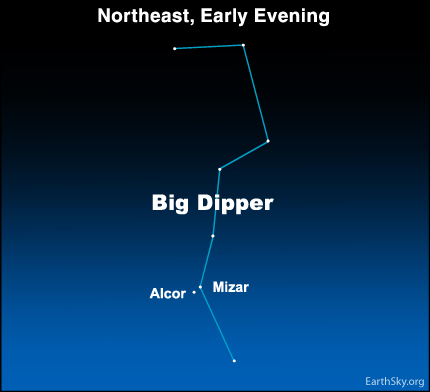
While you’re gazing in awe at tonight’s very bright planets in early evening – Venus and Jupiter close together in the direction of sunset (west) and Mars now at its best for two years in the opposite direction (east) – you might wonder about some other famous sky objects. Have you ever wanted to find the Big Dipper – known as the Plough in the U.K. or, in Hindu astronomy Saptarishi, after the seven rishis – but just couldn’t spot this famous pattern? Then today’s chart is for you. It shows the Big Dipper on an evening in March, ascending in the northeast during the evening hours. See the Dipper shape? In the early evening in March, the handle of the Dipper is pointing down toward the horizon as it rises.

Illustrated guide to Venus and Jupiter conjunction in March 2012

How to see Mars in March 2012

The two outer stars in the Bowl of the Big Dipper always point to Polaris.

Still not sure the Pattern you’ve found is the Dipper? Try to notice if the pattern you see matches the chart shown at right. That chart shows a well-known trick for finding the North Star, or Polaris. That is, the two outermost stars in the bowl of the Big Dipper point to Polaris. Those stars are Dubhe and Merak. They are well known among amateur astronomers as The Pointers. If you extend a line about five times the distance between Dubhe and Merak from the star Dubhe – and don’t find a medium-bright star (Polaris) – then the pattern you see is not the Big Dipper. Keep looking.

An ancient eye test for those wishing to join the Roman army involved spotting stars in the handle of our modern-day Big Dipper. You can take this ancient eye test, too.

Go outside around 9 p.m. You should see the Big Dipper just off the northeast horizon. The middle star in the “tail” of the question mark is Mizar. If you look for a couple seconds longer, you may see a little starry point right next to Mizar. This star is called Alcor. If you had lived in the time of the early Romans and could see Alcor, you would have been eligible to be an archer in the Roman army. If not, you likely would have served in another capacity for the Caesar. It’s said that sultans of the past also tested their soldiers’ eyesight in this way.

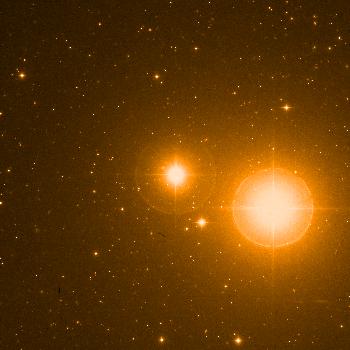
Mizar (brighter) and Alcor (fainter) as seen from Earth. Image Credit: ESO Online Digitized Sky Survey

Mizar and Alcor are a “visual double” star. There are an estimated three light-years between Mizar (78 light years away) and Alcor (81 light years away). This three-light-year distance makes it unlikely that Mizar and Alcor are gravitationally bound to each other. Mizar is a true multiple star, though. It has several companion stars that are gravitationally bound to it and revolve around it.

Bottom line: On these March 2012 evenings, while you’re watching Venus and Jupiter close together after sunset (look west) and Mars now at its best for two years (look east) – you might also spot the Big Dipper or Plough ascending in the northeast during the evening hours.

Illustrated guide to Venus and Jupiter conjunction in March 2012

How to see Mars in March 2012

Mizar and Alcor are a famous double star

Share your comments on Facebook

38 Responses to How to see the Big Dipper

  1. Jon says:

    Venus and Jupiter were AMAZING tonight. Two HUGE lights hanging in the sky, it was so noticable that I stopped what I was doing and looked for a few minutes. I used Google sky map to see what it was, then found this site to confirm. Was truly amazing.

    • Randy says:

      I live near Dulles airport and when I see a light in the sky that big it is usually a plane — I kept waiting for it to move but it never did — I had to look it up to see which stars they were and I found this site. These stars are absolutely incredible! I can’t stop watching them!

    • Virginia from Charlottesville says:

      If freaked me out, that’s why I’m here… they are so low and so incredibly bright… how often do we see five pointed stars that big and beautiful… wow

      • Ginger from Conroe Tx says:

        I did the same thing. We spotted these two very bright stars and living next to an airport thought they were planes. Then noticed their not moving. (kinda, could swear their getting closer to me) Weird!! So of course had to google and ended up here. What a cool site. I can’t stop watching them. So these two bright stars are actually Venus and Jupiter?

    • Dave says:

      Same here on Maui vacation…..too bright to ignore….Bing and joined the gang

      • Rick says:

        Those were the two bright objects in the western sky? Was standing outside at about 8:40 CST and saw the object on the right move up while I watched until about 9:05-9:10.

  2. JD says:

    Why does the moon look like a pumpkin tonight 3/10/12 & this morning 3/11/12??

    I went to buy my morning paper and it looked something like this.

    http://journal.florali.com/.a/6a0120a5914b9b970c013487a8ba70970c-800wi

    • Deborah Byrd says:

      Did you see it near the horizon? The moon or sun seen near the horizon can appear to be flattened, like the pumpkin in your photo. It’s an atmospheric effect – due to the fact that, when we look toward any horizon, we’re looking through more atmosphere than when the moon or sun are overhead.

      The atmosphere in the direction of the horizon can also make the moon or sun look reddish …

      Deborah

  3. Jean Hamrick says:

    Thanks for the confirmation on Mars. All the other sites I checked didn’t mention it. I was pretty sure it was Mars because of the red hue. Last night was a phenomenal night for star gazing. I should remember this site for future questions.

  4. James says:

    Why does one of the upper stars in Orion appear red? I was looking for Mars when I noticed it.

    • Susan says:

      James…That’s Betelgeuse (Pronounced Beetle-Juice!! Sorta.) That’s how I remember it. It is the red and rare supergiant and is located above the left star in Orion’s belt.

  5. BEN JACKSON says:

    10MAR12… LAST EVENING AS MY SON AND I WALKED HOME WE SAW IN THE SKY WHAT WE THOUGHT WAS A FALLING STAR… ANYONE SEE IT?…
    NORCROSS, GA 30093…
    APPROX 21:00 HRS

  6. Martin Shum says:

    It’s been a lovely sunny day here today , clear blue sky to enjoy and sunshine all day . I just hope the sky stays clear at dusk and nightfall so stars and planets can be seen . UK north of BIRMINGHAM .

  7. jaden says:

    wow thats a cool moon!!!!!!!!!!!!!!!!!!!!!!!!!!!!!!!!!!!!!!!!!!!!!!!!!!!!!!!!!!!!!!!!!! hope everyone sees it jd,s version of a pumpkin.

  8. Martin Shum says:

    What a great evening it is here tonight , Jupiter and Venus are very close and Venus is so bright . Orion moving westward and Sirius shining brightly . Mars rising in the east now . Ursa Major so bold and dominant in the north east sky . A lovely orange glow from Betelgeuse and Aldebaran . UK north of BIRMINGHAM .

  9. darren says:

    Just logged on with daughter to see what those two bright stars are in the west. She thinks it is FAB to see two other planets and now wants a telescope! Sky is lovely in Caerphilly tonight.

  10. Kas says:

    Anyone know what the small cluster of stars are to the north of Jupiter….very faint. Wonderful sky tonight….the top of the twins Pollux and Castor really bright.

  11. George says:

    Hello,

    Amazing to see the planets tonight, its a first for me! Even with all the light pollution in Cardiff.

    Does anyone know what the very ‘twinkly’ star/ planet lying low in the south at the moment (20.30 hrs, 11/03/12) is?

  12. Richard says:

    What a night seeing those planets.

  13. Jackie says:

    Agreed that ‘those 2 bright stars’ are incredible. Just stepped outside to have a look and, curious, typed it into google and found this page!! Glad we’re not the only ones who are amazed.

  14. tracey says:

    WOW! This is amazing. Went and woke my daughter up to show her. I’m wondering about that really twinkly star to the north aswell. Does anyone know what it is?

  15. tracey says:

    oops i meant south

  16. I saw 2 stars closely together here in the UK approaching 9pm. They seemed to be in the westerly direction in the night sky.

    It was like they were on fire very strange sight, or rather one of them was.

    Im really interested to hear an explaination if anyone has one in laymans terms? What was it that was burning so bright?

    They say a star is brightest before it dies but someboday said it was a planet??

  17. Joe B says:

    wow is right..they really don’t look like planets at all…looks metalic..like the spacestation or something!

  18. anyone actually got any pictures of the two burning objects in the west?

    • Travis says:

      I have been taking pictures of Jupiter and Venus for a few weeks now, and for the last several nights have taken pics every nite to later compare Venus passing Jupiter.

  19. Jordan says:

    googling the bright lights in the sky brought me here. thanks for the info!

  20. akr says:

    I told three people to look up at Venus and Saturn!! Oops. It was impressive, though, even with a lot of lights in the way. Could see hardly anything else but planes and satellites. I was out for another reason but looked up and was really amazed and wanted other people to see it, too.

  21. Phil says:

    I have been noticing the 2 brilliant lights in the sky for the past couple of nights. So bright and clear in the Virginia sky. How long will they be there?
    Another sight said that Jupiter’s moons could be seen with binoculars. Could this be true?

  22. Chris says:

    Jupiter & Venus looked spectacular in the western sky tonight in Prince George, BC, Canada.

  23. Allen Brock says:

    I’d always thought that the Big Dipper always pointed towards the North Star, but in the mornings it doesn’t appear to. Is this right, or am I looking at the wrong place?

    • Colleen Baltzer says:

      Allen- your comment about the big dipper is why I was looking at this page. I am in Baja Sur and last night the big dipper was upside down – so whatever might be in that dipper was falling out. Then this morning around 5 am, it was right side up. Has anyone noticed that?

Share your comments on EarthSky

Your email address will not be published. Required fields are marked *

*

You may use these HTML tags and attributes: <a href="" title=""> <abbr title=""> <acronym title=""> <b> <blockquote cite=""> <cite> <code> <del datetime=""> <em> <i> <q cite=""> <strike> <strong>