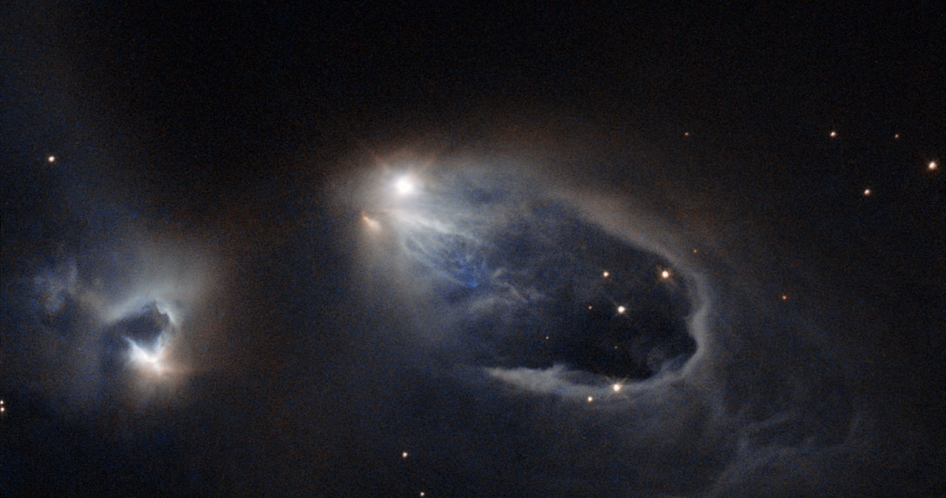
The star at the center of the frame is a young star – a variable star – named V633 Cassiopeiae. In this photo from the Hubble Space Telescope, it appears as if the star just sneezed. In fact, if you could watch over a timescale of many thousands of years, you’d find that the star is having a sneezing fit. It’s firing off rapid releases of super-hot, super-fast gas.
The star’s “sneezes” – launched due to its magnetic fields – can contain as much mass as Earth. They move at hundreds of kilometers/miles per second into nearby clouds of gas. Shock waves form, such as the U-shape below this star. As the waves crash outwards, they can be seen moving across human timescales of years.
Soon, this star will stop sneezing, and mature to become a star like our sun.
Read more about the “sneezing” star – V633 Cassiopeiae – from NASA News
Like what you read?
Subscribe and receive daily news delivered to your inbox.
More from
Deborah Byrd


Visible planets and night sky guide for October

Cassiopeia the Queen is overhead on autumn evenings
What star in the northeast flashes colorfully? It’s Capella!
Proxima Centauri is the closest star to our sun