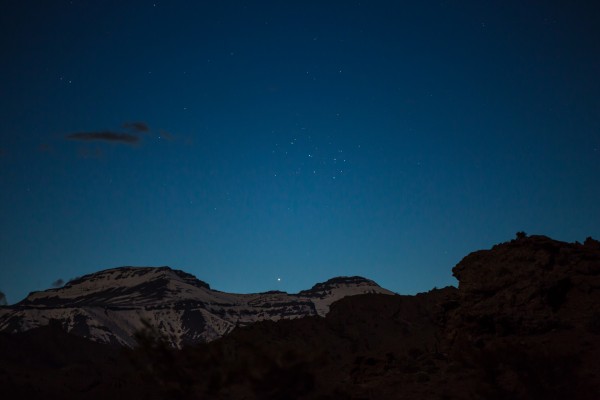
Jack Webb in Wapiti, Wyoming captured this shot last night (April 29, 2015) of Mercury and the Pleiades, a tiny dipper-shaped star cluster also called the Seven Sisters. Congratulations on catching Mercury, Jack!
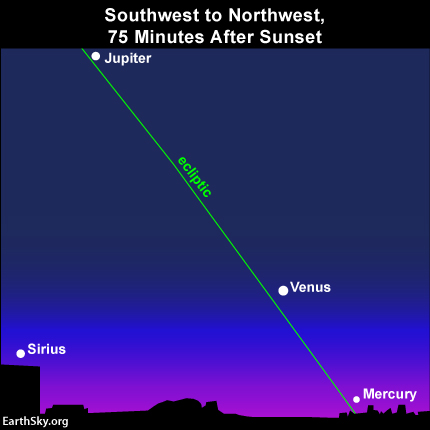
Our sun’s innermost planet, Mercury, and the distant star cluster Pleiades are now low in the west after sunset. They’re just above the place where the sun went down. They are easier to see from the Northern Hemisphere than the Southern, because the ecliptic – or path of the sun, moon and planets – makes a steep angle now with the western horizon in the evening. The steep angle of the ecliptic (from Northern Hemisphere locations) places Mercury above the sunset glare.
Look for them early, because Mercury and the Pleiades will sink below the western horizon by nightfall or early evening. They are beautiful. You will love seeing them!
Read more about Mercury and the Pleiades
Bottom line: The elusive planet Mercury and the lovely Seven Sisters low in the west after sunset. Photo by Jack Webb.
Like what you read?
Subscribe and receive daily news delivered to your inbox.
More from
Deborah Byrd


Visible planets and night sky guide for October

What star in the northeast flashes colorfully? It’s Capella!
Proxima Centauri is the closest star to our sun
NASA’s Perseverance rover on Mars sets off-world driving record