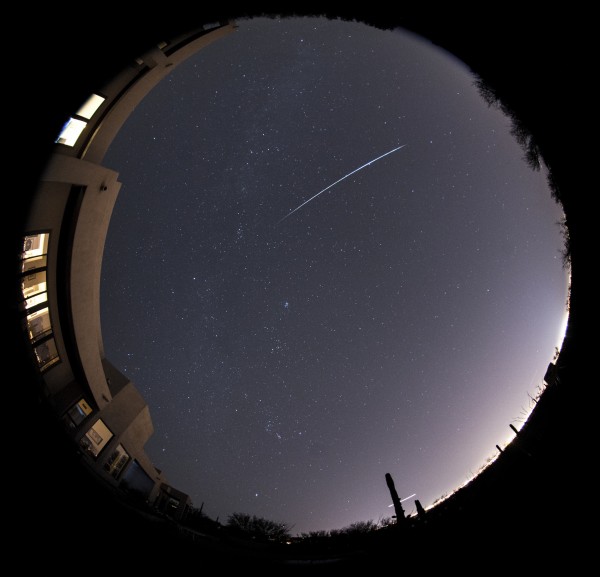
Our friend Eliot Herman – who has a very cool set-up for capturing meteors – sent us this photo. It appears to be an early Geminid meteor, and not just any meteor but a fireball, or exceptionally bright meteor. We’re still many days away from the peak of this shower on the night of December 13 (morning of December 14), 2015. But the shower should be gearing up around now. Eliot wrote:
Fisheyes curve, or distort, so one needs to be a bit careful about projecting back [to the radiant point], but it looks like the right place.
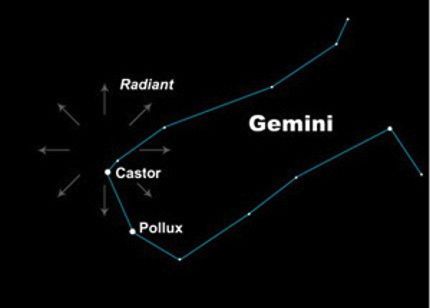
He’s talking about the fact that meteors in annual showers, like the Geminids, all appear to stream in our sky from a single point, called the radiant point. You don’t have to be looking at the radiant point to see the meteor shower, but – to see the greatest number of meteors – it’s better if the radiant point is above the horizon, and best if it’s high in the sky. For the Geminids, the highest point in the sky is around 2 a.m. local time. That’s the time on your clock no matter where you are on Earth.
Thanks, Eliot!
Read more about the Geminid meteors’ radiant point
Bottom line: Photo of an early meteor in the Geminid shower, taken December 3, 2015.
Like what you read?
Subscribe and receive daily news delivered to your inbox.
More from
Deborah Byrd


Zodiacal light: Start watching for it now

Orion’s Belt points to Sirius on September mornings
Mars sometimes is bright and sometimes is faint
Voyager 2: Our 1st and only visit to Neptune