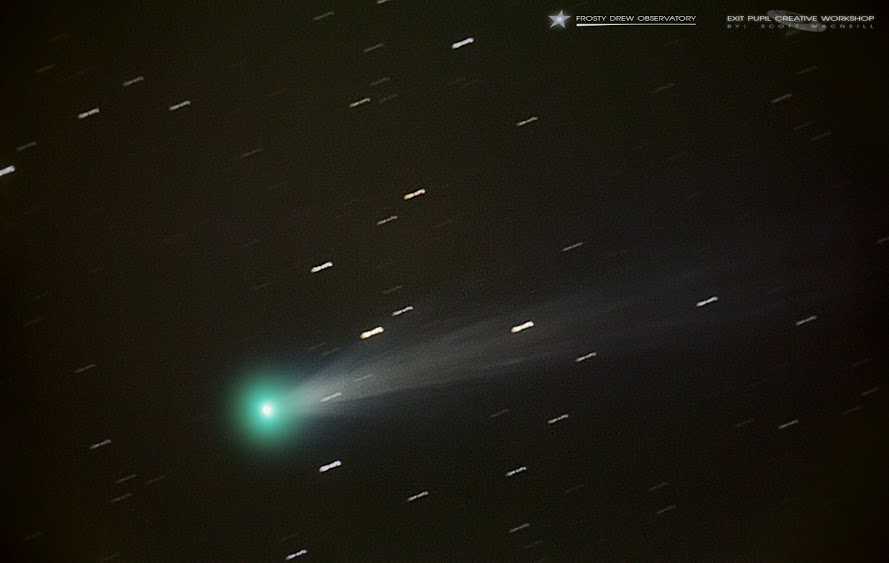
View larger. | EarthSky friend on G+, Scott MacNeill, captured this stunning photo of Comet ISON on the morning of November 15, 2013. Thank you, Scott!
In case you haven’t heard … Comet ISON has been in outburst the past several days. In other words, it has gotten brighter! Our friend Scott MacNeill posted this wonderful photo on EarthSky’s Google+ page.
Many are saying they are glimpsing Comet ISON with the eye alone as a fuzzy barely visible patch in dark skies. The Comet ISON Observing Campaign says:
For those with very dark skies, this now makes it a naked eye object, and even for those in urban environments it is readily visible as a fuzzy green blob about half an hour before sunrise in the southeastern skies.
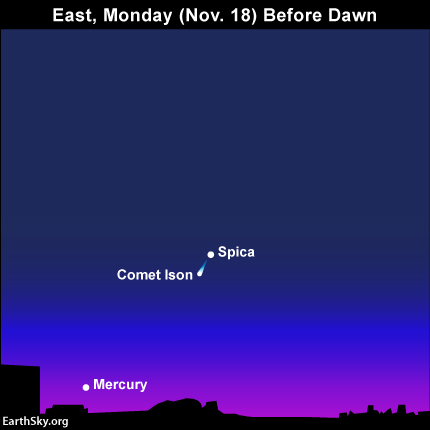
The comet will be in a conspicuous place in the sky for the next several mornings, near the bright star Spica on the sky’s dome. The charts below might help you find it! Look southeast before dawn for Spica. Scan with binoculars near Spica for the comet.
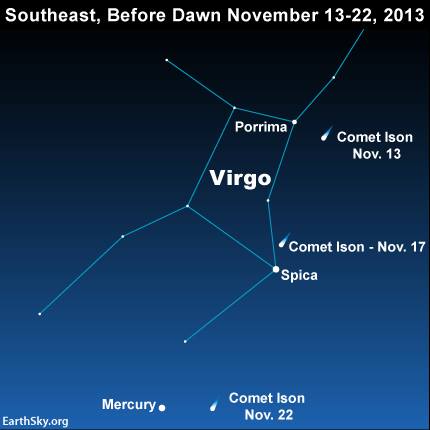
On the mornings of November 17 and 18, Comet ISON and the bright star Spica will be in the same field of view in binoculars. Look southeast before dawn for Comet ISON. Click here to know Spica’s rising time in your sky.Here is the view on November 18. Look southeast before dawn.View larger. | Here’s the same part of the sky as on the chart above – as photographed on November 13, 2013 by Annie Lewis in Madrid, Spain. This photo looks east before dawn. It’s the part of the sky in which you’ll find Comet ISON.
Deborah Byrd (asteroid 3505 Byrd) helps edit EarthSky.org and is a frequent host of EarthSky videos. Deborah created the EarthSky radio series in 1991 and founded EarthSky.org in 1994. Prior to that, she had worked for the University of Texas McDonald Observatory since 1976, and created and produced their Star Date radio series. She has won a galaxy of awards from the broadcasting and science communities, including having an asteroid named in her honor in 1990, a Public Service Award from the National Science Board in 2003, and the Education Prize from the American Astronomical Society in 2020. A science communicator and educator since 1976, Byrd believes in science as a force for good in the world and a vital tool for the 21st century. "Being an EarthSky editor is like hosting a big global party for cool nature-lovers," she says.
Like what you read? Subscribe and receive daily news delivered to your inbox.
Thank you! Your submission has been received!
Oops! Something went wrong while submitting the form.