



We tell you all you need to know about halos in our YouTube video here. Don’t forget to subscribe!
What causes halos?
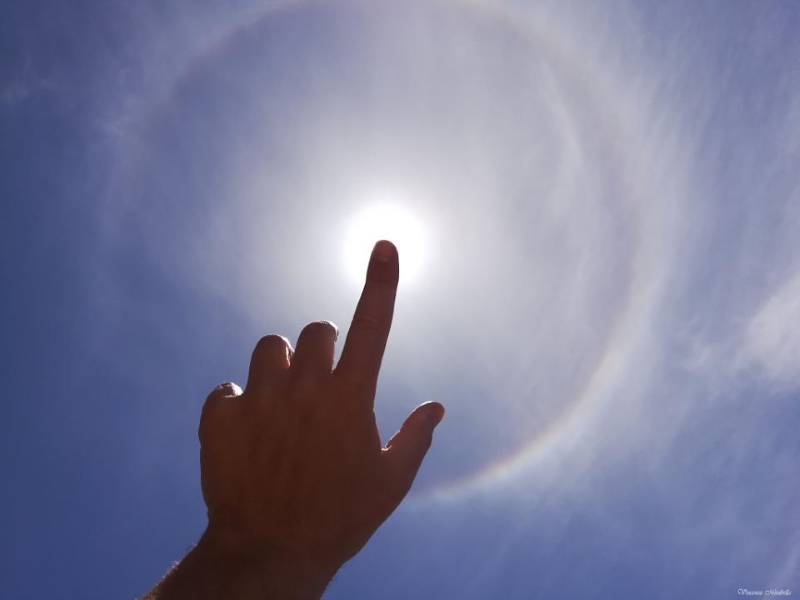
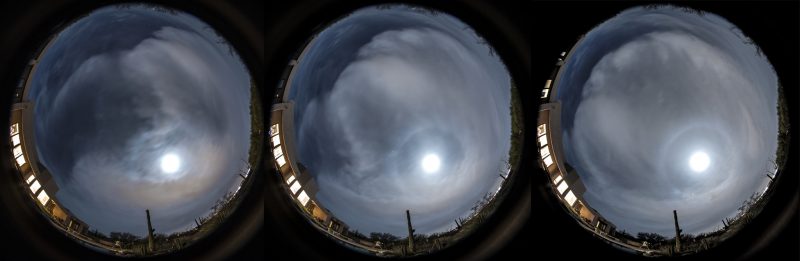
Have you ever looked up and spotted a large ring of light around the sun or moon? Scientists refer to these as 22-degree halos. They got that name because the radius of the circle is always approximately 22 degrees.
There’s an old weather saying: ring around the moon means rain soon. There’s truth to this saying, because high cirrus clouds often come before a storm. Notice in these photos that the sky looks fairly clear. After all, you can see the sun or moon. And yet halos are a sign of high, thin cirrus clouds drifting 20,000 feet (6 km) or more above our heads.
These clouds contain millions of tiny ice crystals. The halos you see are caused by both refraction, or splitting of light, and also by reflection, or glints of light from these ice crystals. The crystals must be oriented and positioned just so with respect to your eye, for the halo to appear.
That’s why, like rainbows, halos around the sun – or moon – are personal. Everyone sees their own unique halo, made by the ice crystals from their point of view. So they are different from the ice crystals making the halo of a person standing next to you.

Are halos more common at high latitudes?
We asked Les Cowley of the website Atmospheric Optics if halos around the sun and moon are more frequently seen at high latitudes and less commonly seen closer to the equator. He said:
That’s a good question that is not easy to answer accurately because no halo frequency statistics are collected except in one or two mid-latitude European countries.
We need to distinguish between (a) halos formed by low level diamond dust during very cold weather and (b) halos formed by ice crystals in high cirrus cloud.
Obviously (a) halos only occur in polar regions or countries with very cold winters.
(b) Halos can occur anywhere on the planet during winter or summer. Their frequency depends on the frequency of cirrus coverage and whether it has had a history such that it contains halo forming crystals. The latter is hard to predict. For example, there are major differences in halo frequencies and types of halos across even 200 miles [321 km] in the U.K.

If you see a halo, notice this!
Because moonlight isn’t very bright, lunar halos are mostly colorless. However, you might notice red on the inside and blue on the outside of the halo. These colors are more noticeable in halos around the sun. If you do see a halo around the moon or sun, notice that the inner edge is sharp, while the outer edge is more diffuse. Also, notice that the sky surrounding the halo is darker than the rest of the sky.
A word of caution for photographers
Take care when photographing solar halos. Pointing a camera directly at the unobscured sun can damage it. Never look directly at the sun, even when it is less bright through clouds or fog.
Solar halo photos from EarthSky’s Community


Lunar halo photos from our friends


Thank you to all who submit images to EarthSky Community Photos! View community photos here. We love you all. Submit your photos here.
Bottom line: That glowing ring around the sun or moon is called a 22-degree halo—but what’s behind this celestial spectacle?
Like what you read?
Subscribe and receive daily news delivered to your inbox.
More from
Editors of EarthSky


Comet Halley is parent of 2 meteor showers

Inferior conjunction — Venus! October 23-24, 2026
Mercury after sunset and great for Southern Hemisphere!
Meteor shower guide 2026: Up next … the Orionids



