



How to watch a total lunar eclipse
Here are some tips to watch the upcoming total lunar eclipse overnight on March 2-3, 2026.
A total lunar eclipse is dramatic, beautiful and easy to view. During the eclipse, the sun, Earth and moon form a line in space. Therefore, Earth’s shadow falls on the moon’s face. An entire hemisphere of Earth can see the eclipse. In fact, the whole side of Earth where it’s nighttime when the eclipse takes place can see the eclipse. And you don’t need any special equipment. Just grab a lawn chair, go outside and plan to spend several hours watching the partial phases of the eclipse, followed by the totality itself, when the moon is completely submerged in Earth’s shadow.
Without a doubt, a total lunar eclipse is one of nature’s grandest spectacles. Here are some tips that can help you enjoy it.
Check the date and time
For example, the penumbral portion of the total lunar eclipse on March 2-3, 2026, begins at 8:43 UTC. See more info and a list of times here.
Consider a dark sky
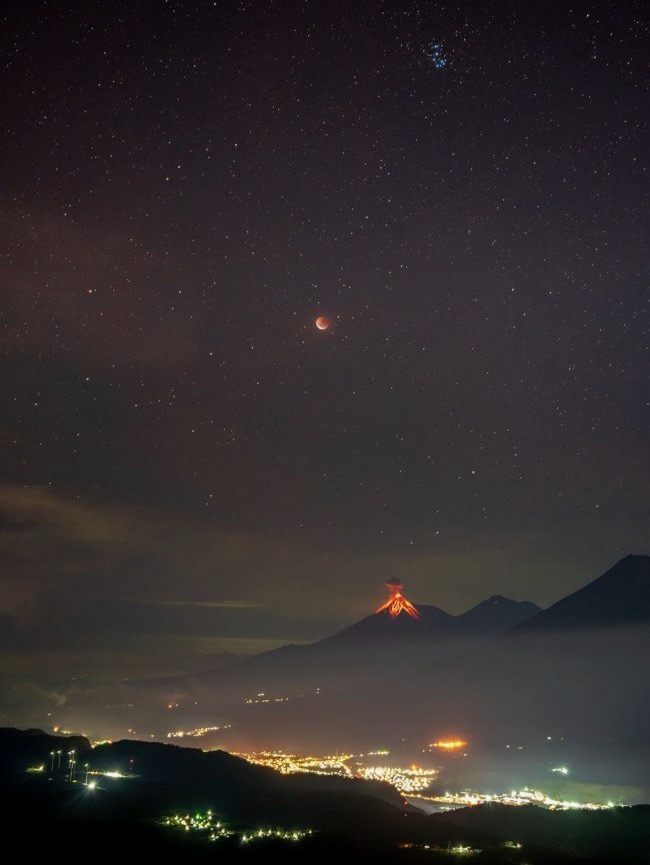
Yes, you can see it from cities or suburbs, but rural locations add clarity to the night sky, plus the sights, sounds and smells that can make an eclipse experience truly memorable. There’s a special beauty to watching in a country location, where thousands of stars pop into view and where the landscape around you will darken as the eclipse progresses.
If possible, the ideal location would have a wide-open view of the sky, unobscured by trees or tall buildings. Additionally, city parks or state parks are often good places to watch the skies. Check the closing times! Or plan to camp out overnight. But check first: they might have night lights.
When the eclipse begins, just recline comfortably (lawn chairs are great!) and observe the eclipse. And remember to take some warm clothes and blankets.
Visit EarthSky’s Best Places to Stargaze to find an eclipse-viewing location
How to take photos of the lunar eclipse
Post your eclipse photo to EarthSky Community Photos
Know the stages of a total lunar eclipse
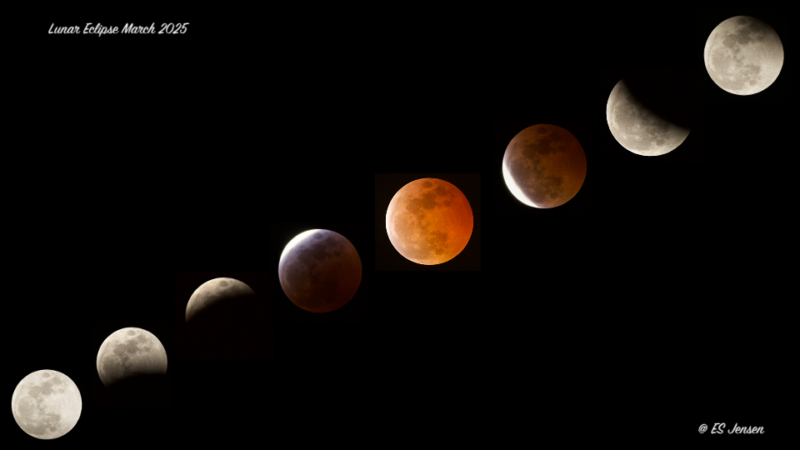
Penumbral eclipse begins. The outer, light penumbral shadow begins to cover the moon. It looks like a dusky shading moving across the moon’s face. This phase of the eclipse is subtle. Some people say they can’t tell it’s happening, even while looking right at it. We’ve heard it said you can’t discern the shadow until it reaches across roughly 70% across the moon’s face, but, in actuality, discernment is an individual skill. You might not detect anything until the partial eclipse begins.
Umbral shadow starts to show: Partial eclipse begins. Like the penumbral shadow, the inner, dark umbral shadow starts on one side of the moon and creeps across the moon’s face. It looks like a dark bite taken out of the moon. Earth’s shadow looks completely dark at first. As the eclipse progresses, it’ll begin to take on a reddish-brown color that you can capture in time-exposure photos. Notice that the shadow on the moon’s face is curved.
By the way, the curved shadow on the moon enabled Aristotle to deduce Earth is a sphere, in the 4th century BCE. When the shadow covers about 3/4 of the moon, the part in shadow should begin to glow dimly, like a burner on an electric stove. Also notice the light surrounding you on Earth. Before, it was a bright moonlit landscape, with dark moon shadows on the ground. Now the brightness gradually dims, and the world around you becomes dark, as on a moonless night.
Totality begins
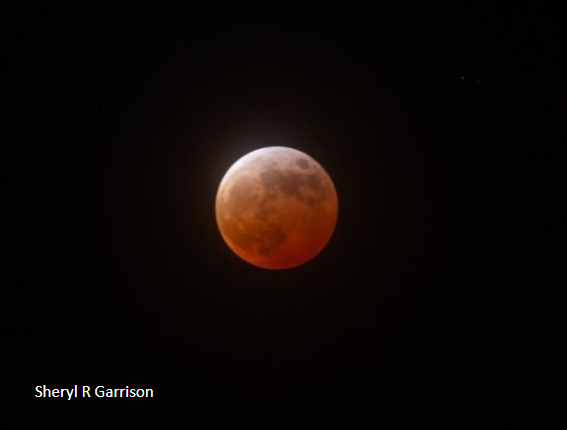
Total eclipse begins. The dark shadow completely covers the moon. This is the total phase of the eclipse, called the totality. It generally lasts for about an hour. During totality, the shadow on the moon often appears red. It is very beautiful, and the subtle colors change and shift throughout totality! So, red isn’t the only color you’ll see during totality. There are oranges, coppers, grays and browns, too.
Some people say they see a rim of the color turquoise around the moon in the minutes close to the start and end of totality. This turquoise color is the result of absorption of light by Earth’s ozone layer. The various swaths of color across the moon’s face – especially toward the beginning and ending of totality – create an effect known as the Japanese lantern effect.
Greatest eclipse is the middle of the eclipse. The shadow on the moon typically looks reddish, or very dark, depending, for example, on whether a major volcanic eruption has recently taken place back on Earth. Volcanic eruptions may add aerosols to Earth’s stratosphere, which can darken an eclipse. Notice that the eclipsed moon looks more three-dimensional than an ordinary full moon. Look deeply within the shadow on the moon’s face. Sometimes Earth’s shadow hides or obscures the moon’s surface features.
Think about what it would be like to be on the moon during the total eclipse. During the totality, an astronaut on the moon would see the sun eclipsed by the Earth. There’d be a sunlit ring around Earth, which is actually the light of all the world’s ongoing sunrises and sunsets. Be aware that, if you were on the moon, you’d experience a sudden and dramatic temperature drop! The moon doesn’t have an atmosphere to retain heat. Before the eclipse, the sunlit side of the moon would start out about 266 degrees Fahrenheit (130 Celsius). Hidden in Earth’s shadow, temperatures on this same part of the moon would plunge to about minus 146 degrees F (-99 C), a drop of over 400 degrees!
The lunar eclipse ends
Total eclipse ends. The inner, dark umbral shadow begins to leave the moon’s face. A sliver of light appears on one edge of the moon. For the next hour or two, gradually less and less of the moon will be in Earth’s inner, dark umbral shadow.
Partial eclipse ends. The dark umbral shadow leaves the moon.
Penumbral eclipse ends. The light, outer penumbral shadow leaves the moon. The eclipse is over.
Can you see a selenelion?
Finally, here’s one more thing you might want to watch for. In fact, it’s rare to get to see it from any location on the globe, but very cool if you’re in the right spot to catch it. If you’re in just the right spot on Earth, you might observe the eclipsed moon setting while the sun rises, or the eclipsed moon rising while the sun sets. This is called a selenelion.
Celestial geometry says this should not happen. After all, in order for an eclipse to take place, the sun and moon must be exactly 180 degrees apart in the sky, in a perfect alignment known as a syzygy. Such perfection – needed for an eclipse to take place – would seem to make it impossible to view the sun and eclipsed moon above your horizon simultaneously.
But thanks to atmospheric refraction – the same effect that causes a spoon in a glass of water to appear broken in two – you might actually see images of the sun and totally eclipsed moon, both above your horizon at once, lifted up by the effect of refraction.
However, you need to be positioned in just the right spot on Earth’s surface to see a selenelion. The chart below shows you who has a shot at it for the March 2-3 total lunar
eclipse.
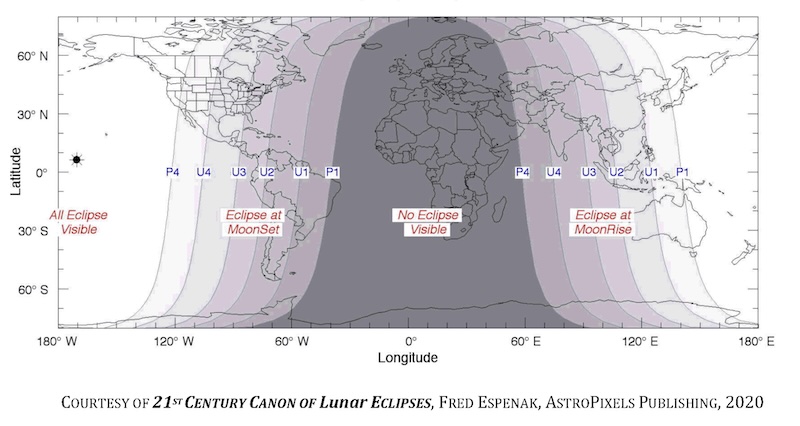
The eclipse map shows your best chance of witnessing selenelion. You must be at or near the very narrow band labeled U2-U3 on the worldwide map above.
It’s along the narrow U2-U3 path where the totally eclipsed moon is about to rise or set opposite the sun. Of course, you’ll need an absolutely level horizon to see a selenelion.
A partially eclipsed moon selenelion?
You still might be able to see a selenelion of a partially eclipsed moon and the sun both above the horizon from a wider swath of the world. Given clear skies and an unobstructed horizon, the section on the worldwide map between U1 (beginning of partial umbral eclipse, before totality) and U2 (beginning of total lunar eclipse) might be in a position to witness a selenelion of a partial eclipse.
Those residing between U3 (end of total lunar eclipse) and U4 (end of partial umbral eclipse, after totality) might have some chance of seeing a partially eclipsed moon and the sun in the same sky, too.
Click here for a larger view of the worldwide map.
Visit Sunrise Sunset Calendars to find out your sunrise/sunset times and moonset/moonrise times. Be sure to check the moonrise and moonset box.
Bottom line: You have to be in the right place on Earth’s globe to see a total eclipse of the moon. But there’s a good chance you will be, since half the world can see a lunar eclipse. You will enjoy a lunar eclipse more under a dark sky. Plan to watch for several hours. Watch the various parts of the eclipse. Also, optical aid, such as binoculars, will enhance the view. Have fun!
Like what you read?
Subscribe and receive daily news delivered to your inbox.
More from
Deborah Byrd


Summer Triangle: Star pattern of the season


