EarthSky // FAQs // Earth By EarthSky Dec 31, 2011

Why does the new year begin on January 1?

January 1 is a logical day for New Years Day. It closely follows the December solstice in the northern hemisphere, the shortest day of the year.

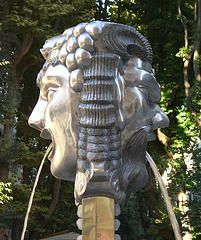
Photo credit: Daniel Moile

The date of New Year’s Day seems so fundamental that it’s almost as though nature ordained it. But New Year’s Day is a civil event. Its date is not precisely fixed by a seasonal marker.

Our modern celebration of New Year’s Day stems from an ancient Roman custom, the feast of the Roman god Janus – god of doorways and beginnings. The name for the month of January also comes from Janus, who was depicted as having two faces – one looking back into the past, and the other peering forward to the future.

January 1 is a logical day for new beginnings. At the December solstice in the northern hemisphere, we have the shortest day of the year. By January 1, the days are obviously lengthening again. This return of longer hours of daylight had a profound effect on cultures that were tied to agricultural cycles. It has an emotional effect on people even in cities today.

The early calendar-makers didn’t know it, but today we know there is another bit of astronomical logic behind beginning the year on January 1. Earth is always closest to the sun in its yearly orbit around this time.

Earth is closest to the sun for 2012 on January 5

People didn’t always celebrate the new year on January 1. The earliest recording of a new year celebration is believed to have been in Mesopotamia, c. 2000 B.C. That celebration – and many other ancient celebrations of the new year following it – were celebrated around the time of the vernal equinox, around March 20. Meanwhile, the ancient Egyptians, Phoenicians, and Persians began their new year with the autumnal equinox around September 20. And the ancient Greeks celebrated on the winter solstice, around December 20.

By the Middle Ages, though, in many places the new year began in March. Around the 16th century, a movement developed to restore January 1 as New Year’s Day. In the New Style or Gregorian calendar, the New Year begins on the first of January.

Share your comments on Facebook

13 Responses to Why does the new year begin on January 1?

  1. elena wates says:

    Doesn’t the Earth reach its closest distance to the Sun around 1/10, each year?

  2. Howard Wu says:

    That seems to make January 1st more arbitrary than logical. Why not Dec 21? Or a few days later when day length can noticeably be observed. And the perihelion is a after the fact coincidence. There is a better answer, but you need to go do more historical research. (think liturgically Jan. 1st 1AD)

    Someone told me once that this was the date that the dog star crosses it’s zenith at midnight which sounds Egyptian predating the Julian calendar, but that must have changed over the ages.

    • EarthSky says:

      Well, just a conjecture here … but if you’re a skywatcher, then you know that – although the shortest day is December 21 (or thereabouts) – the days don’t truly begin to lengthen on BOTH ends until early January.

      By that I mean that neither the earliest sunset, nor the latest sunrise, comes on the solstice.

      Instead, the earliest sunsets come in early December. And the latest sunrises come around now. Here’s more about that: http://earthsky.org/tonight/latest-sunrises-for-midnorthern-latitudes-in-early-january

      So maybe it’s just a perceptual thing. A sense that the days are truly lengthening begins when both the sun is setting later AND the sun is rising earlier. That doesn’t happen until around now. The exact date of earliest sunset and latest sunrise depends on latitude, by the way …

  3. Shahjahan Bhatti says:

    We, some fifty friends celebrated new year in the cold night outside the city. We ate food and danced with local music raising chants of ” Happy New Year To All!” We burnt bonfire and debated all night on how to eliminate terrorism. Haroon Awan, Waqar Khattak, Laghari and Aslam participated in this debate. We passed a resolution to celebrate such events in the future to discourage terrorism. I left the scene at 9 am next morning.

  4. Mooney says:

    Uh, some sources also claim that January 1 was also based on Christ’s circumcision. Any comments on that?

    http://www.officeholidays.com/countries/global/new_years_day.asp

    “During the Middle Ages, a number of different Christian feast dates were used to mark the New Year, though calendars often continued to display the months in columns running from January to December in the Roman fashion.

    Most countries in Western Europe had officially adopted January 1st as New Year’s Day even before they adopted the Gregorian calendar. This was called Circumcision Style, because it was the date of the ‘Feast of the Circumcision’, which occured on the eighth day after Christmas Day, and is said to have been the day when Christ was circumcised.”

  5. Barb says:

    You all know about April Fool’s day being a previous ‘new year’, right? When they changed it to Jan 1st the people who still celebrated on April 1st were called fools. Also I believe the names of the months Sept, Oct, Nov and Dec were derived from the latin for their (original) numbers in the calendar. (7,8,9, and 10th) but I’m not sure how that squares with January being named after Janus. (Were the other months squeezed in later somehow?)

  6. Marianne Connolly says:

    New Year’s Day falls halfway between Christmas and Epiphany. Do you think there’s a connection?

  7. Heather says:

    It would be much more logical and preferable to celebrate New Year on a different date, March 1st for example, instead of it coming in the middle of Christmas celebrations. March is the first spring month and it would seem right for the year to start at the spring instead of the middle of winter.

  8. Gary says:

    I don’t know when New Year starts, but it has to be the same moment all over the world. It would be at the moment the earth reaches a particular point in its orbit around the sun, whatever point would be chosen, since the orbit is continuous. So if you want to make it at midnight on January 1, that is fine, but midnight on January 1 where? Right now we recognize the beginning of the new year at 24 different moments around the world. What would make most sense is for it to be at the moment the earth reaches its aphelion or perihelion, probably the latter since it is so close to January 1. Other logical options would be at a solstice or equinox. But we have chosen a relatively arbitrary time. And as such, I guess it’s OK that we recognize it at 24 different moments around the world.

  9. [...] the website where I did all my “research” : http://earthsky.org/earth/why-does-the-new-year-begin-on-january-1 Advertisement GA_googleAddAttr("AdOpt", "1"); GA_googleAddAttr("Origin", "other"); [...]

Share your comments on EarthSky

Your email address will not be published. Required fields are marked *

*

You may use these HTML tags and attributes: <a href="" title=""> <abbr title=""> <acronym title=""> <b> <blockquote cite=""> <cite> <code> <del datetime=""> <em> <i> <q cite=""> <strike> <strong>