EarthSky // Tonight // Brightest Stars By Larry Sessions and Deborah Byrd Feb 16, 2012

Canopus is home star of fictional Arrakis of Dune

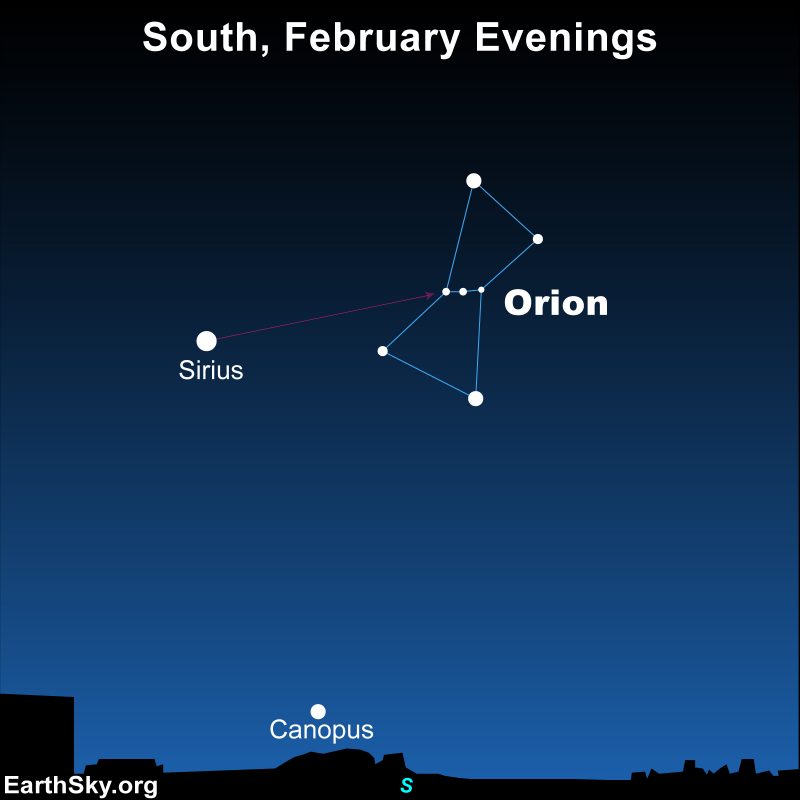
From southerly latitudes, you’ll easily find Canopus on February evenings. Look southward below brilliant Sirius. Canopus is our second-brightest star.

Look for Canopus tonight!

In Frank Herbert’s 1965 novel Dune and other novels in his Dune universe, the fictional planet Arrakis – a vast desert world, home to sandworms and Bedouin-like humans called the Fremen – is the third planet from a real star in our night sky. That star is Canopus – the second-brightest star visible in Earth’s sky – in what we know as the constellation Carina.

Artist's conception of Arrakis, the third planet of Canopus in Frank Herbert's science fiction novel Dune. Via Wikipedia's Stars and Planetary Systems in Fiction

In Herbert’s novel, the desert planet Arrakis is the only source of “spice,” the most important and valuable substance in the Dune universe.

It’s possible, according to Wikipedia (which references the famous book Star Names: Their Lore and Meaning by Richard Allen), that Herbert was influenced in his choice of this star as the primary for Arrakis by a common etymological derivation of the name Canopus:

… as a Latinization (through Greek Kanobos) from the Coptic Kahi Nub (“Golden Earth”), which refers to how Canopus would have appeared over the southern desert horizon in ancient Egypt, reddened by atmospheric absorption.

Indeed, from much of the civilized world in ancient times, Canopus would have appeared low in the sky, when it was visible at all. And so, yes, its bright light would be reddened the fact of looking at it through a greater thickness of atmosphere in the direction toward the horizon – just as our sun or moon seen low in the sky looks redder than usual. Golden Earth indeed.

Canopus as seen from 35 degrees N. latitude. When a star (or the moon) is seen so low in the sky, it appears reddish. That's because you are looking at it through a greater thickness of atmosphere, in the direction toward the horizon, than when the star is overhead. This image is Canopus seen from Tokyo via Wikimedia Commons

By the way, although Arrakis is fictional, Canopus is not only very real but also much hotter and larger than our sun. See the “Science” section below.

Are you situated on Earth to be able to see Canopus?

The second-brightest star in all the heavens, as seen from Earth, Canopus, is located far to the south on the celestial sphere, the imaginary sphere of stars surrounding Earth. That’s why it appeared golden to early Egyptian and it’s why modern observers in the northern U.S. and similar latitudes never see it. Meanwhile observers at latitudes like those in the southern U.S. enjoy this star in the evening only during the winter months.

If you're at a southerly latitude in the Northern Hemisphere, you'll find Canopus below Sirius, the sky's brightest star, on winter evenings.

Those who can see it from the Northern Hemisphere sometimes ask, “What is that bright star below Sirius?” Fair question, because Canopus is almost directly south of Sirius, the brightest star of the nighttime sky. So when Sirius is at its highest point to the south, Canopus is about 36 degrees below it.

Will you see it? It depends on how far south you are, and what time of year you’re looking. Canopus never rises above the horizon for locations north of about 37 degrees north latitude. In the United States, that line runs from roughly Richmond, Virginia; westward to Bowling Green, Kentucky; through Trinidad, Colorado; and onward to San Jose, California – just south of San Francisco. You must be south of those place to see Canopus.

If you’re in the southern U.S., you’ll have no trouble finding Canopus on winter evenings. Just look to the south, below brilliant Sirius. February evenings are a perfect time to look, when Canopus is at its highest in the sky around 9 p.m.

Canopus as seen from the International Space Station.

At the end of December, Canopus stands at is highest point to the south after midnight. In January, it reaches that point at about 10 p.m. By the beginning of March, Canopus is due south at about 8 p.m., although the exact timing on all of these dates depends on the observer’s geographic location.

For observers in the Southern Hemisphere it is an entirely different story. From latitudes south of the equator, both Canopus and Sirius – the sky’s two brightest stars – appear high in the sky, and they often appear together. They are like twin beacons crossing the heavens together. The sight of them is enough to make a northern observer envy the southern skies!

History and Myth

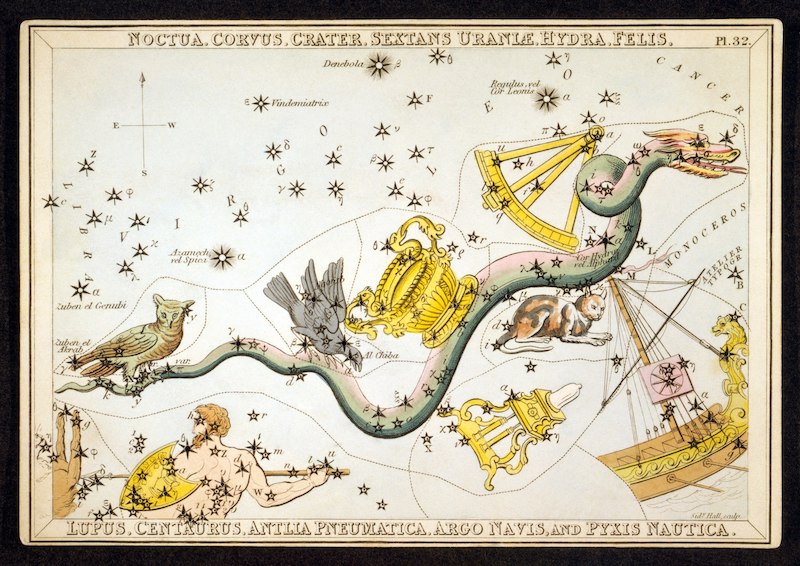
As Alpha Carinae, Canopus is the brightest star in the Keel, a part of the former constellation of Argo Navis, the ship of Jason and his famed Argonauts. Canopus originally marked a keel or rudder of this ancient celestial ship. Alas, the great Argo Navis constellation no longer exists. Modern imaginations see it as broken into three parts: the Keel (Carina, of which Canopus is part), sails (Vela) and the poop deck (Puppis).

Drawing from Urania's Mirror, 1825, showing Carina as part of the ancient ship Argo Navis. Via constellationofwords.com

For those far enough south to see it, Canopus was a star of great importance from ancient times to modern times as a primary navigational star. This is surely due to its brightness.

The origin of the name Canopus is subject to question. By some accounts it is the name of a ship’s captain from the Trojan War. Another theory is that it is from ancient Egyptian meaning Golden Earth, a possible reference to the star’s appearance as seen through atmospheric haze near the horizon from Egyptian latitudes.

Science

According to data obtained by the Hipparcos Space Astrometry Mission, Canopus is about 313 light-years away. Spectroscopically, it is an F0 type star, making it significantly hotter than our sun (roughly 13,600 degrees F at its surface, compared to about 10,000 degrees F for the sun). Canopus also has a luminosity class rating of II, which makes it a “bright giant” star much larger than the sun. (Some classifications make it a type Ia “supergiant”.”)

A comparison of our sun to Canopus. Via dunenovels.com

Placed side by side, it would take about 65 suns to fit across Canopus. Although Canopus appears significantly less bright than Sirius, it is really much brighter, blazing with the brilliance of 14,000 suns! With non-visible forms of light energy factored in, it surpasses the sun by more than 15,000 times.

Although its exact age is unknown, Canopus’ great mass dictates that this star must be near the end of its lifetime, and is likely is a few million to a few tens of millions of years old. Compared to our sedate middle-aged five-billion year old sun, Canopus has lived in the fast lane and is destined to die young.

Canopus’s position is RA: 6h 23m 57s, dec: -52° 41′ 45″

Best images of sand dunes on planet Mars

Dune fields on Titan, Saturn’s large moon

Why does the sun look reddish at sunset?

Share your comments on Facebook

36 Responses to Canopus is home star of fictional Arrakis of Dune

  1. Mechelle, I wrote the original article, but you should probably just credit EarthSky. Exactly how you cite it depends on what you are doing, but there are many resources online. Try a search on “How to cite a website.”
    Larry Sessions

  2. Scarlet Jones says:

    I am am doing a research on this star and would like to know what galaxy it is located in.
    Thanks.

  3. Scarlet,
    The Milky Way Galaxy (as is every star you can see in the night sky)

    • Martha says:

      I don’t think the Andromeda Galaxy, which is naked eye visible, is “in the Milky Way”…?

      • Martha, the Andromeda Galaxy is not a star, either. It’s a galaxy. I said every “star” you can see is in the Milky Way. You cannot see stars in the Andromeda Galaxy with your naked eye, just the combined light of all the stars in the galaxy.

        • Perhaps I should have said originally that every star you can see without a telescope is in the Milky Way. In fact even those that we can see are a very small count of the stars in the Milky Way that are closest to us. Past a few thousand light years at most, they are too dim to see with just the eye — and yet the Milky Way is about 100,000 light years across and Andromeda more than 2 million light years away. Even telescope fail us at great distances and the most ditant galaxies cannot be resolved into individual stars.

  4. Brian Miller says:

    I live in Wisconsin about 30 miles north of Milwaukee and according to google sky it was Canopus but it is due south and at about 9 o’clock

  5. Brian, you must be misreading something, as Canopus is never visible from Milwaukee. It is physically impossible. In addition, Canopus would not have been due south at that time even if it were visible in Milwaukee. Bright Jupiter was roughly due South at your location at 9 p.m. last night, so I suspect that is what you saw. Note that Jupiter is actually much brighter than Canopus.

  6. Seth R says:

    In Belize right now. Was trying to identify that bright star in the southern part of the sky. Turns out it is Canopus! I live in NY and have only seen it a few times in my life (on various vacations). Thanks for the useful data!

  7. Larry S says:

    Seth, sounds great. I’ve only been far enough south to see it once and frankly I don’t really remember it, but I do remember the Large and Small Magellanic Clouds and the Southern Cross. Gotta go back some time. Enjoy!

  8. Jerry F says:

    Here in Los Alamos, NM, I live at roughly 7200′ and at latitude 35.9 degrees north. On the clearest nights when Sirius is near its zenith, I go to the end of my driveway and look to the south down the street just above the horizon. If I’m lucky, there in the distance, glowing reddish to yellow and alternately fading in and out of view, is Canopus! For Canopus to be visible at this sliver of altitude, the sky has to be clear many miles past Albuquerque which is ~60 miles to the south. Nevertheless, I enjoy hunting for this star every year at this time and pointing it out to anyone else when given the chance. Happy viewing to all!

    • Jerry, in a previous life I lived in Fort Worth, and sometimes got to observe even farther South, so I likely got to view it from time to time, but that being more than 3 decades ago, I just don’t remember. The best skies I ever experienced were at the McDonald Observatory for the Perseid Meteors in ’77 or ’78, but that was the wrong time of year for Canopus!

  9. Dave Mc says:

    Just viewed Canopus from Melbourne, FL. What a site to see. I’m just starting out in this new hobby and so far I’m lovin it! except that dang street lamp. I used Google sky on my droid x and identified it as Canopus. WOW, the colors coming off that star are unreal. Blues, reds, yellows and white. What causes these incredible colors? Thanks for the info Larry.

  10. Larry Sessions says:

    Dave,
    All stars produce a variety of colors, but normally we see them all mixed together. If the colors are more or less equal in intensity, the result is white and the star appears largely colorless. Sometimes, depending on overall temperature, some stars appear slightly more red or more yellow or more blue, but even then all the colors are there. Soemetimes when sunlight passes through raindrops at the right angle, we get a rainbow. That’s because the raindrops act as little prisms, which spread the otherwise white light out into it constituent colors. Something similar happens when bright starlight passes through thick layers of the Earth’s atmosphere. As the starlight passes through the atmosphere, it passes through various regions where the density changes rapidly. This causes the various colors to quickly change direction slightly, and the result is that for a brief moment, the blue light predominates, then maybe yellow and then maybe red and so on. All the colors are there all the time, but the atmosphere acts as a kind of rapidly changing filter. This is particularly prominent when the star, such as Canopus, is near the horizon, because it passes through a longer column of air near the horizon. I can’t really explain that without a diagram, but it is the reason that stars near the horizon — especially bright stars — flicker and rapidly change color — they “twinkle.”

  11. Bill F says:

    How far south do i have to go to see the southern cross. I wasn’t interested in astronomy when I lived in Brazil (darn it), but remember seeing the southern cross. I am interested in Astronomy now and spend two weeks in Belize every other year. Can I see it from there? What else from there is a good view?

  12. Bill,
    There are limited chances to see the Southern Cross from as far North as northern Mexico, Southern Texas and most of Florida (better in Hawaii). Of course, the farther South you are, the better your chances. Belize has some good chances, but probably the best time for late night viewing is Spring. Folks in Australia have good chances most nights of the years, and from southern Australia, Tasmania, most of New Zealand and points South, it is circumpolar.

  13. tonganz says:

    hey..i l ive in hawaii..would i be able to see the canopus star over here..

  14. tonganz says:

    would i be able to see this star in hawaii

  15. Tonganz, yes, you could at times see Canopus when it is is highest to the South. Probabaly best around midnight in early winter. Or roughly any time when Orion is just west of due South in the sky. I would be low in the southwest sky as it gets dark in late April.

  16. Eugine Smith says:

    Hi y’all,
    I appreciate this site, very helpful! L.O.L. I love researching stars.
    I must admit I would rather date a star than a woman! I’m just kidding I’m very loyal to both of my wives! Shout out to my ladies Felicity and Nigella.
    Remember that the further south you are the easier to see this star. My wives and our 6 children love to go out to the local observatory and discover the solar system.
    I must say, boy oh boy, you know your stuff Larry.
    Quick Question Larry. If i am In Australia, Melbourne how many days a year would i be able to see this gorgeous star?
    Thanks for your help. We plan to see it as many weekends as we can.
    Eugine Smith, xoxo

  17. Eugine,
    Should be just circumpolar from Melbourne and points South, and hence visible all night (at least technically, but may be difficult when near the norizon). It is nearly circumpolar from the rest of Australia, and hence visible at some point on any clear night of the year.

  18. jaime rivera says:

    what is the mass of canopus

    • Jaime, no one can say with certainty, but the best guess is between 8 & 10 times the mass of our Sun, which puts in the range between about 1.6 and 2 times 10 to the 31st power kilograms (this is about 3.5 to 4.4 times 10 to the 31st power pounds). Suffice it to say, this is a very large number.

  19. Faisal says:

    I live in The Kingdom of Saudi Arabia

    From which date till which date is Canopus visible?

    Thank you very much,

  20. Faisal, Canopus is above the horizon every day of the year from your location, but the Sun is too close for easy observation from about May through August. At other times of the year it can be seen at some time during the night. From your location, Canopus rises far to the southeast and sets far to the southwest, rising only to an altitude of roughly 25 degrees when it is due South. (The exact figures depend on your exact geographic location).

    lthough you can see it most of the year except summer, I would say the best time of year is winter. (At least by my definition.) At this time of year, it rises at roughly 10:30-11 p.m. local time, and is highest (to the South) at about 1:30 a.m. By the end of December it will be rising at about 8:30 p.m. and reaching it’s greatest height (again, to the South) at about midnight. By late January it will rise shortly after sunset and reach its height at about 10 p.m. local time. So really, the “best” time depends on when you want to observe. I hope thi shelps.

  21. soheil salimi says:

    mu name is soheil .Soheil means Canopus star that is symble of rare thing in persion literature.
    thanks a lot .from iran

  22. Canopus seems to be the star that I mistook on Monday, Dec 26 at about 10pm to midnight to be a pulsating stationary UFO that I reported to newspaper, radio, and tv. Now I know how something natural can be misinterpreted if we don’t have enough experience. Canopus seemed to be too high in the sky to be affected by atmospheric turbulence in Palm Beach County Florida but now I know it isn’t.

    • Oh, yeah. For your location that far South, and at that time, it certainly could have been Canopus. Bright stars low to the horizon (such as Canopus would have appeared from your location at that time) often flicker, change color, and can even appear to move around a bit due in part to motions of the Earth’s atmosphere and in part to the physiological functioning of the eye-brain connection. This really has nothing to do with the star and certainly is not due to any alien spacecraft. (However, note that in a technical sense, it *could* be considered a UFO, simply because you do not know what it is. But that does not imply that it is unnatural or alien in any way. All it implies is that the observer does not know what it is. Some people ignore the real definition and automatically assume that it is alien.)

  23. Kimberly Riley says:

    It is 1:06 am on January 3rd 2012 here in South Texas and I am enjoying watching Canopus twinkle at me through my bedroom window. So beautiful…

  24. Yea! Wish I could see it, too, but I’m too far North.

  25. Doc John says:

    Last February of 2011 I was vacationing at Rancho Hidalgo in the most southwest corner of New Mexico. Ther under pristine skies I could see Canopus every night. Most amazing is the prismatic changes of color caused by Canopus’ light through our atmosphere.

    Canopus is the star most often used by spacecraft for navigation.

    Other stars exhibit amazing color hues. If you have a picnic table handy, grab your binoculars, lie on your back on the table, and just scan your binoculars across the myriad stars of our Milky Way. There is a star in Perseus that is the most beautiful garnet red.

  26. Doc John, for the majority of folks too far North to see Canopus, of course Sirius also displays many prismatic colors, all due to earthly atmospherics. Although its normal color is a bluish white, Sirius’s light is refracted by the atmosphere into a veritable rainbow, often flickering maddly. In fact many stars have color, but most people don’t note because rarely do they let their eyes properly adapt to the dark such that they can detect faint objects and colors in the stars.

  27. shahab says:

    I live in kerman, Iran, 30 deg.
    on 2nd of march we had a very very nice bright view of canopus. watching through a little window from inside, The Great Lonely Glorious Canopus fascinated us from behind all the buildings…. it was fantastic

    • Shahab, glad you got to see it. It is never visible from where I live at 40 degrees North Latitude, although I have seen it from Texas and even from South of the Equator.

Share your comments on EarthSky

Your email address will not be published. Required fields are marked *

*

You may use these HTML tags and attributes: <a href="" title=""> <abbr title=""> <acronym title=""> <b> <blockquote cite=""> <cite> <code> <del datetime=""> <em> <i> <q cite=""> <strike> <strong>