They call it the Flying Star
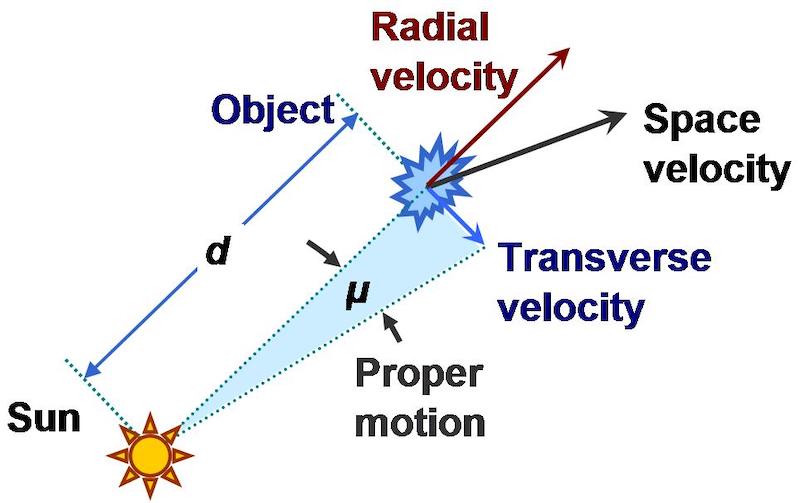
61 Cygni is a double star in the constellation Cygnus the Swan. It’s not a standout in brightness. Why go to the trouble of finding it? Stars are individuals, and there’s something interesting about each one. But 61 Cygni is particularly cool because it has one of the highest proper motions of any visible star. That’s its sideways movement across the dome of the sky.
If you took photos of 61 Cygni over the course of several years, you’d see it shift position in the sky with respect to the more distant stars around it.
This unusual motion across our sky earned 61 Cygni the nickname the Flying Star.
The movement of the double star 61 Cygni over 8 years. pic.twitter.com/2HujtmYayl
— Dave Eagle FRAS ? Keep Looking Up. (@Dave_StarGeezer) June 14, 2023
61 Cygni has a high ‘proper motion’
So why does this star have such a high proper motion? Think of two people who are running, one near you, and the other farther away. In relation to the more distant landscape, the person closer to you would appear to cover more ground – more objects would pass behind them – than the person farther away.
Then in a similar way, very distant stars appear “fixed” in relationship to each other. However, they’re actually all moving through space in their various journeys around the center of our Milky Way galaxy. But most are so far away that we can’t easily detect their proper motions. On the other hand, 61 Cygni is different. It moves relatively rapidly in front of the fixed stars because 61 Cygni is relatively near Earth.
While not the closest star to the sun (that honor goes to the Alpha Centauri system), 61 Cygni is just 11.4 light-years distant. That makes it the fourth-closest star visible to the unaided eye, after Alpha Centauri, Sirius, and Epsilon Eridani. And it’s the 15th nearest known star system to the Earth.
Science of 61 Cygni
First, 61 Cygni isn’t just one star. In fact, it’s a binary system with an orbital period of about 659 years. So, to the unaided eye and through most binoculars, it appears as one star. However, if you look at it through a modest-sized telescope, you’ll see it resolved as two stars. They have apparent magnitudes of 5.21 and 6.03.
The 61 Cygni binary system is the 15th-nearest known star system to us. Both are K-type dwarf stars in the main sequence, thought to have formed 6 billion years ago (the sun, in comparison, is 4.6 billion years old). The more massive star of the pair has 70% of the sun’s mass and puts out 15% of the sun’s total electromagnetic energy. Its companion has 63% of the sun’s mass and shines at just 8.5% of the sun’s luminosity. Both are a bit over half the size of the sun. They’re also variable stars, exhibiting small changes in brightness over time.

The history of 61 Cygni
61 Cygni has no role in classical mythology. Of course, since it’s barely visible to the eye, the ancients apparently left no written reference to it at all. But its role in the history of astronomy is assured.
The motion of 61 Cygni across our sky, while large compared to other stars, can’t be easily detected with the eye alone over the span of a human lifetime. It was with the arrival of telescopes and through meticulous observations that astronomers discovered high proper motions of stars.
Astronomer Giuseppe Piazzi, in 1792, first noticed that 61 Cygni had a high proper motion when he compared his observations to those taken by another astronomer 40 years earlier. By 1804, he had gathered enough information to be the first to publish about this extraordinary star that he nicknamed the Flying Star.
Piazzi correctly noted that this high proper motion indicated that 61 Cygni was a nearby star, and that parallax measurements could be used to figure out its distance. German astronomer F. W. Bessel was the first to get reliable measurements of 61 Cygni stars’ parallaxes that gave a distance of 10.4 light-years, which is pretty close to the actual distance we know today, 11.4 light-years. It’s also the first time a star’s distance was reliably measured.
How to see it
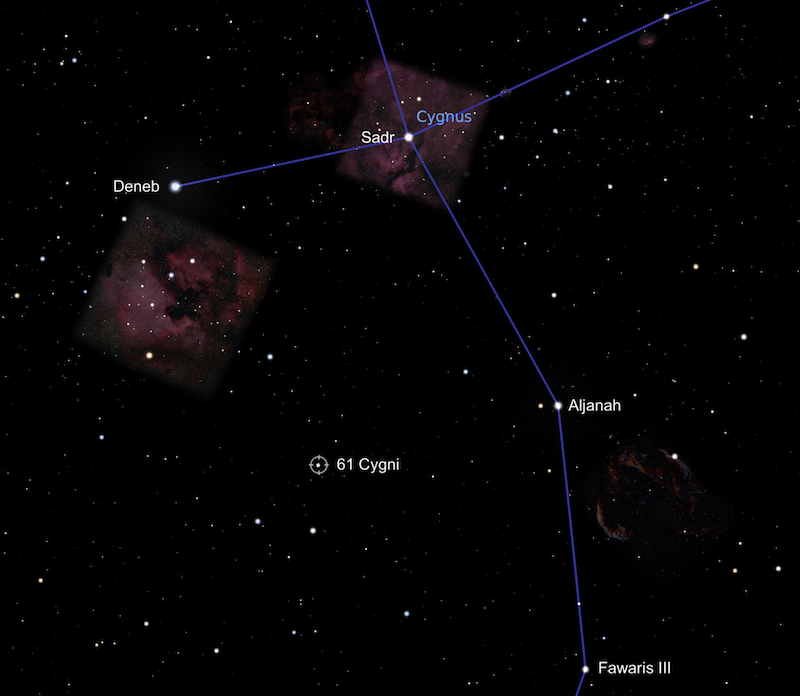
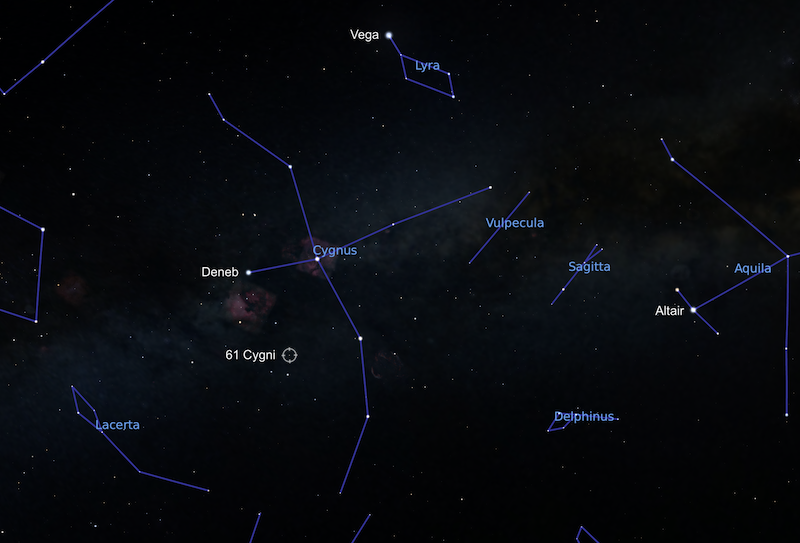
As a matter of fact, 61 Cygni is roughly halfway between two other stars that you can probably identify. First, the brighter one is Deneb, the brightest star in the constellation Cygnus the Swan. And the other star is Zeta Cygni, at one end of the Swan’s wing. You’ll find 61 Cygni between these two. Several other similarly dim stars are located nearby, so you’ll need a detailed finder star chart to properly identify 61 Cygni.
61 Cygni’s position is RA: 21h 06m 55s, Dec: +38° 44′ 57″
Proper motion: 4″ in Right Ascension, 3″ in Declination
Parallax: 0.286″
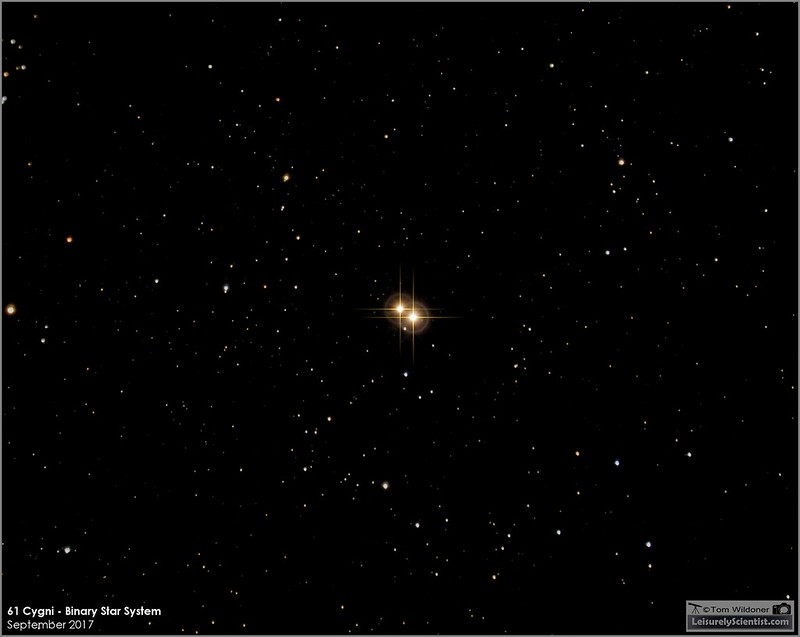
Bottom line: 61 Cygni, while faint to the unaided eye, is one of the closest stars to Earth. It exhibits a high proper motion – or motion across the sky – compared to other stars.
Like what you read?
Subscribe and receive daily news delivered to your inbox.
More from
Larry Sessions


Beta Centauri is one of the Southern Pointer Stars

The moon: 5 myths about our natural satellite
Meet the Crab Nebula, remnant of an exploding star
Bright Procyon: The Little Dog Star in Canis Minor