



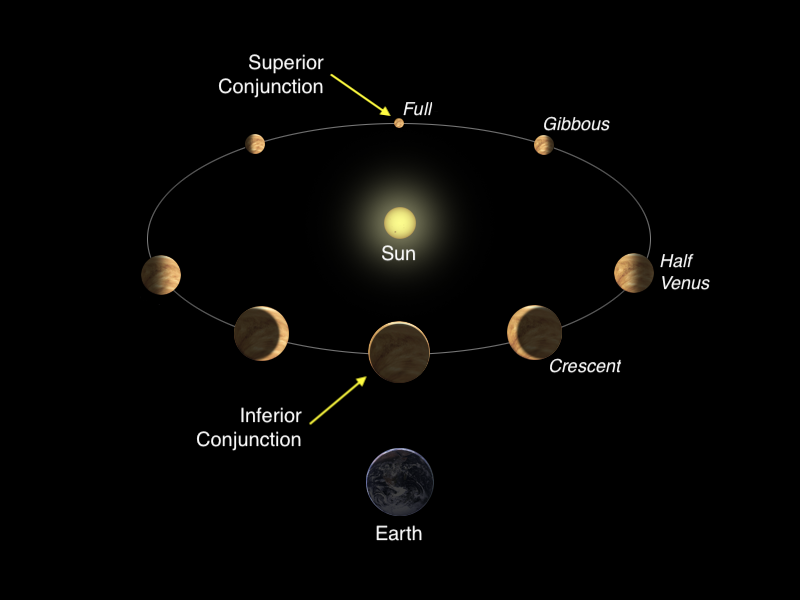
Venus in inferior conjunction
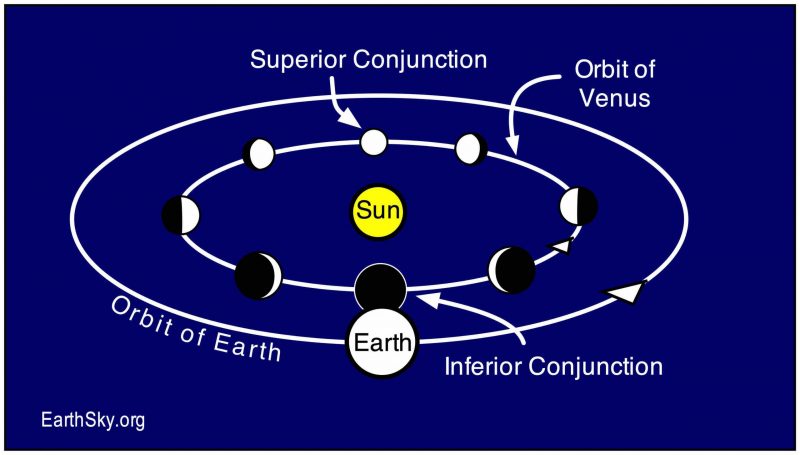
Venus travels one step inward from Earth in orbit around the sun. Its orbit is smaller than Earth’s. It has less distance to cover. And it moves faster in orbit (about 35 km/s or 78,300 mph in contrast to about 30 km/s or 67,000 mph for Earth). So – because Earth travels fast, too – Venus manages to gain a lap on us, going between us and the sun, about every 19.5 months. And, at such times, earthly astronomers say Venus is in inferior conjunction with the sun. Venus reaches inferior conjunction in 2026 at 4 UTC on Saturday, October 24, 2026. That’s 11 p.m. on October 23 CDT.
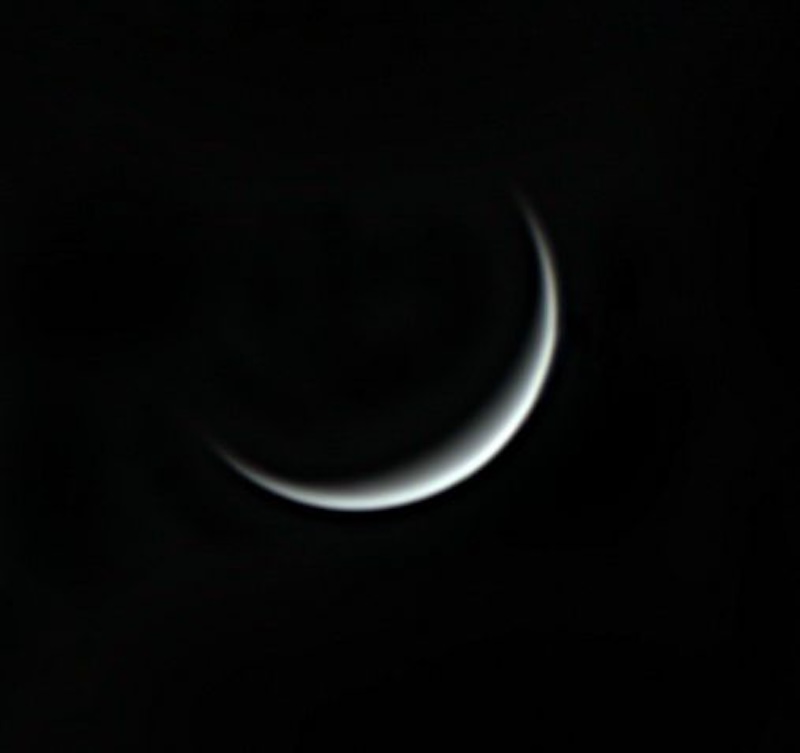
Will you see Venus on the day of inferior conjunction? It’s not likely, unless you’re an extremely careful and experienced telescopic and/or photographic observer. After all, on the day of inferior conjunction, Venus will be crossing the sky – as a slender crescent – with the sun during the day. And sometimes it’s closer to the sun than others. Please do not attempt to observe Venus near the sun unless you’re an experienced sun observer.
Venus moves to the morning sky
So, in a casual way, we say Venus goes between us and the sun on October 24, 2026. But it doesn’t go directly between. If it did, there’d be a transit of Venus. Venus – our closest planetary neighbor and the brightest planet in our sky – passes between the Earth and the sun about every 19 months (1.6 years). So inferior conjunction for Venus happens that often.
But transits of Venus are rare. And they happen in pairs. The last transits of Venus were on June 8, 2004 … and June 5-6, 2012. The previous pair of transits were in December 1874 and December 1882. The next transits of Venus will take place on December 10-11, 2117, and December 8, 2125.
The 2026 inferior conjunction of Venus
In 2026 – moving through the constellation Virgo the Maiden – Venus will pass south of the sun in our sky at the moment of inferior conjunction, at a distance of 6.6 degrees.
At the moment of inferior conjunction, Venus will officially shift from the evening to the morning sky for all observers on Earth.
When will you next see Venus?
So, when you can expect to see Venus come back to the morning sky? Around mid-month in November, look east about 20-30 minutes before sunrise. Since Venus is the brightest planet, you’ll be able to spot it low in the east, near the sunrise point, not long before the sun comes up. Venus will surprise you with its brightness so low in the sky! It’ll quickly become a bright morning “star” in November. In fact, by the middle of April, Venus will be heading for another greatest brilliancy around November 29.
Cycles of Venus
The 1.6-year period – after which the position of Venus relative to the sun repeats, as seen from Earth – is called its synodic period.
Notice that five synodic periods of Venus add up to eight years (just 2 1/2 days short). And so we have a cycle: inferior conjunctions of Venus that are eight years apart happen at the same time of year, in the same part of the sky, with Venus at a similar angular distance from the sun, that is, the same apparent distance from the sun on the sky’s dome. Over time, this 2 1/2-day variance will accumulate, so that the conjunctions “jump” into the previous month.
So inferior conjunctions of Venus strongly resemble each other on an 8-year cycle.
June transits of Venus
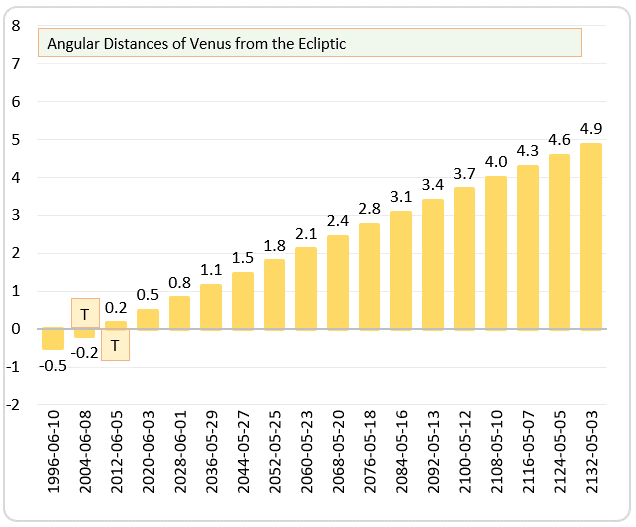
The June 3, 2020, passage of Venus nearly between us and the sun was quite dramatic. Venus appeared in our sky within “touching distance” of our star. Venus missed the solar disk in 2020 by only a quarter of a degree.
So, in 2020, Venus fell short of transiting, or crossing, the solar disk as it had done eight years earlier, on June 5, 2012 (and also eight years before that, on June 8, 2004).
With the conjunctions of 2004 and 2012 resulting in transits, and the one in 2020 resulting in a near-miss, one could correctly conclude that the angular distance from the sun during these (currently) June series of inferior conjunctions is slowly but steadily increasing. And so they are. The June-May inferior conjunctions of Venus will not result in any more transits for many centuries.
January transits of Venus
The last inferior conjunction on January 8-9, 2022, did not carry the drama of its predecessor in June 2020.
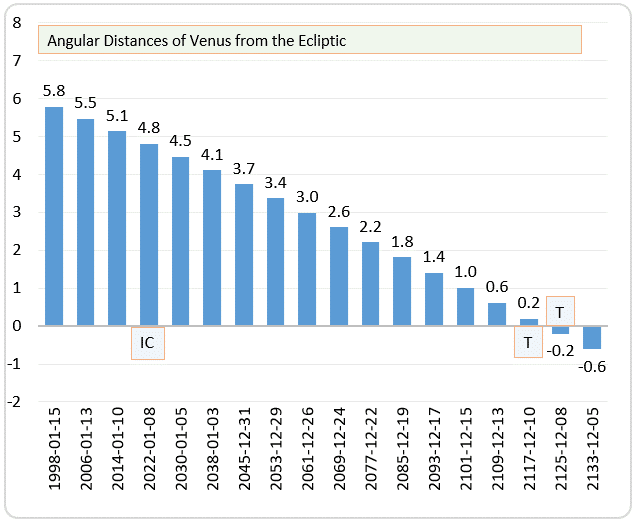
During the previous January inferior conjunction on January 10, 2014, Venus was around 1/3 of a degree farther from the sun than it was at the January 8-9, 2022, event. The next January conjunction, in 2030, will fall even closer than 2022, at just 4.5 degrees. So one might assume that this January series is slowly inching (in astronomical terms) towards the sun.
And that would be a correct assumption. Venus is currently getting closer and closer to the sun on the sky’s dome at the January inferior conjunctions.
What’s more, as the conjunction of 2022 fell on the 8th day of January, the 2 1/2 day shift will cause this January series to shift into December relatively soon, in 2045. From that moment, the now-December series will result in closer and closer approaches to the sun in the second half of the century and in the early 22nd century. The angular distance with the sun at the December inferior conjunction series will have decreased so much that it will bring us another pair of transits in years 2117 and 2125.
Some children alive today will likely live to see the Venus transits of the early 22nd century.
For experts, seeing Venus at inferior conjunction
Please do not attempt to observe Venus near the sun unless you’re an experienced sun observer.
Keen observers – depending on your location – might be able to see Venus through a telescope at – or near inferior conjunction – when it passes 6.6 degrees south of the sun on October 23-24, 2026. It’ll shine at -3.9 magnitude. And it’ll be a razor-thin crescent, only 61.12 arcseconds across.
To see a precise view from your location, try Stellarium Online.
One day before inferior conjunction – Venus in true color showing it has an atmosphere pic.twitter.com/RVmcFTQPoB
— Space Porn (@redditSpacePorn) January 9, 2022
Bottom line: Venus reaches inferior conjunction – passing between Earth and the sun – in 2026 at 4 UTC on October 24. Then Venus emerges in the morning sky.
Like what you read?
Subscribe and receive daily news delivered to your inbox.
More from
Milan B


