The October 6-7 full moon is a Super Harvest Moon! It’s bigger, brighter, and later than usual in 2025. EarthSky’s Deborah Byrd explains what makes a full moon a Harvest Moon and the science behind supermoons, plus give tips for observing the Harvest Moon in your sky. This livestream is perfect for beginners, stargazers, and anyone curious about the night sky. Learn everything you need to know before the Super Harvest Moon rises! Watch here or at EarthSky’s YouTube channel.
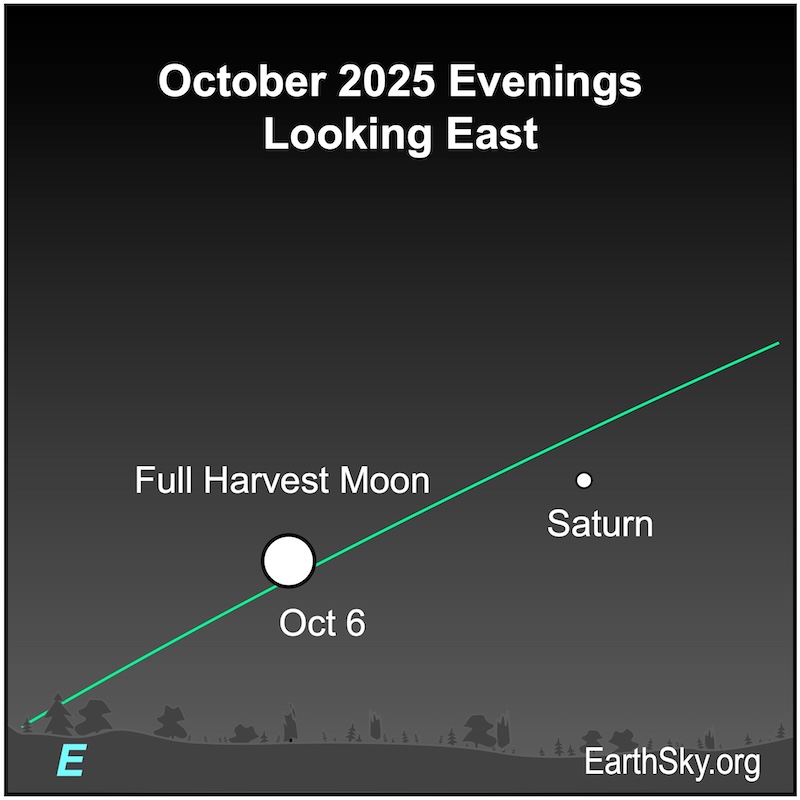
When and where to look in 2025: Look for the bright, round full moon climbing in the east at sunset on October 6, glowing in the south near midnight, and dropping low in the west just before sunrise on October 7. This is the full moon closest to the equinox, and so we call it a Harvest Moon. It’s also an especially close full moon: a supermoon.
Crest of the full moon will fall at 3:48 UTC on October 7. That’s 10:48 p.m. CDT on October 6 when the moon hasn’t yet reached its highest point for viewers in central North America.
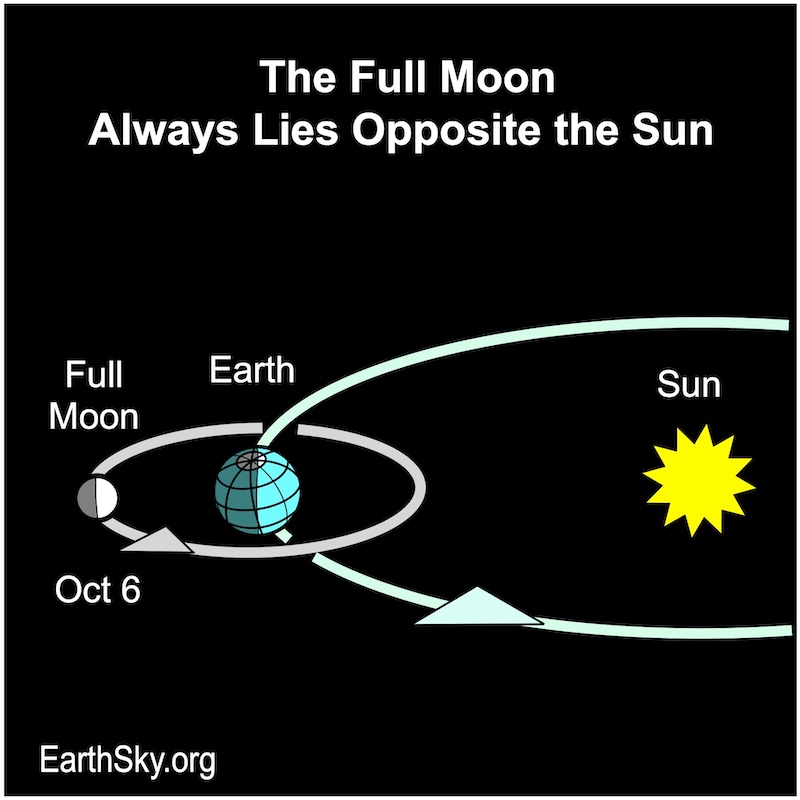
The 2025 Super Harvest Moon will lie near golden Saturn on the night of September 6-7. Saturn’s opposition – when it was opposite the sun from Earth – fell on September 21. A full moon is always opposite the sun. And Saturn is just past opposition, but still generally opposite the sun now, too. So it makes sense that this full moon and Saturn are close together. Check Stellarium.org for a precise view from your location.
Harvest Moon and autumn equinox
2025 has been a confusing year for Harvest and Hunter’s Moons! Here’s the “rule” of folklore:
- The Harvest Moon is the full moon closest to (not after) the September equinox.
- The Hunter’s Moon is the full moon following the Harvest Moon.
We say it’s been “confusing” because, in 2025, we’ve seen so many people get this wrong! But here’s the story, as best we can tell it from our vantage point of 50 years of educating about astronomy. In 2025, the September full moon fell early in the month, on September 7. And the October full moon falls on October 6 for us in North America (3:48 UTC on October 7). So the October full moon – closer to the equinox on September 22 – is the Harvest Moon.
September 2025’s full moon, which fell at 1:08 p.m. CDT (18:08 UTC) on September 7, was called the Green Corn Moon.
November 2025’s full moon, which falls at 8:19 a.m. CDT (13:19 UTC) on November 5, will be the Hunter’s Moon … because the Hunter’s Moon always follows the Harvest Moon by one cycle of the moon. Phew!
The full Harvest Moon can occur anywhere from two weeks before the September equinox to two weeks after, or between September 8 and October 7. So the Harvest Moon is either the last full moon of the summer season, or the first full moon in autumn.
In the Southern Hemisphere, the Harvest Moon marks the full moon nearest the autumnal equinox too. But the Southern Hemisphere’s autumnal equinox comes in March, around March 21. So, for our friends south of the equator, the Harvest Moon falls in March or early April.
Is Harvest Moon just a name?
Harvest Moon is just a name … sort of. But all full moons have unique characteristics, which you – as a skywatcher – can notice. And these autumn full moons have some of the most notable characteristics, which is probably why the Harvest and Hunter’s Moons are so famous.
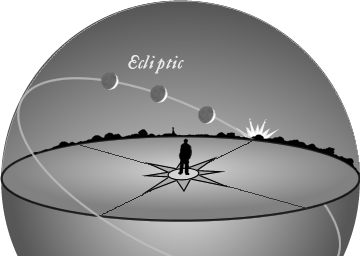
Those full moons are special because of where on the horizon they rise from one night to the next, around the time of full moon. They rise noticeably farther north on the horizon each night.
And they’re also special because of the time of moonrise from one night to the next. They rise closer to the time of the previous night’s moonrise than the full moon at other times of the year.
All full moons rise around sunset. And, generally speaking, the moon rises about 50 minutes later each day, as it moves in orbit around Earth. But when a full moon happens close to an autumn equinox, the moon on the following nights rises closer to the time of sunset. For mid-temperate latitudes, the moon rises only about 20 to 25 minutes later daily for several days before and after the full Harvest (or Hunter’s) Moon.
That doesn’t sound too amazing. But it is amazing, for those who watch the skies! Keep reading, and you’ll find out why.
How did the Harvest Moon get its name?
The shorter-than-usual lag time between moonrises around the full Harvest Moon means no long period of darkness between sunset and moonrise for days in succession.
The difference between 50 minutes and 25 minutes might not seem like much. But it means that, in the nights after a full Harvest Moon, you’ll see the moon ascending in the east relatively soon after sunset. The moon will rise during or near deepening twilight on these nights, presenting dusk-till-dawn moonlight for several nights in a row around the time of the Harvest Moon.
In the days before tractor lights, the lamp of the Harvest Moon helped farmers gather their crops despite the diminishing daylight hours. As the sun’s light faded in the west, the moon would soon rise in the east to illuminate the fields throughout the night.
Who named the Harvest Moon? That name probably sprang to the lips of farmers throughout the Northern Hemisphere, on autumn evenings, as the Harvest Moon aided in bringing in the crops.
By the way, for very high northern latitudes, there’s even less time between successive moonrises. The farther north you live, the greater the Harvest Moon effect. For instance, at Anchorage, Alaska (61 degrees north latitude), the moon will rise at nearly the same time for a week!
This Harvest Moon is also a supermoon
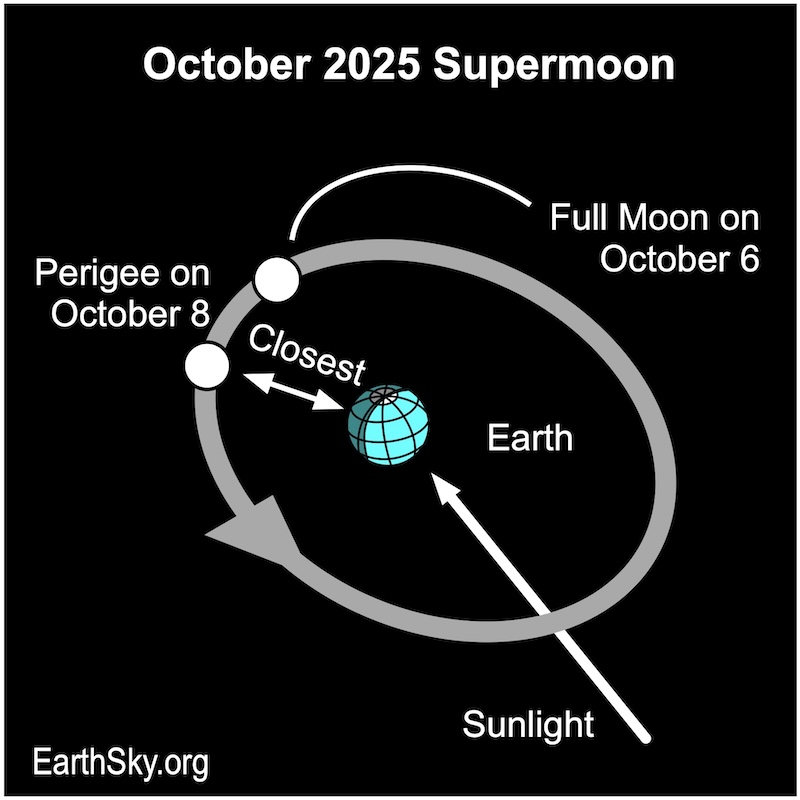
October 2025 sees lunar perigee – the point in the moon’s orbit where it comes closest to Earth – occur about 34 hours after the crest of the full moon. It happens about 13:00 UTC (or 1:00 p.m. CDT) on October 8. Since it is closer in its orbit to us on Earth, does a supermoon appear noticeably larger than an ordinary full moon?
While it is true that experienced observers do say they can detect a difference, you’d have to be a very keen observer to notice it. Truly, most of us can’t tell any difference in the size of a supermoon and an ordinary moon.
But … do supermoons look brighter than ordinary full moons? Yes! By a noticeable amount. That’s because a supermoon exceeds the disk size of an average-sized moon by up to 8% and the brightness of an average-sized full moon by some 16%. And then, it exceeds the disk size of a micromoon (a year’s most distant, and, therefore, smallest full moon) up to 14% and the brightness of a micro-moon by some 30%. So, if you go outside on the night of October 6, there’s the potential you’ll notice the supermoon is exceptionally bright!
And people living along the coast might notice that particularly high tides – sometimes called king tides – will not only occur on but precede and follow a supermoon by a day or so.
Is the Harvest Moon bigger, brighter or more colorful?
Because the moon’s orbit around Earth isn’t a perfect circle, the Harvest Moon’s distance from Earth – and apparent size in our sky – differs from year to year. In 2019, the Harvest Moon was actually a micromoon or mini-moon: the most distant and smallest full moon of that year. And – in 2015 – the Harvest Moon was the year’s closest and biggest supermoon of the year.
So, the full Harvest Moon isn’t necessarily closer than any other full moon. But it might be. The moon’s distance at full moon varies from year to year. In 2024, the Harvest Moon was a full supermoon, but not the closest supermoon for the year. There was also a partial lunar eclipse.
It looks bigger, but isn’t
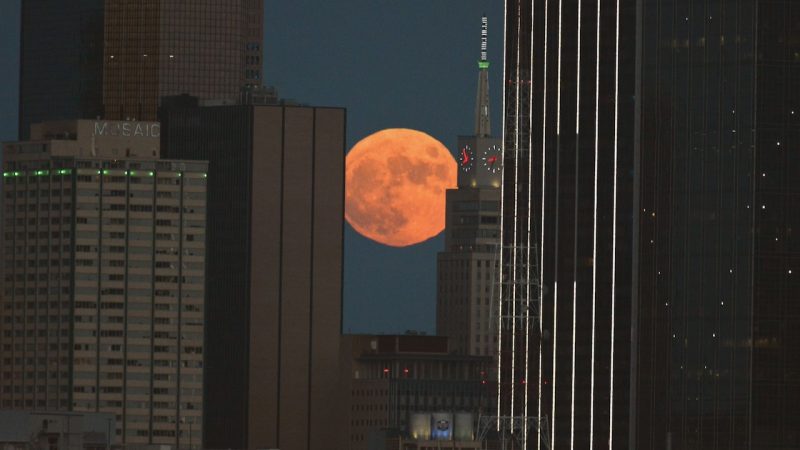
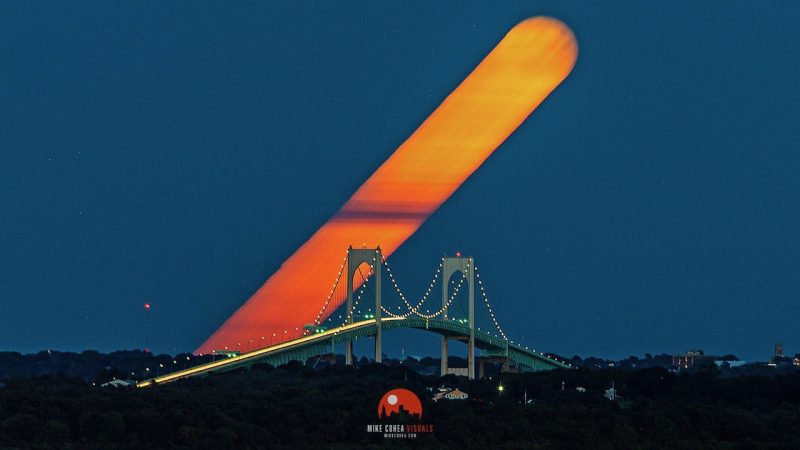
Still, in any year, you might think the Harvest Moon looks bigger, brighter or more orange. That’s because the Harvest Moon has such a powerful mystique. Many people look for it shortly after sunset around the time of full moon. After sunset around the time of any full moon, the moon will always be near the horizon. It’ll have just risen. It’s the location of the moon near the horizon that causes the Harvest Moon – or any full moon – to look big and orange in color.
A big moon seen near the horizon presents you with a psychological effect. It’s a trick your eyes are playing – an illusion – called the moon illusion. You can find many lengthy explanations of the moon illusion by doing an online search for those words.
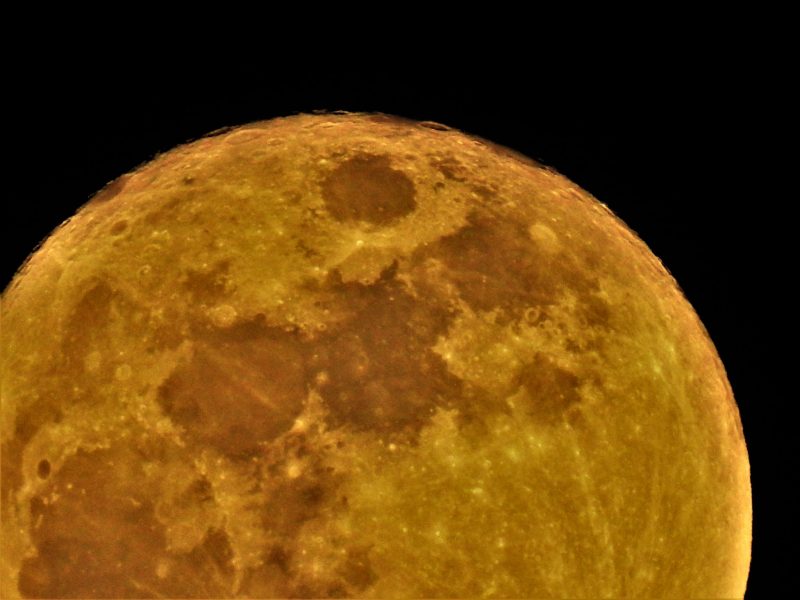
Orange color due to thickness of Earth’s atmosphere near horizon
By the way, the orange color of a moon near the horizon isn’t a psychological effect. It’s a true physical effect, which stems from the fact that – when you look toward a horizon – you’re looking through a greater thickness of Earth’s atmosphere than when you gaze up and overhead.
Read more: What makes oddly shaped suns and moons on the horizon?
Southern Hemisphere moons, and Blue Moons
For the Southern Hemisphere, the Harvest Moon always comes in March or early April. But, it’s our understanding that the Southern Hemisphere doesn’t name its full moons as we do in the Northern Hemisphere. Do you know? If so, tell us your thoughts on Southern Hemisphere full moon names in the comments below.
Read more: Full moon names by month and season
Most often, a season has three full moons. Having four full moons in one season is quite atypical. Therefore, some people refer to the third of these four full moons as a seasonal Blue Moon.
Seasonal Blue Moons preceded what’s now a better-known definition. By popular acclaim, most regard a Blue Moon as the second of two full moons in one calendar month. In fact, on August 30-31, 2023, we had a full Blue Moon supermoon. The next monthly blue moon will be May 31, 2026.
And have you heard of Black Moons? They’re like Blue Moons, but for new moons instead of full moons.
October’s full moon falls in Pisces
The October full moon can lie in front of one of two constellations of the zodiac and one additional constellation. Most years, it lies in Pisces, as it does this year. But it infrequently falls in Aries, as it will next year. And in 2036, it will land in the large, neighboring constellation Cetus the Whale. The moon is roundest on the day when it is full, but the day before and the day after, it appears almost, but not quite full.
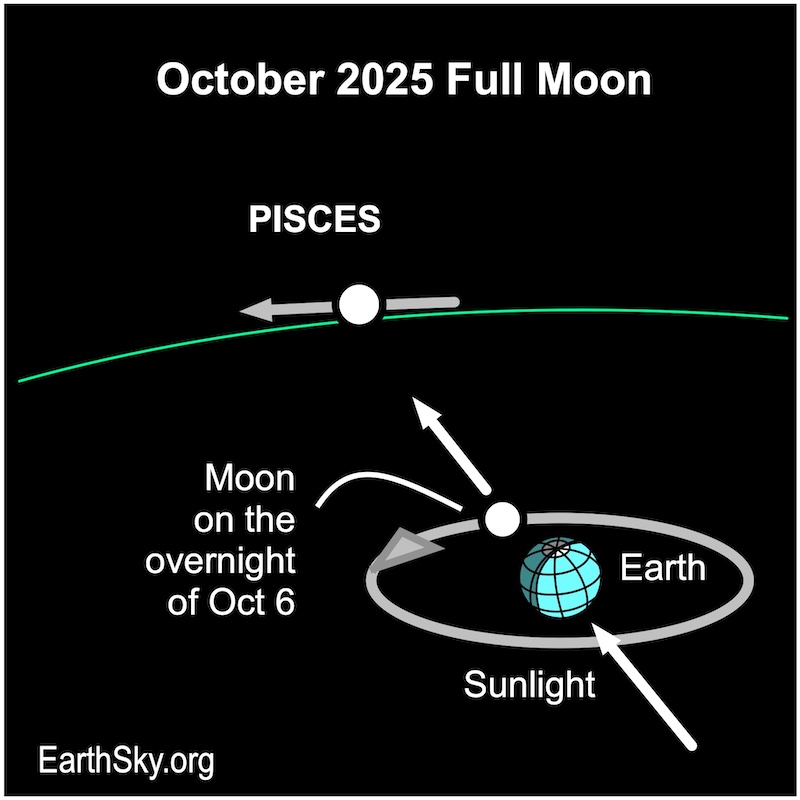
Bottom line: The October full moon is the Harvest Moon that happens overnight on October 6, 2025. It is also a supermoon and the first of four supermoons in a row.
Like what you read?
Subscribe and receive daily news delivered to your inbox.
More from
Deborah Byrd


Mars sometimes is bright and sometimes is faint

Voyager 2: Our 1st and only visit to Neptune
1st photo of Earth from the moon 60 years ago
Voyager 2 spacecraft launched 49 years ago today