Moon and Mercury: beauties!
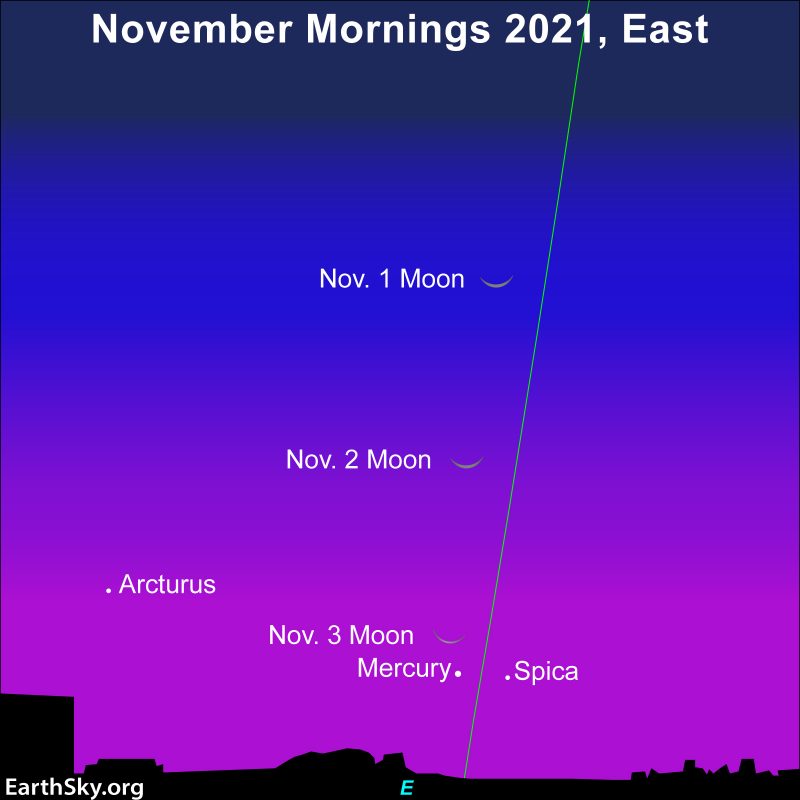
Mercury, the smallest planet and innermost to the sun, is now wrapping up a string of morning appearances that began in mid-October. Early risers can still spot it above the sunrise point in late October and during the first few days of November. At that time of the morning, it’ll be in brightest twilight, near the not-yet-risen sun. Mercury can be difficult to identify. Northern Hemisphere observers must look outside at exactly the right time (not so early that Mercury hasn’t risen yet, and not so late that Mercury fades from view against the bright morning twilight). If you choose that magic moment, the mornings of November 1, 2 and 3, 2021, provide a good opportunity for positively spotting the planet near the waning crescent moon, or “old” moon. The steep autumn angle of the ecliptic for those of us in the Northern Hemisphere will help. Look near the horizon for the thin crescent. Mercury will be the point of light just below it, or – on the morning of November 3 – next to it.
Here is a great way to start your day: Break out the binoculars to spot the little world and to examine the earthshine on the moon’s dark side.
Because of the tilt of the ecliptic, Southern Hemisphere viewers unfortunately won’t have a good view of Mercury or the moon on November 3, or at any other time during the October-November morning apparition of Mercury.
The 2022 lunar calendars are here. Order yours before they’re gone!
Daylight occultation of Mercury
The moon will occult, or cover Mercury, on November 3, 2021. The occultation will be visible from most of Canada and the northeastern United States. But it will be during daylight hours. So this will be a challenging observation to do, and only veteran observers, with telescopes or other optical aids, will have a shot at success. A very clear sky will be essential!
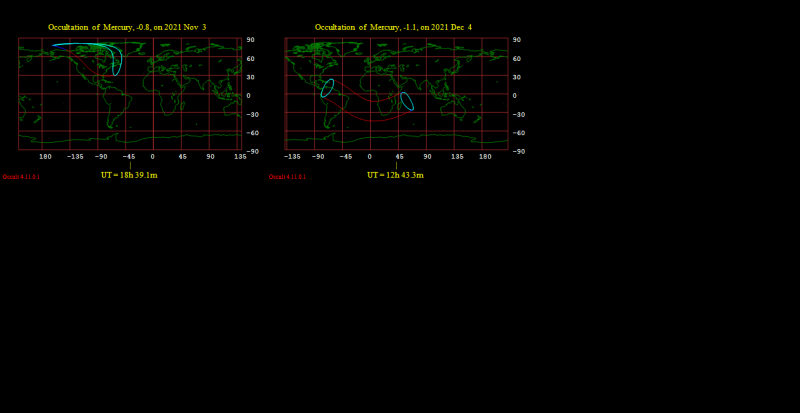
Bottom line: The old moon will sweep near Mercury on the mornings of November 2 and 3, 2021. From Canada and the northeastern U.S., the moon will occult – cover – Mercury during daylight on November 3.
Like what you read?
Subscribe and receive daily news delivered to your inbox.
More from
John Jardine Goss


Visible planets and night sky guide for October

The September full Moon is the Harvest Moon near Saturn
The July full moon is the beautiful Buck Moon