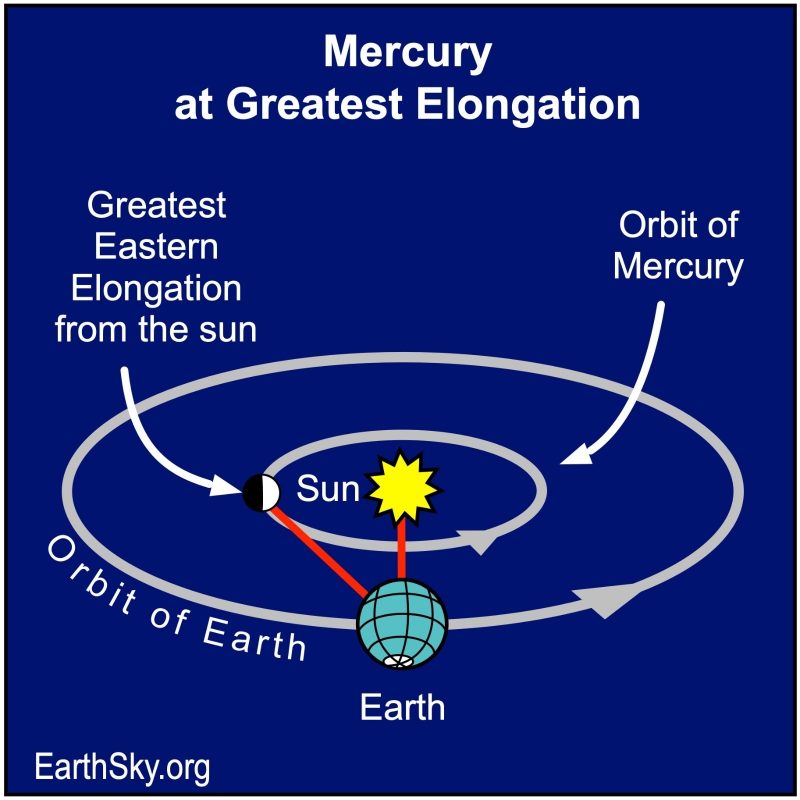
June 2026 is a great opportunity to see the most elusive planet, Mercury. As our sun’s innermost planet, Mercury always lies near the sun in our sky. This small, speedy planet is now in the west after sunset. It’ll reach its greatest elongation – its greatest apparent distance from the sun in our sky – on June 15, 2026. Just don’t mistake Mercury for the blazing planet Venus – or for bright Jupiter – which are also in the west in evening twilight.
Mercury after sunset in June 2026
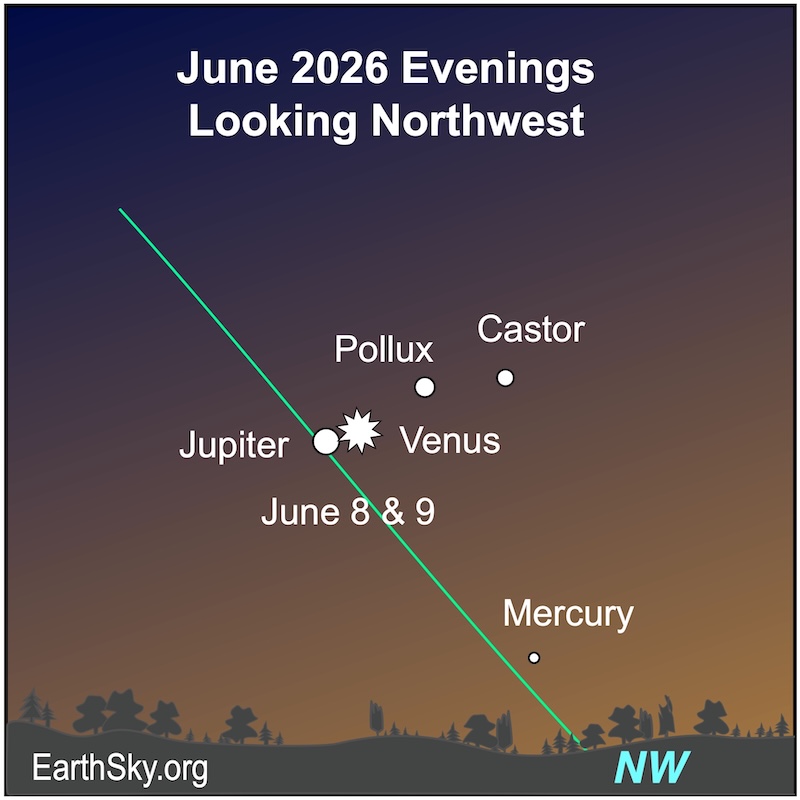
Where to look: Look west, in the sunset direction – shortly after sunset – for Mercury. Venus is up there, too, blazing away at -4.0 magnitude. And bright Jupiter is there shining at magnitude -1.8. Mercury emerged in the evening twilight sometime in late May. Watch for the moon near Mercury on the evening of June 16.
Greatest elongation: Mercury is farthest from the sun on our sky’s dome at 20 UTC (3 p.m. CST) on June 15, 2026. At that time, Mercury will be 25 degrees from the sun in our sky. See a comparison of elongations, below.
Brightness: Mercury emerged in the evening sky late in May. Since then, it’s been shining at around 0.1 magnitude. At greatest elongation it’ll be farther from the sunset glare, shining around 0 magnitude and therefore brighter than most stars! In the evenings after greatest elongation, the innermost planet will drop rapidly closer to the horizon the rest of the month. And Jupiter will draw close enough that you can see both of them in a pair of binoculars. Mercury will be moving between Earth and the sun, with its illuminated side becoming less and less visible. It’ll disappear in early July and will reach inferior conjunction – when it passes between Earth and the sun – at 1 UTC on July 13.
Through a telescope: Mercury will appear about 38% illuminated at greatest elongation. It’ll measure 8.19 arcseconds across.
Constellation: Mercury will lie in front of the constellation Gemini the Twins at this elongation. Doubtless, the stars in this constellation will be lost in the twilight.
Note: As the innermost planet, Mercury is tied to the sun in our sky. As a result, it never ventures very far above the horizon after sunset. So as soon as the sun disappears below your horizon, your clock starts ticking. Will you see the glowing point of light that is Mercury before it drops below the horizon, following the setting sun?
For precise sun and Mercury rising times at your location:
timeanddate.com (worldwide)
Stellarium (online planetarium)
A trio of planets around June 8 and 9
Mercury events in 2026
Jan 21, 2026: Superior conjunction (passes behind sun from Earth)
Feb 19, 2026: Greatest elongation (evening)
Mar 7, 2026: Inferior conjunction (races between Earth and sun)
Apr 3, 2026: Greatest elongation (morning)
May 14, 2026: Superior conjunction (passes behind sun from Earth)
Jun 15, 2026: Greatest elongation (evening)
Jul 13, 2026: Inferior conjunction (races between Earth and sun)
Aug 2, 2026: Greatest elongation (morning)
Aug 27, 2026: Superior conjunction (passes behind sun from Earth)
Oct 12, 2026: Greatest elongation (evening)
Nov 4, 2026: Inferior conjunction (races between Earth and sun)
Nov 21, 2026: Greatest elongation (morning)
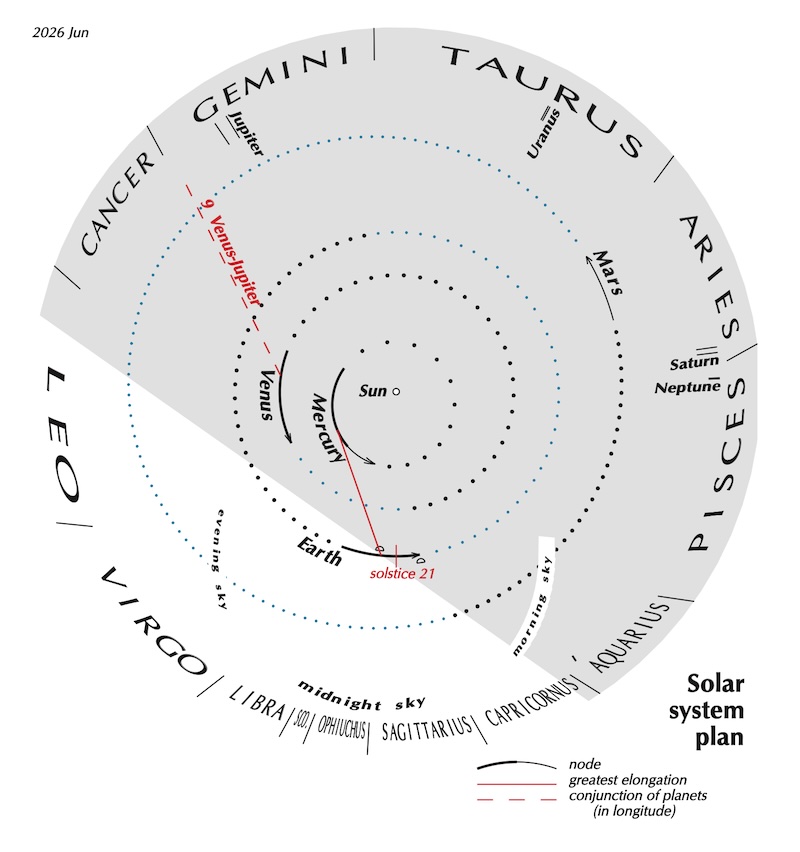
Heliocentric view of Mercury June 2026
A comparison of elongations
In June 2026, Mercury stretches out 25 degrees from the sun in our sky. In fact, the farthest from the sun that Mercury can ever appear on the sky’s dome is about 28 degrees. And the least distance is around 18 degrees.
Mercury (and Venus) elongations are better or worse depending on the time of the year they occur. So in 2026, the Northern Hemisphere will had the best evening apparition in February. And the Southern Hemisphere will have its best evening elongation of Mercury in October.
In the autumn for either hemisphere, the ecliptic – or path of the sun, moon and planets – makes a narrow angle to the horizon in the evening. But it makes a steep slant, nearly perpendicular, in the morning. So, in autumn from either hemisphere, morning elongations of Mercury are best. That’s when Mercury appears higher above the horizon and farther from the glow of the sun. However, evening elongations in autumn are harder to see.
In the spring for either hemisphere, the situation reverses. The ecliptic and horizon meet at a sharper angle on spring evenings and a narrower angle on spring mornings. So, in springtime for either hemisphere, evening elongations of Mercury are best. Meanwhile, morning elongations in springtime are harder to see.
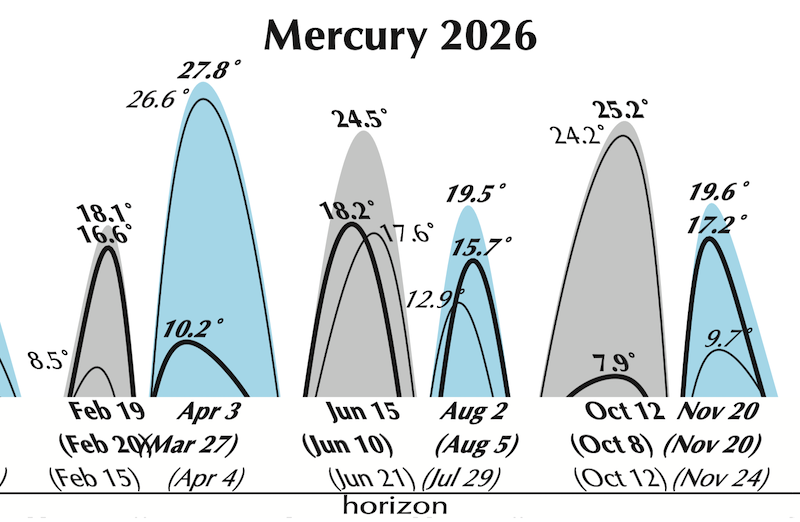
More Mercury evening elongation comparisons for 2026
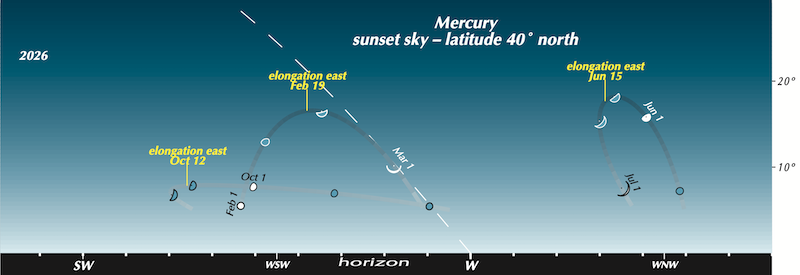
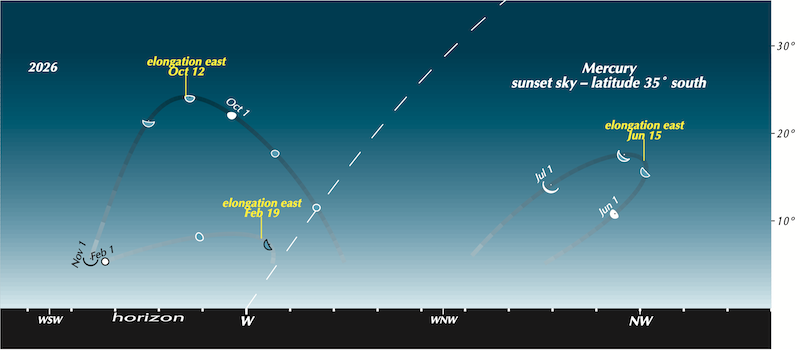
Bottom line: The sun’s innermost planet, Mercury, will be 25 degrees from the sunset when it reaches its greatest elongation at 20 UTC on June 15. Also, this is a decent evening apparition of Mercury in 2026 for both the Northern and Southern Hemispheres.
Submit your photos to EarthSky here.
Read about greatest elongations, superior and inferior conjunctions: Definitions for stargazers
Like what you read?
Subscribe and receive daily news delivered to your inbox.
More from
Editors of EarthSky


The Lyrid meteor shower peaks tonight. Don’t miss it!

Asteroid Apophis to sweep close 3 years from tomorrow
Pareidolia is seeing things like faces in random objects