Potentially hazardous asteroid to safely pass Earth Monday
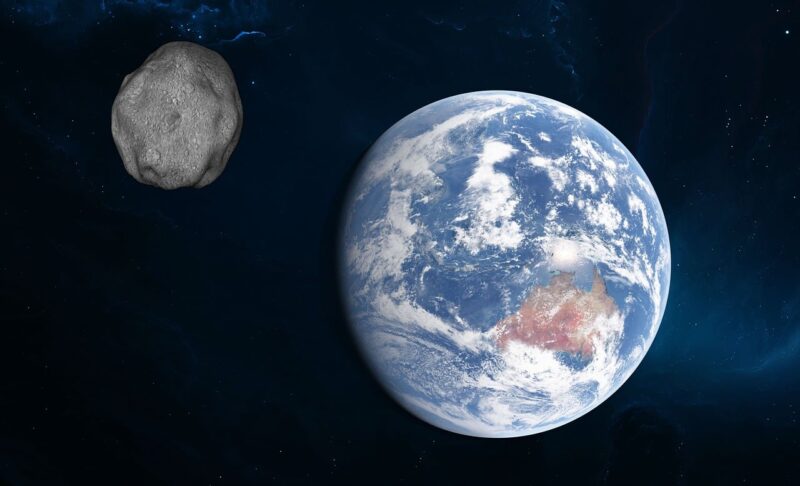
Back on October 24, 2005, the Catalina Sky Survey on Mount Lemmon in Arizona discovered a near-Earth asteroid with an estimated diameter of nearly a mile (1.6 km). That’s some 97% bigger than most known near-Earth objects. In fact, it’s big enough that this asteroid bears the scary nickname planet killer.
This flying space rock falls is having a close approach to Earth on January 12, 2026. But it’s not coming anywhere near. Asteroid 2005 UK1 will fly within .08 astronomical units (AU, or sun-Earth distances) of Earth. That means, as it passes Earth on Monday, it’ll be 32 times farther than the moon.
What are potentially hazardous asteroids? Two criteria define them. The asteroid must have an orbit that can bring it (someday) within 0.05 astronomical units (AU) of Earth’s orbit. That’s 19.5 lunar distances, or approximately 4.6 million miles (7.5 million km). 2005 UK1 isn’t coming that close this time, but it might, someday.
And the asteroid must be big enough that, if it were to strike us, it would cause significant regional damage. So potentially hazardous asteroids are those with estimated sizes at least about 0.087 miles across (0.14 km). And size estimates for 2005 UK1 range somewhere between 0.4 and 0.85 miles wide (0.6 and 1.4 km). So it’s quite large.
How do we know the size of the asteroid?
Astronomers determine the size of near-Earth asteroids based on their brightnesses, or magnitudes. The brighter the asteroid, the larger it’s likely to be. Asteroid 2004 UK1 has a magnitude of 18.1.
That’s much dimmer than what you or I can see in an average backyard telescope. But it’s bright enough to suggest that 2005 UK1 is somewhere between 0.4 and 0.85 miles wide (0.6 and 1.4 km).
How does that brightness compare with other asteroids? Well, 2005 UK1 is an Apollo asteroid. That means its orbit intersects with Earth’s orbit. But it’s not the largest-known Apollo asteroid. That distinction goes to 1866 Sisyphus, which has a diameter of about 5 miles (8.5 km) across.
Another large Apollo asteroid is 3200 Phaethon, the parent object of the Geminid meteor shower. It spans about 3.6 miles (5.8 km). But – if 2005 UK1 falls at the larger range of its estimate – it’s still large enough to be considered a planet killer. That nickname is for any asteroid larger than 1 kilometer (.6 mile). But again, while asteroid 2005 UK1 is passing close to Earth in the grand scheme of our solar system, it is not passing close enough to affect Earth in any way.
How does it compare to asteroids that have hit Earth? The Chelyabinsk meteor that exploded in the air over Russia in 2013 was about 65 feet (20 meters) wide. And the Tunguska asteroid that also exploded above Russia, in 1908, was somewhere around 160 to 330 feet (50 to 100 meters) in size.
So 2005 UK1 is big! It’s worth noting. But it’s not coming very close.
How big are asteroids? See this video
When will 2005 UK1 be closest to Earth?
On Monday, the asteroid will make its closest pass by Earth at 10:26 UTC. That translates to 4:26 a.m. CST. But again, it will be more than 32 lunar distances from Earth at that time.
This asteroid orbits the sun in approximately 3.97 years or roughly 1,450 days. Its last close encounter with Earth was on April 24, 2018. And the next one will be on December 24, 2029. But both of those encounters are at a greater distance than the pass on January 12, 2026.
Bottom line: A potentially hazardous asteroid, 2005 UK1, will safely pass Earth on January 12, 2026. At this time it will be more than 32 times the moon’s distance away.
Like what you read?
Subscribe and receive daily news delivered to your inbox.
More from
Kelly Kizer Whitt


Another satellite breakup raises concerns about space junk

Smile mission releases its stunning 1st aurora footage!
Visible planets and night sky guide for October
Hera mission hits the brakes to arrive at asteroid