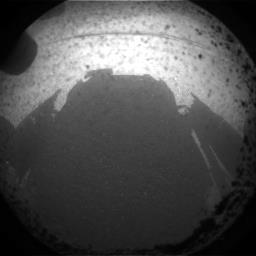
Scientists at NASA’s Jet Propulsion Laboratory were jubilant last night, letting out a long whoop, following word of the picture-perfect descent and landing of the new Mars rover, Curiosity. The descent of the rover from the top of Mars’ atmosphere to the planet’s surface had earlier been called seven minutes of terror by these scientists, because of its extreme difficulty and zero margin for error. The safe landing of Curiosity marks the beginning what promises to be the most ambitious planetary missions in history. Mission mechanical system lead Adam Stelzner said:
It looks extremely clean. We touched down in conditions that were on the more benign side of our nominal expectations. It looks – at least by my eye – like we landed in a nice flat spot. Beautiful. Really beautiful.
Video: Mars Curiosity rover’s seven minutes of terror

The Curiosity rover will be able to travel at speeds of up to 90 meters (0.06 miles) per hour, though it is expected to travel at a slower average of about 30 meters per hour. The rover can roll over obstacles up to 75 centimeters (30 inches) high.
Bottom line: NASA’s Mars Curiosity rover has landed safely on Mars.
Like what you read?
Subscribe and receive daily news delivered to your inbox.
More from
Deborah Byrd


Visible planets and night sky guide for October

Cassiopeia and Perseus on October evenings
Orionid meteor shower 2026: All you need to know
See brightest star, Sirius, in your morning sky