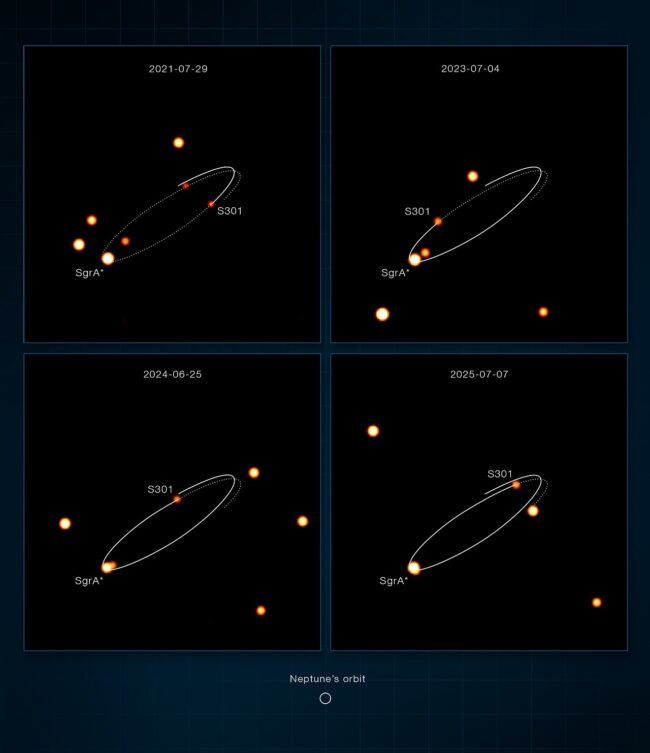
This video shows the fastest star in the galaxy, S301, as it orbits the supermassive black hole at the center of the Milky Way galaxy. When closest to the black hole (named Sagittarius A*), the star moves at more than 8% the speed of light. Astronomers are hoping to see the influence of the warped space-time around the black hole on the star’s orbit. This would reveal, for the 1st time, the spin of the black hole. Video via ESO.
Fastest star in the galaxy could unlock black hole secrets
Astronomers have discovered the fastest star in the Milky Way galaxy. They call it S301, and it moves at more than 8% the speed of light, or 56 million miles per hour (25,000 km/s), as it orbits the central supermassive black hole in our galaxy.
But the real triumph in discovering this star, the European Southern Observatory said on August 19, 2026, is that it can unlock the mystery of our central black hole’s spin.
S301 is the closest star to the Milky Way’s black hole that astronomers have yet discovered. It lies just 12 Earth-sun distances (12 AU) from the mammoth gravity well. Co-author Reinhard Genzel of the Max Planck Institute for Extraterrestrial Physics in Germany said:
Decades carefully tracking stars orbiting our galaxy’s central black hole, Sagittarius A*, have led to this breakthrough discovery of a very promising star. Because it orbits so close to Sagittarius A*, S301 opens a new window to the fundamental properties of spacetime in this extreme black-hole environment.
The researchers published their peer-reviewed study on August 19, 2026, in the journal Nature.
Speeding through a warped space-time environment
S301 has an elliptical (oval-shaped) orbit, so it’s not always 12 AU from our supermassive black hole, Sagittarius A*. That is the closest it gets in its orbit. But the orbit is speedy, whipping around the black hole once every 8.7 years.
Astronomers have already found data from the Very Large Telescope Interferometer to reveal one orbit of the swift star around the black hole. They hope to get even better data for a second orbit once the Extremely Large Telescope comes online around 2030.
S301 gets so close to Sagittarius A* in its orbit that astronomers think it could be affected by the rotating black hole. This rotation is something astronomers have been itching to measure.
According to Einstein’s theory of general relativity, a massive object such as Sagittarius A* will warp the space-time around it. So, astronomers are hoping that when S301 is at its closest to the supermassive black hole, they’ll be able to detect the warp of space-time in the speedy star’s orbit. That would help them measure the spin of the black hole for the first time. Co-author Felix Mang of MPE said:
With this star we hope to measure, within the next 10 years, the spin of the black hole. That would be a dream come true.
How did the star get so close?
S301 is the closest star we know of to the Milky Way’s central black hole. Mang said:
What is special about this star is that it’s orbiting Sagittarius A* on a very tight orbit, taking just 8.7 years to complete it, and is approaching the black hole at a mere 12 times the distance of Earth to the sun. That is unprecedented.
So how did this star get so unprecedentedly close to the black hole? It couldn’t have formed there, because the gravitational tugs from the black hole wouldn’t have allowed any clouds of gas and dust to coalesce into stars. Therefore, astronomers think the star migrated there. They say it was likely after this star and its binary pair felt the tidal yank of the supermassive black hole. One got flung away from the black hole, while the other was pulled toward it.
That’s fortunate for us, because now – thanks to a speedy star with a short orbit – astronomers can continue to unlock the mysteries of Sagittarius A* and help bolster Einstein’s general theory of relativity. Co-author Juan Osorno of LIRA Observatoire de Paris–PSL, France, said:
For the first time, we would actually be able to measure very directly the spin of a massive black hole, which would be a key test of Einstein’s theory. Without this star, we would need to measure the motion of other stars for several more decades to get anywhere close to measuring the spin of the black hole.
Watch the black hole pull in the fastest star
This animation shows how the fastest known star – S301 – likely came to orbit the supermassive black hole so closely. Initially, the 2 stars orbit each other. But as they near the black hole, the tidal forces pull S301 in, while yeeting the other star into a new neighborhood. Video via ESO/ L. Calçada, M. Kornmesser.
Bottom line: Astronomers have discovered the fastest star in the galaxy. It’s orbiting the supermassive black hole at the center of our galaxy, and it could reveal the black hole’s spin.
Source: Discovery of a star sensitive to the spin of Sagittarius A*
Read more: Astronomers discover a black hole star, a new type of object
Read more: A first! 3 supermassive black holes discovered in 1 galaxy
Like what you read?
Subscribe and receive daily news delivered to your inbox.
More from
Kelly Kizer Whitt


Why does anything exist? New theory emerges

Visible planets and night sky guide for October
Euclid was mapping the universe. Then it found a comet
Auriga the Charioteer and bright Capella on October evenings